Free Product Launch Plan Template (+ How to Use It)

Published : 29 August 2026
Mostly, "product launch plans" live in someone's head, get half-written in a Slack thread, and fall apart the second two teams disagree on the launch date. If that sounds familiar, you're not alone, and you're also exactly who this template is for.
A structured launch plan isn't busywork. It's the difference between a launch that feels like organized chaos and one that feels like, well, actual chaos. Below, you'll find a full breakdown of what belongs in a product launch plan, a ready-to-copy template you can paste straight into a Google Doc, Sheet, or Notion page, and a filled-in example so you're not staring at a blank page wondering where to start.
No downloads, no email walls slowing you down (for now, at least) just copy what you need.
What a Product Launch Plan Actually Is (and How It's Different From a Checklist)
People use "launch plan" and "launch checklist" interchangeably, and honestly, it's easy to see why. But they're not the same document, and mixing them up is how launches end up either over-strategized with no execution, or fully task-managed with no strategic backbone.
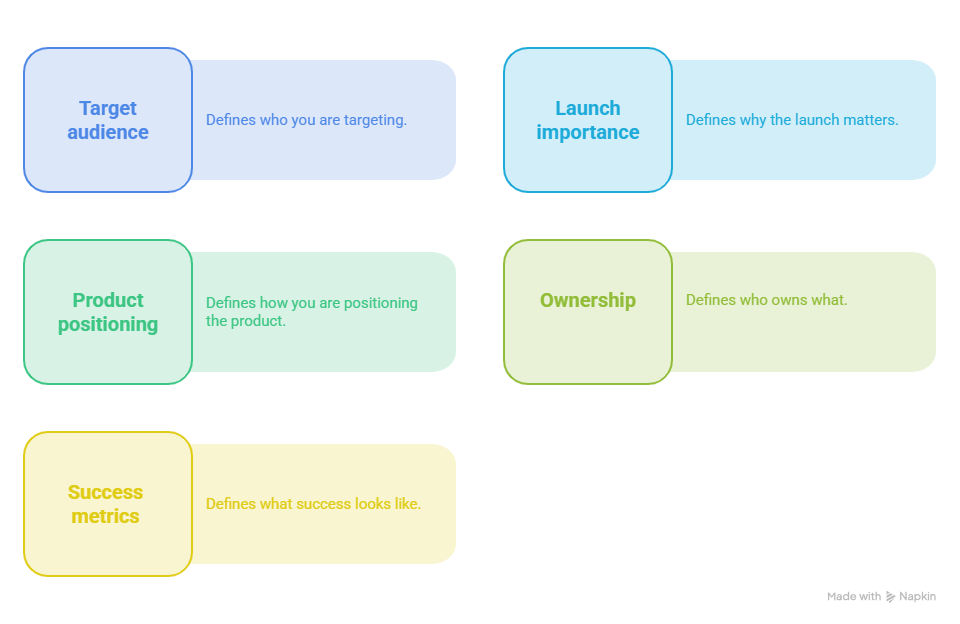
A product launch plan is your strategy document. It defines who you're targeting, why the launch matters, how you're positioning the product, who owns what, and what success looks like. It answers the big questions before anyone touches a task board.
A product launch checklist is what happens after the plan is set: the granular, day-by-day list of tasks, owners, and deadlines that gets the launch out the door. Think of the plan as the map and the checklist as the turn-by-turn directions.
If you're also building out your execution checklist, it's worth pairing this plan with a dedicated launch checklist. We've got a full breakdown of that here: The SaaS Product Launch Checklist.
And if you want to know how "launch plan" relates to your broader go-to-market strategy, quick answer: your GTM strategy is the long-term operating model for how you sell your product at all; your launch plan is the specific, time-bound campaign for this release, nested inside it.
What's Inside This Template
This template covers the seven sections that actually matter for a launch, not forty fields nobody fills in. You'll build out:
- Positioning and messaging
- Audience and buyer personas
- A competitive summary
- A phased timeline with clear ownership (using the DACI framework more on that below)
- A channel and deliverables plan, including your launch video
- Success metrics and KPIs
Copy each section below into your doc of choice and start filling in the blanks. Seriously, it's built to be pasted, not admired.
The Template: Copy This Into Your Doc
How to Fill In Each Section (Quick Walkthrough)
You don't need to complete this top to bottom in one sitting, but there's a logical order that saves you from rewriting things twice.
Start with positioning. Everything else in the plan depends on it, so get this sentence right before anything else. If your team can't agree on the positioning statement, that's a sign the launch isn't ready, no matter what the calendar says.
Then build your personas. Keep the user and buyer personas separate, even if they're sometimes the same person. The questions they're asking are different. A user wants to know "will this make my day easier?" A buyer wants to know "will this survive procurement?"
Assign DACI roles before you build the timeline, not after. It's tempting to build the whole calendar first and figure out ownership later. Don't. Timelines without a single clear Approver per task are exactly how launches slip by "just one more week" three times in a row.
Fill in deliverables last, once the channel plan is set. This is where the launch video row lives. Decide early who owns it and when it needs to be ready, because video tends to get treated as an afterthought when it should be one of the first assets in motion. If you want to see what that looks like end to end, here's how to make a product demo video, or you can just jump straight to making one.
Product Launch Plan Example (Filled-In Sample)
Here's a quick look at how this comes together, using a fictional project management SaaS tool called "Flowdesk" launching a new automation feature:
Positioning: For operations managers who lose hours to manual task handoffs, Flowdesk Automate is a workflow tool that eliminates repetitive task creation. Unlike Zapier, we require zero setup time and work natively inside your existing boards.
Timeline snapshot: 6-week pre-launch (positioning finalized week 1, beta testing weeks 2–4, sales enablement week 5, press briefings week 6), single launch day, 30-day post-launch activation tracking window.
Deliverables: Landing page (Owner: Marketing), demo video built in PuppyDog showing the automation builder in action (Owner: Product Marketing), press release (Owner: Comms), in-app announcement banner (Owner: Product).
KPI target: 500 feature activations within 30 days of launch.
That's it. Nothing fancy, just enough structure that six different people know exactly what they're responsible for and by when.
FAQ
What is a product launch plan?
It's the strategic document that aligns product, marketing, sales, and support around a launch covering positioning, audience, timeline, ownership, and success metrics.
What should a product launch plan include?
At minimum: a positioning statement, target personas, a competitive summary, a phased timeline with clear ownership, a channel and deliverables plan, and KPIs.
How do I create a product launch plan?
Start with positioning, define your personas, assign DACI ownership, build a phased timeline (pre-launch, launch day, post-launch), then map deliverables to channels and set your KPIs.
What's the difference between a launch plan and a launch checklist?
The plan is the strategy. Why, who, and what success looks like. The checklist is the execution. The specific tasks and deadlines that get you there.
What is a go-to-market plan?
It's the broader, long-term framework for how your company sells a product at all. Pricing, segments, distribution. A launch plan is a single, time-bound campaign inside that larger strategy.
Who owns the product launch plan?
Usually the Product Marketing Manager, working across product, sales, and customer success to keep everyone aligned.
Get Building
Copy the template above into whatever tool your team actually uses- Docs, Sheets, Notion, doesn't matter. The format isn't the important part; having one source of truth for your launch is.
And when you get to that launch video row in your deliverables table, you don't have to wait two weeks for a production team. Try PuppyDog and have your demo video ready before your next standup.

Sarah Thompson is a storyteller at heart and Business Developer at PuppyDog.io. She’s passionate about creating meaningful content that connects people with ideas, especially where technology and creativity meet.