Weekly Video Production Workflow for a Solo SaaS Marketer


A one-person team can run a video production workflow by giving each weekday one job: plan on Monday, script on Tuesday, build on Wednesday, review on Thursday, and publish on Friday. Keep every video to one feature, limit review to two people and one revision round, and track waiting time apart from work time.
You ship a feature on Tuesday. By Friday, nobody has made a video about it. Sound familiar?
When you are the whole marketing team, video is the task that slips first, because it feels like a project instead of a routine. Wistia's 2026 State of Video report found that company size and resources are the top barrier to making more video. So the answer isn't more hours. It's a smaller loop you can repeat.
How do you set up a weekly video workflow?
Tie one release to one video and one week. Wistia's report says most companies make video monthly or weekly, and 76% make at least one a month. So a steady rhythm is normal.
Here is a proposed example schedule. It is illustrative, not a tested result.
Honestly, I'd keep Friday light, so a slipped release doesn't wreck the week.
How much product video planning do you need?
Less than you think, but never zero. A one-page brief is enough. It names the goal, the audience, one sentence of core message, the source assets, the claims you've approved, one CTA, and what to leave out.
Choose one feature. TechSmith advises that a demo doesn't need to show every step, and extra detail can go in separate videos. One feature gives you one clear story.
- Essential: a clean, current recording with no personal data, a script built on approved claims, and one CTA.
- Optional polish: extra graphics, fancy transitions or a second cut.
Finish the essentials first. That's your minimum publishable video.
How do you design an AI video generation workflow?
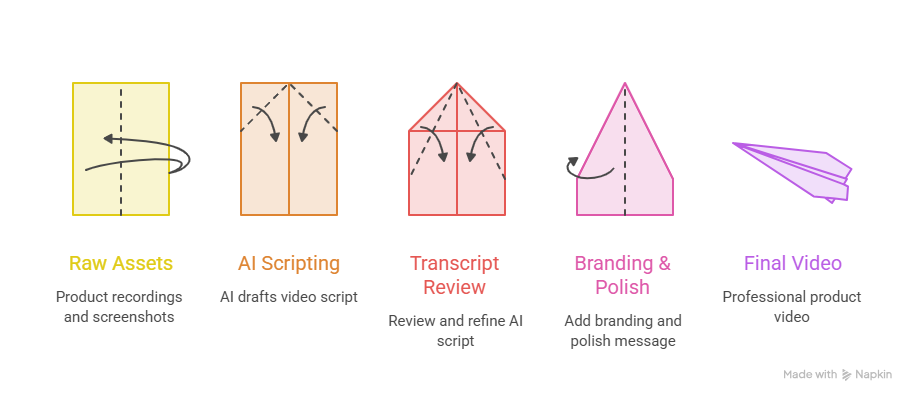
PuppyDog turns approved source assets into a product video with a reviewed script and narration, so you get professional product videos without a production team. These are the steps as PuppyDog describes them in its own demo and marketing material:
- Record your product with the screen recorder, or use screenshots. Your input: choose the feature and confirm the screens are current.
- Give the AI a few details: topic, video purpose, optional notes, and language. It drafts the script. Your review point: PuppyDog's own screen warns that AI scripts can be inaccurate, so read every line.
- Refine the transcript, add your branding, and polish the message. Your review point: this is your main edit.
- Share the finished video with a direct link or an embed code.
Adobe says AI output needs human oversight, with subject matter experts and product managers checking it before it goes live. For speed and cost benchmarks, see the Related guide.
How do you run a video review process with a small team?
Use two people. One product reviewer checks that the screens, steps, and claims are true. One marketing owner decides the message, branding, CTA, and release timing. Neither rewrites the other's work.
Review is where videos sit and wait. Filestage's 2023 survey of 366 marketers and creatives found that an approval averages eight days and more than three versions, and waiting for feedback was the top problem. That's a vendor survey, so treat it as a signal, not a law.
Three rules keep review small:
- Collect every note in one place, such as a shared doc or a proofing tool. The review happens in your own tools, not inside PuppyDog.
- The marketing owner merges conflicting notes before anything goes back for edits.
- Allow one revision round and one quick check. Not three rounds.
How do you manage the video publishing workflow?
You take the link or embed code and place it yourself. Use this checklist every time:
- Destination: the page, email or channel where the video will live. Play it once there.
- CTA: one action. Click the link and confirm it lands on the right page.
- Description: a plain title and a short description of what the video shows.
- Tracking: add UTM tags to your links. Google's guidance is to use utm_source, utm_medium, and utm_campaign, and to keep names consistent, since the fields are case-sensitive.
- Approval: confirm the marketing owner signed off, and save that note.
Which video workflow bottlenecks should you measure?
Measure three things apart: active work, waiting, and rework. Kanban University explains that lead time is work time plus wait time, and flow efficiency is the share of lead time spent actually working. In software teams, it says, those who ignore it often sit near 15%.
Waiting is usually the big one. Here's a blank log. Fill it with real times only.
Build your own baseline. After two or three weeks, you'll see which column keeps growing.
Then change one thing. For example, if waiting is the widest column, give your product reviewer a one-day window. If rework is high, tighten the brief.
FAQ
Can one marketer produce a product video every week?
It's possible if you keep each video to one feature and review to two people. But I can't show proof yet. Treat your first month as a test and use the log to see what's realistic.
Which production tasks still need human review?
Four: the facts in the script, the narration and wording, the brand and CTA, and the link and tracking before you publish. AI can draft, but people own the claims.
How do I avoid spending more time reviewing than generating?
Cut the number of reviewers, the number of rounds, and the number of places feedback lives. Then check your log. If waiting is bigger than active work, you need a review window, not faster editing.
What should I do when a release misses its planned date?
Product Marketing Alliance's Richard King suggests separating the build date from the go-live date, and tying content to a quarterly theme instead of one feature. Fill the empty slot with other material, such as a customer story.
Next step
Ready to run your first video production workflow week? Pick one feature, write your one-page brief, and create your first video with the AI product video maker. Want to see how it works first? Read about Product video creation.

Sarah Thompson is a storyteller at heart and Business Developer at PuppyDog.io. She’s passionate about creating meaningful content that connects people with ideas, especially where technology and creativity meet.