Product-Led vs Sales-Led Growth: A 2026 Guide

Published: 24 July 2026
What Is Product-Led Growth?
The mechanics are pretty consistent across companies that do this well:
- Self-serve acquisition. Either a freemium plan (a limited but fully functional free tier, forever) or a free trial (full access, time-boxed, usually 14 days). Freemium wins on top-of-funnel volume; trials win on urgency.
- Frictionless onboarding. SSO, pre-filled empty states, skippable checklists, anything that lets a user configure and explore the product without waiting on a human.
- A fast "aha moment." This is the crux of it. Time-to-first-value used to be measured in minutes; in 2026, the bar has dropped to under 60 seconds for a lot of well-run PLG products. If someone can't find real value almost immediately, they bounce.
Why did this become such a dominant model? A few reasons, honestly. B2B buyers now expect the same effortless interfaces they get from consumer apps. Nobody wants a mandatory training session just to try a tool. Buyers have also gotten allergic to cold outreach; a large majority now prefer to self-educate and test a product before they'll even take a sales call. And from a pure unit-economics standpoint, PLG lets you acquire thousands of users with a fraction of the sales headcount a traditional motion would need.
What Is Sales-Led Growth?
The pipeline usually looks like an assembly line with three roles:
- SDRs handle outbound prospecting and initial qualification.
- AEs run the actual sales cycle. Discovery calls, tailored demos, technical mapping, negotiation.
- CSMs/AMs take over post-sale for onboarding, retention, and expansion.
Rather than letting a prospect self-explore, the AE serves as a consultant, digging into the buyer's specific pain points and mapping them to a solution and a business case. Pricing tends to follow suit: instead of a fixed public tier, it's negotiated around seats, usage, security requirements, and custom SLAs.
Despite PLG's rise, sales-led growth isn't going anywhere, and for good reason. It still dominates in a few specific situations:
- High-ACV enterprise deals. Once a contract clears roughly $50,000 a year, a self-serve credit-card checkout stops making sense. Six-figure budgets need executive sign-off and a real procurement process.
- Complex or regulated products. Cybersecurity platforms, healthcare systems, ERP software these can't just be self-onboarded. They need custom configuration, compliance review (HIPAA, SOC 2, GDPR), and integration work that a signup flow can't handle.
- Multi-stakeholder buying committees. Enterprise deals often involve somewhere between 13 and 17 internal decision-makers. Good luck getting all of them aligned without someone whose job is literally to manage that process.
Product-Led Growth vs Sales-Led Growth: Side-by-Side Comparison
Numbers tend to make the product-led growth vs sales-led growth debate a lot less abstract. Here's how the two motions plus the hybrid model most companies actually land on stack up on the metrics that matter:
A few things jump out here. PLG wins hands-down on speed and cost efficiency, but SLG still commands the deals that actually move an enterprise budget line. And that hybrid column? It's not a compromise so much as an upgrade. It borrows PLG's low CAC and SLG's high NRR, which is exactly why it's become the default at scale.
When to Use Each (and Why the Hybrid Motion Wins in 2026)
Here's the part a lot of GTM decks gloss over: pure PLG has a ceiling, and it's usually somewhere around $50 million in ARR. Past that point, your biggest potential accounts need someone to navigate security reviews, legal redlines, and custom billing, none of which a self-serve flow handles gracefully. Pure SLG has the opposite problem. It closes enterprise deals beautifully but is far too expensive to run against lower-value accounts, where the CAC simply can't be justified by a rep's time.
That mismatch creates what's sometimes called the "broken zone", strong signup volume at the top, healthy enterprise revenue at the bottom, and a leaking middle where self-serve users can't figure things out on their own and sales can't afford to chase them manually.
The fix most companies land on is a product-led growth strategy layered with a sales-assist team of reps who don't carry a traditional quota but step in when product usage signals real intent. This is the Product Qualified Lead (PQL) model: instead of chasing every signup, sales focuses only on accounts hitting meaningful milestones, like adding teammates or bumping into a usage limit.
You can see this pattern play out across real companies:
- Pure PLG: Calendly and Notion barely need a sales team. Every booking link or shared template is basically free marketing.
- PLG evolving into hybrid: Slack and Figma both started as pure self-serve products and layered enterprise sales on top once bottom-up adoption within individual teams needed IT-level consolidation.
- Sales-led by necessity: Salesforce, ServiceNow, and Workday all sell into complex, compliance-heavy enterprise workflows that simply don't onboard themselves.
- Hybrid by design: Datadog, HubSpot, Zoom, and Airtable all let users start free or cheap, then bring in sales-assist once an account's usage. More seats, more data, and an SSO request signal it's ready to grow.
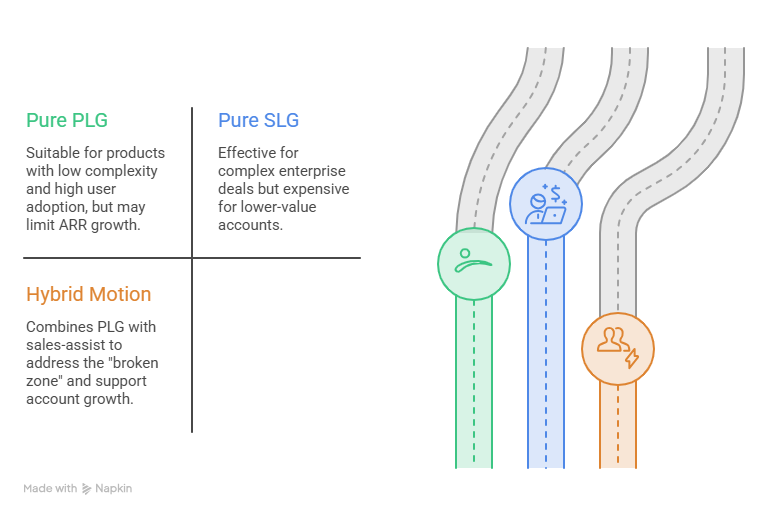
The takeaway isn't "pick a lane and defend it forever." It's that your ideal motion probably shifts as an account grows, and building your GTM engine to expect that shift beats forcing every customer through the same funnel.
The Common Thread: Every Motion Needs to Show Value Fast
Here's the thing both camps actually agree on, even if the PLG and sales-led folks would never admit it out loud: the whole game comes down to proving value quickly. In PLG, that happens through the product itself. In sales-led motion, it happens through the pitch. Different delivery mechanism, identical goal.
And buyers aren't waiting around for either one anymore. Most B2B buyers are already roughly 60% of the way through their evaluation before they contact a vendor directly, and the vast majority of deals get won by whichever vendor made the "Day-One" shortlist, the ones a buyer found and trusted on their own. If a prospect can't quickly see your product actually doing something useful, they'll just move on to a competitor who lets them.
This is exactly why interactive, personalized demos have overtaken static screenshots and generic recorded walkthroughs as the format that converts. A few data points worth sitting with:
- Interactive demos on landing pages lift conversion by roughly a third compared to static pages.
- Visitors spend nearly three times longer on pages with an interactive demo than the site average.
- Generic product tours lift conversion by 15–20%. Deeply personalized ones, tailored to a prospect's industry, logo, and actual workflow, push that lift to 40–50%.
That last stat is the one worth underlining. Personalization isn't a nice-to-have polish step; it's the single biggest lever separating a demo that converts from one that gets closed in another tab.
How PuppyDog Powers Both Motions
Here's where we're a little biased, but bear with us, because this is genuinely the problem PuppyDog was built around. Whether you're running pure PLG, pure sales-led, or (more realistically) some hybrid version of both, you eventually hit the same bottleneck: creating enough personalized demo content to match how many different buyers, industries, and use cases you're now selling to.
PuppyDog turns a simple screen recording, or even just a handful of screenshots, into a polished, personalized demo video automatically. That means:
- For PLG teams: embed a personalized demo directly on your landing page or in-app onboarding flow, so self-serve visitors see your product in action before they ever create an account.
- For sales-led teams: arm reps with a tailored demo video for every prospect, built around that account's actual industry, logo, and use case- no more recycling one generic walkthrough for every deal.
- For hybrid teams: use the same underlying workflow for both, a self-serve demo on the site, and a sales-assist version sent the moment a PQL trigger fires.
The motion doesn't matter nearly as much as most GTM debates make it sound. What matters is whether a prospect can see your product solving their specific problem in the first few seconds of looking at it. That's true whether they're clicking a "Start Free Trial" button or sitting on a Zoom call with your AE.
Ready to see it for your own product? Try the Product Demo Video Maker and turn a single recording into demos personalized for every segment, motion, and deal you're running. If you're building out the rest of your funnel around it, our Marketing solution and our deeper dive on SaaS go-to-market strategy are good next stops. And our guide on choosing your GTM motion breaks down how to pick between PLG, sales-led, and hybrid.
FAQs
What is product-led growth?
Product-led growth (PLG) is a GTM motion where the product itself drives acquisition, activation, and expansion, often via free trials and self-serve signup. Users experience value directly, without a sales rep guiding them through it.
What is the difference between product-led and sales-led growth?
PLG lets the product convert users with minimal sales touch, while sales-led relies on reps to guide the buyer through the deal. PLG tends to fit lower-priced, simpler products; sales-led fits higher-ACV, more complex ones.
Can you use PLG and sales-led together?
Yes, many SaaS companies run a hybrid motion, using PLG for signups and sales for expansion and enterprise deals. It's actually the most common setup among companies past the early-stage phase, not the exception.
Bottom Line
Product-led vs sales-led growth was never really a "pick one forever" decision. It's more like a set of dials most SaaS companies keep adjusting as they scale. PLG gets you volume and efficiency at the low end. Sales-led gets you the enterprise accounts that actually move the revenue needle. And the hybrid motion, PQLs and all, is what lets you run both without either one collapsing under its own weight.
The one thing that doesn't change no matter which dial you're turning: buyers need to see real value, fast, before they'll commit to anything. Give them that, through the product, through the pitch, or both, and the motion you're running matters a lot less than you'd think.
Start with the Product Demo Video Maker and get a personalized demo working for whichever motion, or blend of motions, your GTM actually runs on.

Sarah Thompson is a storyteller at heart and Business Developer at PuppyDog.io. She’s passionate about creating meaningful content that connects people with ideas, especially where technology and creativity meet.