SaaS Go-to-Market Strategy Framework

Published 15th July 2026
Let's Talk About Why "Go-to-Market" Got Complicated
If you've been in SaaS a few years, you've probably watched "go-to-market strategy" evolve from a single slide in a sales kickoff deck into something closer to a full operating system for the company.
The old playbook. Hire enterprise AEs, cold-call your way into a boardroom, close a deal nobody outside procurement has used yet doesn't work like it used to. Buyers don't want a 45-minute pitch before they've even touched your product. They want to try it, poke around, and decide for themselves.
That's the environment a modern SaaS GTM strategy has to operate in. This guide covers a practical, 7-step GTM strategy framework, how to pick the right GTM motion for your product, and why the demos you show at each funnel stage might be the most underrated lever in the whole plan.
What Makes SaaS GTM Different (Hint: It's Not Just About Closing Deals)
Traditional software sales were built around one big moment: the signature. Everything led up to it, and once it happened, the deal was basically "done." SaaS doesn't work that way. Treat the signed contract as your finish line, and you're in trouble.
A few things make SaaS go-to-market strategy different from the old model:
Self-serve and PLG flipped the funnel upside down.
Instead of sales generating interest and handing off to product, the product now generates interest and sales. If it's involved at all, show up later to clear friction out of the way. Free trials and sandbox environments let people evaluate your software on their own schedule.
Retention is the growth engine now, not a side metric.
New customer acquisition has gotten genuinely expensive. The median CAC ratio for new SaaS customers sits around $2.00, meaning companies spend two dollars to generate one dollar of new recurring revenue. Expansion revenue now makes up close to 40% of new ARR industry-wide. If your GTM strategy stops at "get the sale," you're leaving the more profitable half of the business on the table.
Buyers are doing their homework somewhere you can't see.
A huge chunk of early-stage research now happens inside AI chatbots and generative search, the "dark funnel" most marketing dashboards don't track. By the time a prospect talks to a human, they've usually formed an opinion. Your job isn't to introduce the product; it's to confirm what they suspect and clear up whatever the AI got wrong.
The 7-Step SaaS GTM Framework
There's no shortage of GTM frameworks floating around, most drawn from firms like Bessemer, a16z, and Winning by Design. Strip away the branding, and they circle back to the same core stages. Here's the synthesized version: a 7-step SaaS GTM playbook you can actually run.
1. Define your ICP by behavior, not just firmographics.
Company size and industry tell you who might buy. Tech stack, hiring patterns, and usage triggers tell you who's actually ready to. Tier your accounts so high-fit prospects get high-touch attention, and everyone else gets a smooth, automated path.
2. Build positioning around outcomes, not features.
Nobody buys a "robust analytics dashboard." They buy "I stopped losing three hours a week to spreadsheets." Map your messaging to the pain your ICP already feels.
3. Design pricing that scales with value.
Pure per-seat pricing is looking shakier by the year as AI agents shrink the number of humans who need a login. Hybrid models, a subscription base plus usage-based components, tend to hold up better and protect margin.
4. Pick your channels deliberately, including AI search.
Where buyers research matters as much as where they buy. That increasingly means optimizing content so AI tools and chatbots can parse and recommend it, a discipline often shorthanded as GEO.
5. Make onboarding a conversion tool, not an afterthought.
This is where a huge share of deals are quietly won or lost. It deserves its own section below.
6. Equip sales to validate, not pitch.
Buyers no longer need someone to explain what your product does. They've probably asked an AI tool already. They need a human who can confirm it and handle what procurement and security care about.
7. Measure the full loop, not just the top of the funnel.
Activation, time-to-value, and retention all need dashboards that RevOps actually looks at.
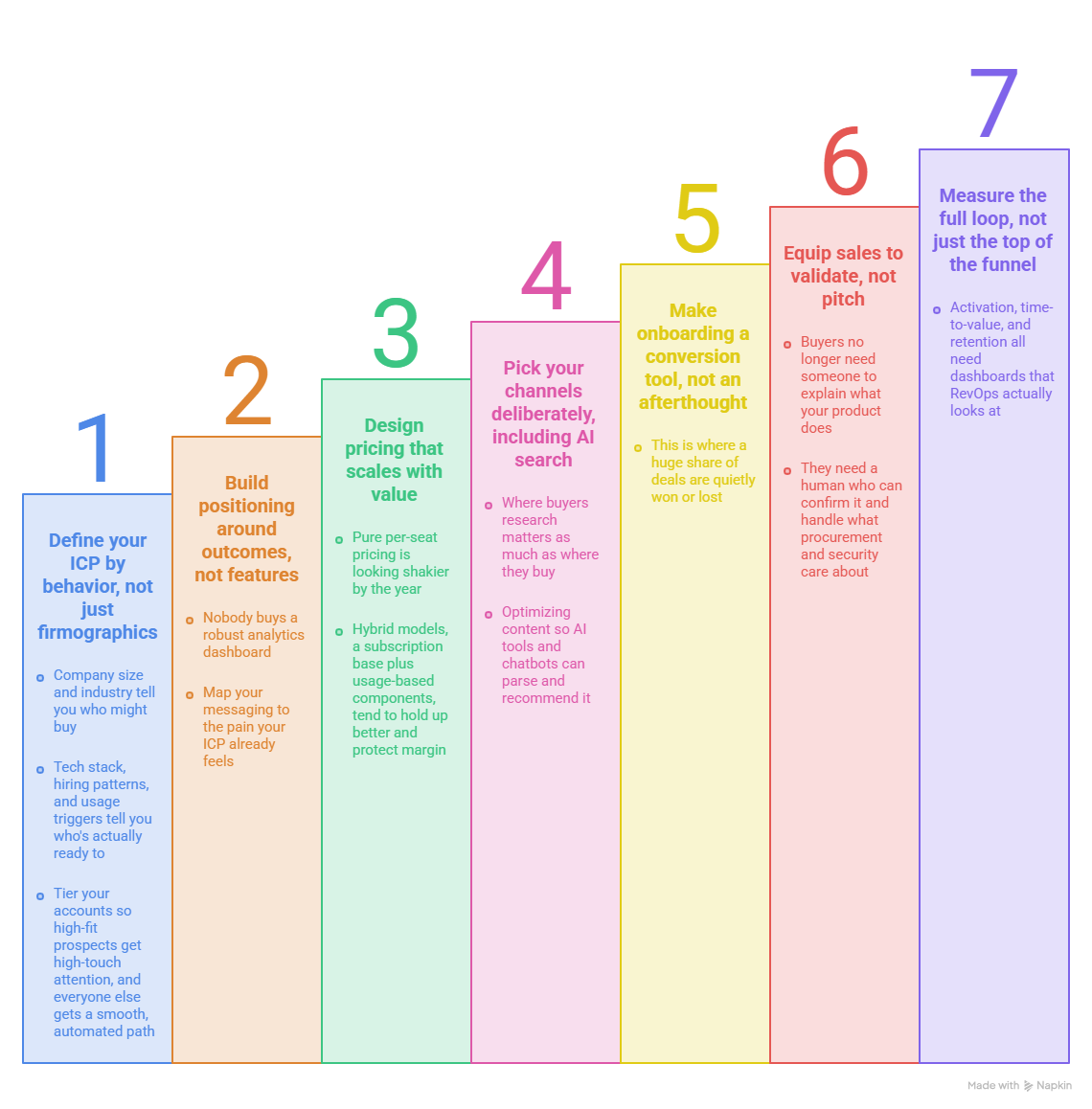
Every one of these steps ties back to a demo need. First, let's talk about motion.
Choosing Your GTM Motion: PLG, Sales-Led, or Hybrid
Before you can execute any framework, you need to know which lane you're driving in. Broadly, there are three:
Product-led growth (PLG).
The product does the selling. Users sign up, explore, and upgrade with essentially zero human intervention. Works well under roughly $10K ACV, where the buyer and user are the same person. Think Slack, Calendly, Loom.
Sales-led growth (SLG).
A human-driven, consultative process for complex, high-stakes purchases usually north of $50K ACV, with multiple stakeholders and real procurement requirements. Think large enterprise platforms.
Hybrid (product-led sales).
The most common model at scale, and arguably the most realistic for most SaaS companies today. Self-serve drives initial adoption; sales gets looped in once usage data shows real intent, a "product-qualified lead." HubSpot and Notion both run variations of this.
Pure-play motions tend to hit a ceiling. PLG-only companies struggle to clear procurement in larger organizations. Sales-led-only companies burn cash on long cycles that mid-market buyers won't sit through anymore. That's why most SaaS companies at meaningful scale run some flavor of hybrid GTM. Product handles early qualifying, and sales focuses only on accounts that genuinely need a human touch.
If you're trying to figure out exactly where your product falls on that spectrum, we go deeper on the tradeoffs in our product-led vs. sales-led growth breakdown, worth a read before you lock in your motion.
Mapping Demo Content to Every Stage of the Funnel
A lot of GTM strategies fall apart here: they treat "the demo" as a single event, usually a sales call. Your funnel actually needs a different kind of demo at every stage; a single static screen recording doesn't hold up across all of them.
Landing page demo.
Often, a prospect's first real look at your product needs to work without a human guiding them through it. Interactive, self-guided demos embedded on product pages convert visitors at dramatically higher rates than pages without one, roughly eight times the rate in some benchmark studies, and deals touched by an early demo tend to close faster too.
Sales demo.
A generic slide-deck walkthrough doesn't cut it with buyers who've already done their own research before your rep said hello. Personalized sandbox environments that reps send before or after a call keep momentum going and let the whole buying committee explore at their own pace.
Onboarding demo.
This is where time-to-value either happens fast or doesn't happen at all. In-app, contextual walkthroughs showing a new user their specific use case, not a generic tour, meaningfully lift activation rates.
Expansion demo.
Once someone's a customer, a personalized walkthrough of a new feature or higher-tier module often turns "I didn't know we had that" into an upgrade, without CS booking a call.
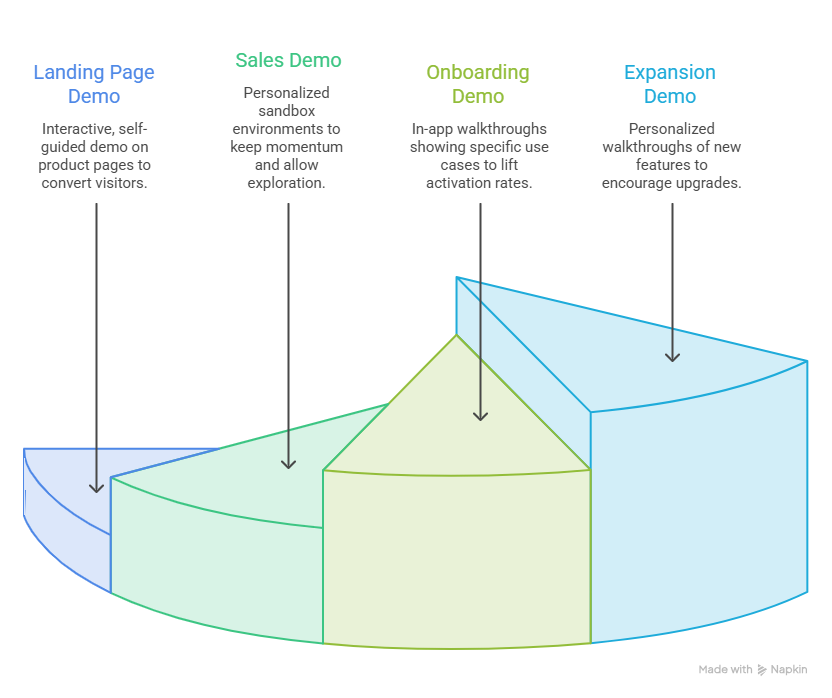
The common thread: personalization matters more than production value. A demo reflecting a prospect's actual industry or use case converts better than a generic one exactly why manually producing a unique demo for every segment and funnel stage isn't realistic for most teams.
The Metrics That Actually Matter: Activation, TTV, and NRR
You can have a beautifully designed framework and still fly blind without the right metrics. Three deserve a permanent spot on the dashboard:
Activation rate:
The percentage of new users who reach a defined "aha moment" milestone, not just the percentage who sign up. Sign-ups feel good in a board deck; activation tells you whether people are actually getting value.
Time-to-value (TTV):
How long does it take a user to hit that first real value moment after account creation? Users who don't meaningfully engage within the first few days are overwhelmingly likely to churn, while customers who reach value within two weeks retain dramatically better than those who take a month or longer.
Net revenue retention (NRR):
The change in recurring revenue from your existing base, factoring in expansion and churn alike. Consistently above 100% means existing customers are growing revenue before a single new logo closes. Below 100%, you're on a treadmill, replacing lost revenue just to stay flat.
As a rough compass: early-stage companies typically sit under 100% NRR, growth-stage companies land around 100–108%, and best-in-class businesses push well past 115%. Tracking below your stage's benchmark is usually a sign to fix onboarding and activation before pouring more budget into acquisition.
Executing Your SaaS GTM Strategy Faster with Automated, Personalized Demos
Here's the uncomfortable truth about most GTM frameworks: easy to write down, hard to execute because "a personalized demo for every segment and funnel stage" sounds great in a strategy doc and turns into a full-time production job the moment someone tries to build it.
That's the exact bottleneck PuppyDog was built to remove. Instead of manually recording, editing, and re-cutting demo videos every time you launch a new segment or campaign, PuppyDog turns a screen recording or a handful of screenshots into a polished, personalized demo video automatically. That means:
- Marketing gets a fresh, on-brand landing-page demo for every campaign or segment without booking studio time.
- Sales gets a tailored leave-behind for each deal instead of reusing one generic walkthrough.
- Onboarding teams can spin up use-case-specific walkthroughs that reflect what a user actually signed up to do.
- Customer success can push expansion demos the moment usage data signals someone's ready for the next tier.
In other words, the 7-step framework above stops being aspirational; the demo production step, which used to be the slowest part, gets automated out of the bottleneck.
Check out the Product Demo Video Maker to see what that looks like for your own product — it plugs directly into a GTM motion like the one above, whether you're PLG, sales-led, or hybrid.
For the marketing or CS side specifically, explore our Marketing and Customer Success solutions, or grab our SaaS GTM strategy template as a starting point.
FAQs
What is a SaaS go-to-market strategy?
A SaaS GTM strategy is the plan for acquiring, activating, and retaining customers for a software product across self-serve and sales-led motions. It covers ICP definition, pricing, channels, and how you measure success.
What are the main SaaS GTM motions?
The three main motions are product-led growth (PLG), sales-led growth, and a hybrid of both. Which one fits best comes down to price point, buyer complexity, and how much of the decision a single user can make alone.
How do demos fit a SaaS GTM strategy?
Personalized product demos shorten time-to-value at every stage — from landing-page conversion to onboarding and expansion. Demo content should show up wherever a prospect or customer is making a decision, tailored to what they care about in that moment.
Bringing It All Together
A SaaS GTM strategy that works in 2026 doesn't chase one big moment; it stacks a series of small, well-timed ones: a landing page that shows rather than tells, a sales process that validates instead of pitches, an onboarding flow that gets people to value fast, and an expansion motion that grows revenue quietly in the background.
The framework isn't complicated. The execution is what trips teams up specifically, keeping demo content fresh and personalized across every stage without burning your team out. That's the piece worth fixing first.
Ready to put this framework into action? Start with the Product Demo Video Maker and get a personalized demo live at every stage of your funnel.

Sarah Thompson is a storyteller at heart and Business Developer at PuppyDog.io. She’s passionate about creating meaningful content that connects people with ideas, especially where technology and creativity meet.