What Is a GTM Engineer? The AI-GTM Role for 2026


Published: 14th 2026
If you've spent any time on LinkedIn in the last year, you've probably seen the title floating around: GTM Engineer. Not "Growth Marketer." Not "RevOps Manager." Something new, something that sounds like it belongs on an engineering team but somehow lives inside sales.
You might be wondering if this is just a rebrand or if something real is happening here? Turns out, it's real. And the numbers behind it are honestly a little wild.
What Is a GTM Engineer?
A GTM engineer is a technical builder who blends revenue operations knowledge with software, data, and automation skills to design and scale go-to-market systems. Instead of manually prospecting, enriching lists, or sending one-off emails, they build the pipelines and workflows that do those jobs automatically.
Put simply: a traditional SDR runs the machine. A GTM engineer builds the machine.
The term itself isn't decades old it was coined in 2023 by Clay, the data enrichment platform, to describe reps who could solve complex customer workflows on the fly rather than lean on scripted sales pitches. Clay didn't just name the role, either. They built an entire ecosystem around it. A newsletter, a 30,000-member Slack community, an annual conference, and dozens of partner agencies, which is a big part of why the title spread so fast.
Clay co-founder Varun Anand put it well: the GTM engineer is a new kind of revenue operator who thinks in systems, not headcount. That distinction between systems and headcount is really the whole story.
Why the Role Exploded in 2025–2026
Here's the part that tends to surprise people: GTM engineering didn't grow steadily. It exploded. Job postings jumped from 63 in early 2024 to 3,342 by late 2025, a 5,205% increase. For context, that's roughly ten times faster than DevOps engineering grew in its early adoption years.
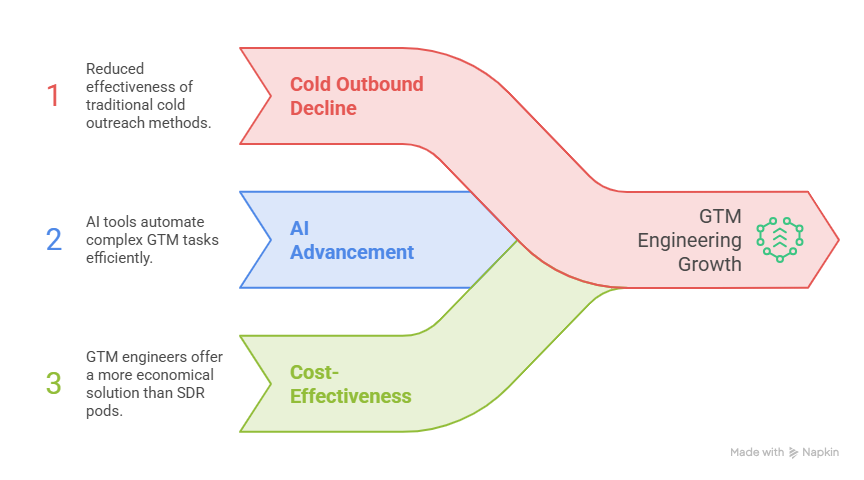
Three things are driving it.
Cold outbound stopped working the old way.
Industry-wide cold email reply rates have dropped to around 3.43%. Generic, high-volume blasts now get filtered before a human ever sees them. The only way to clear modern spam filters is genuinely personalized, signal-driven outreach, and that's hard to do by hand at scale.
AI got good enough to actually do the work.
Research agents like Claygent or Claude Code can now research thousands of accounts, scrape data in real time, and classify replies, tasks that used to require a custom engineering build. What took weeks now takes hours.
The math changed in the boardroom.
A standard five-person SDR pod costs $500K–$800K a year once you count salaries, tooling, and management overhead. One skilled GTM engineer paired with an automation stack runs $135K–$175K fully loaded and can produce a comparable or better pipeline. When a CFO sees that gap, the decision kind of makes itself.
As Norwest's Mike Heilmann put it, before hiring five more SDRs, ask whether one GTM engineer could rebuild the machine they're about to operate.
Core Responsibilities and Skills
Day to day, GTM engineers work across three layers, sometimes called the "three rungs" of GTM engineering:
- Data foundation: Keeping CRM records clean, deduplicated, and properly formatted through automated enrichment and audit scripts.
- Data modeling: Combining signals hiring activity, tech stack changes, website engagement into custom scoring models that flag real buying intent.
- Data activation: Turning those models into live workflows: automated outreach sequences, intelligent lead routing, and follow-ups triggered by call transcripts.
On the technical side, Python shows up in roughly a third of job postings for API and LLM work, SQL appears almost as often for querying data warehouses, and familiarity with no-code tools like n8n, Make, or Zapier is close to a baseline requirement. Interestingly, GTM engineers who can code earn about $45,000 more on average than those who can't, a pretty clear signal of where the market's placing its bets.
Most people land in the role from one of three backgrounds: SDRs who taught themselves Clay and Python, RevOps professionals who leveled up into automation, or technical founders who happen to enjoy solving revenue problems.
The Modern GTM Engineering Stack
If there's a common thread across GTM teams right now, it's Clay. It sits at the center of most stacks, with adoption reportedly as high as 84% overall and 96% among specialized agencies, largely because it lets teams "waterfall" through data providers, starting cheap (Apollo) and only paying for expensive lookups (ZoomInfo) when the cheaper source comes up empty.
A typical GTM software stack looks something like this:
- Signal and data layer: Apollo, ZoomInfo, Sales Navigator
- Orchestration hub: Clay
- Automation engine: n8n (fast overtaking Zapier thanks to unlimited execution runs), Make, or Zapier
- CRM: HubSpot, Salesforce, or newer database-style tools like Attio
- Outbound delivery: Instantly, Smartlead, HeyReach
This is where "GTM AI" really earns its place in the conversation AI research agents and coding copilots like Claude Code have crossed 71% adoption in GTM teams, letting non-developers write custom scripts and API wrappers without waiting on an engineering sprint.
Automating Demo Creation: The Last Manual Bottleneck
Here's the thing nobody quite advertises about GTM engineering: for all the automation happening at the top of the funnel, demos are still stubbornly manual.
Sales reps spend about 72% of their week on non-selling admin work, according to Salesforce's State of Sales report: CRM updates, note-taking, and yes, building out demo environments and follow-up recaps. After a single one-hour call, reps typically spend 25–40 minutes just writing up the recap. And without immediate capture, people forget fast: 40% of meeting details are gone within a day, 70% within a week.
Then there's the personalization gap. Eighty-five percent of brands think they deliver personalized buying experiences. Only 60% of customers agree. That mismatch matters: personalized experiences convert 19% better and cut acquisition costs by up to 50%, but building a custom demo for every prospect by hand simply doesn't scale past a handful of reps.
GTM engineers can script a beautiful outbound sequence, enrich a list to perfection, and trigger the exact right email at the exact right moment, and then hit a wall the second a prospect actually wants to see the product in action.
How PuppyDog Fits a GTM Engineer's Workflow
This is exactly the gap PuppyDog is built to close. Instead of treating demo creation as a manual, one-off task a rep has to sit down and build, PuppyDog turns it into a programmatic step in the GTM stack, something that plugs in alongside Clay, your CRM, and your outbound sequencer rather than sitting outside them.
Connected via API and CRM sync, PuppyDog can take a screen recording or a set of screenshots and automatically generate a personalized product demo video the moment a signal fires, a pricing page visit occurs, a qualified lead enters the pipeline, or a specific ICP match is made. No engineer needs to hand-build a sandbox environment. No rep needs to burn thirty minutes recording and editing a walkthrough for one prospect.
Pair that with PuppyDog's AI Script Generator, and the whole demo-creation step script, recording, and personalization starts to look a lot more like the rest of the modern GTM stack: automated, repeatable, and triggered by data instead of a rep's calendar availability.
For a GTM engineer building a signal-based outbound play, that's the missing piece. You've already automated list building, enrichment, and outreach. PuppyDog lets you automate the demo too, so the entire funnel, top to bottom, runs on the same programmatic logic.
(For a deeper look at the tools GTM engineers rely on across the whole stack, check out our upcoming guide to the best GTM software and tools.)
FAQs
What does a GTM engineer do?
A GTM engineer builds and automates the go-to-market tech stack connecting data, enrichment, outreach, and demo tools to run revenue plays at scale. Rather than manually prospecting or sending outreach, they design the systems that do it automatically, from list enrichment to lead routing to personalized follow-ups.
Is a GTM engineer a technical role?
Yes, it blends revenue operations with light engineering: APIs, automation platforms, and AI tools rather than traditional software development. Most GTM engineers use scripting languages like Python and SQL alongside no-code orchestration tools like n8n or Make, but they rarely write production software.
What tools does a GTM engineer use?
Common tools include CRMs like HubSpot or Salesforce, data enrichment platforms like Clay and Apollo, automation engines like n8n, and AI demo automation like PuppyDog. The stack typically runs as a connected pipeline, with data flowing from enrichment tools into the CRM, then triggers automated outreach and, increasingly, personalized demo content.
Ready to Close Your Own GTM Bottleneck?
If your GTM stack automates everything except the demo, you're leaving conversions on the table. See how PuppyDog turns screen recordings and screenshots into personalized, API-triggered demo videos with the Product Demo Video Maker.

Sarah Thompson is a storyteller at heart and Business Developer at PuppyDog.io. She’s passionate about creating meaningful content that connects people with ideas, especially where technology and creativity meet.