Free Go-to-Market Strategy Template (2026)

Published: 16th July 2026
Let's be honest: most go-to-market plans die in a Google Doc nobody opens again after week one. You spend two weekends wrestling with a positioning statement, drop it into a slide deck for the leadership review, and then. marketing builds its own campaign calendar, sales builds its own pitch, and product just ships whatever's next on the roadmap. Sound familiar?
A solid go-to-market strategy template fixes that, but only if it's built to actually get used, not just admired in a kickoff meeting. Below, you'll find a free, editable go-to-market plan template that covers every stage from ICP to metrics, plus a worked example so you know exactly how to fill it in.
Why You Need a GTM Template (and What Most Templates Miss)
Here's a number that should stop you mid-scroll: an estimated 95% of newly launched products never achieve meaningful commercial success, and only 60% of the ones that even reach the market generate real revenue. That's rarely a "we didn't try hard enough" problem. It's usually a "we never wrote down who we're selling to, or why they'd care" problem.
Two-thirds of companies (66.7%) don't treat product launches as a strategic priority, and more than half rate their own GTM process maturity as a 6 or lower out of 10. A template forces the conversation that usually gets skipped: who is this for, what do we actually say to them, and how do they find out we exist in the first place?
But here's where most free GTM templates fall short: they're either glorified checklists with no strategic reasoning behind the tasks, or investor-pitch slide decks dressed up as operating documents. They almost never include a demo or content plan tied to each funnel stage, which is a strange gap given that 42% of startup failures trace back to building something the market didn't actually want, and a lot of that comes down to never letting prospects experience the product before asking them to buy it.
That's the gap this template closes.
The Go-to-Market Template, Section by Section
A good go-to-market plan template isn't 40 pages of theory. It's six sections that force clarity:
- Ideal Customer Profile (ICP): who you're selling to, and just as importantly, who you're not.
- Positioning: why you're uniquely qualified to solve their problem, relative to what they're already doing about it.
- Messaging: how that positioning translates into language different buyers actually respond to.
- Channels: where those buyers already spend their time, and how you'll reach them there.
- Demo plan: what someone needs to see or try at each funnel stage to move forward.
- Metrics: how you'll know if any of this is actually working.
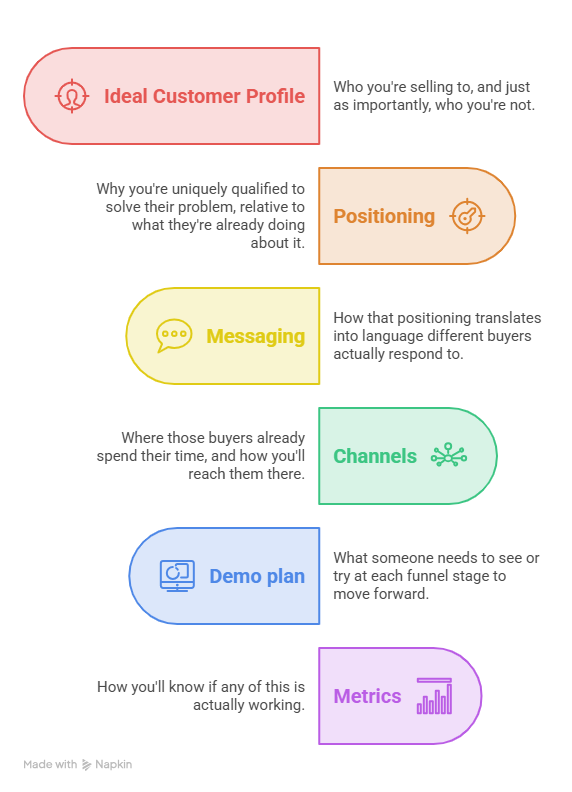
Notice section five. Most go-to-market strategy templates jump straight from "channels" to "metrics" and skip the part where a real human actually experiences your product. That's a mistake: well over half of B2B buyers now do self-directed, digital-first research long before they'll take a sales call.
How to Fill Out Each Section (Worked Example)
Theory's fine, but templates only click once you see one filled in. Let's walk through a fictional mid-market SaaS company, call it SyncOps AI, that helps subscription businesses stop losing money to billing and reconciliation errors.
ICP:
B2B SaaS and subscription-commerce companies between $10M–$50M ARR, 100–500 employees, running Stripe, NetSuite, or Salesforce. The trigger event? Month-end reconciliation is eating more than 20 staff hours, or ledger totals that don't match CRM contract values.
Positioning (using April Dunford's framework):
Instead of leading with features, SyncOps AI starts with the alternative manual spreadsheet audits and custom SQL scripts. Then it names what it does differently (real-time, bi-directional sync between billing and CRM data with automated anomaly detection) and backs it with proof: reconciliation time cut from 7 business days to under 3 hours.
Messaging:
For a finance director, the pitch is "stop closing the books late." For a RevOps lead, it's "stop reconciling three tools by hand." Same product, different pain point leading the conversation.
Channels:
A mix of pain-point SEO content ("how to reconcile NetSuite entries with Stripe billing"), an ungated interactive product tour on the pricing page, and SDR outbound targeted at trial accounts showing heavy API usage.
Demo plan:
This is the row most templates skip entirely and the one that actually moves deals. Map it to funnel stage:
- Awareness: an ungated interactive tour, no form required.
- Consideration: a role-specific walkthrough (finance and RevOps see different flows).
- Decision: a personalized sandbox the buyer can forward to security and finance.
- Onboarding: a guided walkthrough tied to whatever feature drove the most trial engagement.
Metrics:
SyncOps AI tracks demo-to-close rate (targeting 25%, roughly the current mid-market median), CAC payback (aiming under the 15-month industry median), and LTV: CAC above 3:1 to stay capital-efficient.
Swap in your own numbers, and you've got a working go-to-market plan template instead of a wishlist.
Turning the Plan Into Action: Automating Your Demo Content
Here's the part that trips almost everyone up. You've mapped four different demo needs across the funnel: an interactive tour, a role-specific walkthrough, a sandbox, an onboarding sequence, and now someone actually has to build all four. That's usually where the plan quietly stalls, because "record and edit a polished demo video" isn't exactly a five-minute task, especially if it means learning a video editor from scratch or waiting weeks in a production queue.
This is genuinely the best return you'll get from filling in that demo-plan row. Demo touchpoints aren't a nice-to-have, either: deals with one close at a 46% win rate versus 38% for static content, and website visitors who engage with an interactive demo convert nearly 8x better than those who don't.
PuppyDog's Product Demo Video Maker exists for exactly this bottleneck. Upload a screen recording, or even just a handful of screenshots, and it generates a polished, on-brand demo video automatically no editing timeline, no waiting on a freelancer, no re-recording because someone said "um" one too many times. Whatever's sitting in your demo-plan row, an awareness-stage teaser, a role-specific walkthrough, or an onboarding clip, you can produce it the same week you wrote the plan, not the same quarter.
If you want to know how fast that turnaround really is, it's worth trying it on your own product screenshots rather than taking our word for it.
Get the Free Go-to-Market Strategy Template
You don't need another 40-page strategy document sitting in a shared drive collecting dust. You need a go-to-market strategy template your product, marketing, and sales teams will actually open, fill out, and act on demo plan is included.
Download the free, editable template above, fill in your ICP, positioning, channels, and demo plan using the SyncOps AI example as a guide, then start a free trial to turn that demo-plan row into actual videos instead of another to-do list item.
For more on adapting this framework for SaaS launches specifically, see our SaaS go-to-market strategy guide, or browse real go-to-market examples from companies that got this right.
FAQs
What should a go-to-market template include?
A GTM template should include your ICP, positioning, pricing, channels, messaging, sales motion, a demo/content plan, and success metrics. Skip any one of these, and you end up with a strategy that sounds good in a meeting but doesn't actually align product, marketing, and sales.
Is there a free GTM strategy template?
Yes, this guide includes a free, editable go-to-market strategy template you can download and customize. It's built to include a demo-plan section that most free templates leave out entirely.
How detailed should a GTM plan be?
Detailed enough to assign owners and metrics to each stage, but concise enough that the whole team can act on it. Most effective plans run from one page for a single feature launch to about ten pages for a major product release. Anything longer usually means nobody's actually reading it.

Sarah Thompson is a storyteller at heart and Business Developer at PuppyDog.io. She’s passionate about creating meaningful content that connects people with ideas, especially where technology and creativity meet.