The Modern GTM Motion: A Stage-by-Stage Map

Published: 25th July 2026
Here's a question most SaaS founders eventually wrestle with: why do two companies with nearly identical products end up with wildly different growth outcomes?
Usually, it's not the product. It's the motion.
Your go-to-market (GTM) motion is the system that takes someone from "never heard of you" to "we can't live without this." Get it right, and every team marketing, sales, customer success pulls in the same direction. Get it wrong, and you end up with misaligned handoffs, slow sales cycles, and churn you can't fully explain.
This guide maps the full GTM motion stage by stage, names the exact demo content each stage needs, and shows how PuppyDog automates it all.
What Is a GTM Motion?
If you're new to the concept entirely, check out our full breakdown of what GTM means and why it matters before diving in.
Most SaaS companies run one of four core motions:
- Product-Led Growth (PLG): The product sells itself. Users self-onboard, get value fast, and upgrade via self-service. Best for low-ACV, horizontal tools with a short time-to-value.
- Sales-Led Growth (SLG): A dedicated team guides enterprise buyers through multi-stage deals. Right for complex, high-ACV products with longer sales cycles.
- Channel-Led Growth: Partners, resellers, and marketplaces handle distribution. Common in regulated industries or new geographies.
- Hybrid / Product-Led Sales (PLS): The dominant model for scaling SaaS right now. Self-serve trials drive early adoption at low cost, and sales steps in when usage signals enterprise intent.
The stakes here are real. Companies with a clearly defined GTM motion grow 19% faster and achieve 15% higher profitability than those without one. And organizations with a highly structured GTM strategy are 60% more likely to hit their revenue targets after a product launch.
Choosing the wrong motion creates problems that compound fast. Running a high-touch sales process for a low-ACV product burns cash. Running pure self-serve for complex enterprise software leads to onboarding failures and early churn. Getting this right is foundational. Everything else builds on it.
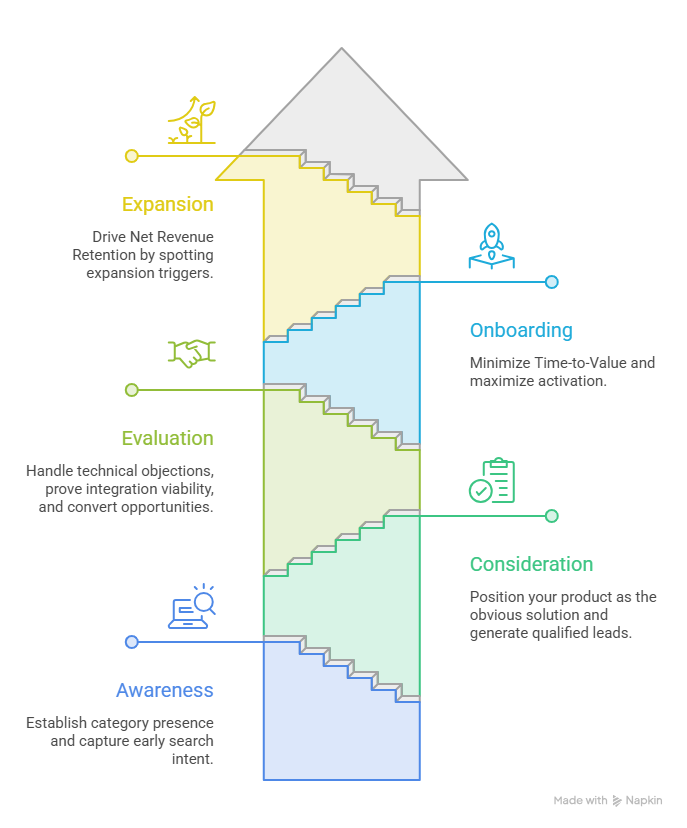
The 5 Stages of the Modern GTM Motion
Let's be honest, most SaaS teams treat demos as a sales tool. They're not. They're a full-funnel asset. Every stage of the GTM motion needs a different type of demo content, and delivering the wrong one at the wrong time is one of the fastest ways to lose a deal.
Here's what each stage actually requires.
Stage 1: Awareness
What the buyer is doing: Experiencing pain without a clear solution in mind. They're searching for answers, not vendors.
GTM goal: Establish category presence and capture early search intent before buyers start evaluating tools.
Best demo format: A 30-to-60-second micro-explainer video focused on the solved state of a pain point, not a feature tour. Animation and high-level screen recordings work well here. The goal is to make someone nod and think, "yes, that's exactly my problem."
HubSpot is the classic example. Their content library ranks for almost every sales and marketing question a buyer might search, long before that buyer knows they need a CRM. By the time someone starts evaluating tools, HubSpot already feels familiar.
Stage 2: Consideration
What the buyer is doing: They've named their problem and are comparing approaches. They want to see options before talking to sales.
GTM goal: Position your product as the obvious solution and start generating qualified leads.
Best demo format: Interactive product walkthroughs embedded on landing pages or sent via email. Prospects should be able to click through a product experience without booking a call or creating an account. Remove every barrier between the buyer and the "aha" moment.
Loom does this brilliantly. When someone receives a Loom video, they experience the product's core value without signing up. The demo and the product are the same thing.
Stage 3: Evaluation
What the buyer is doing: The buying committee has expanded. IT, legal, finance, and executives are all at the table. They want specifics, not overviews.
GTM goal: Handle technical objections, prove integration viability, and convert opportunities to closed-won.
Best demo format: Live, personalized demos built for the specific account. Generic demos consistently fail at this stage because they ignore the exact use cases, security requirements, and business outcomes each buying committee cares about.
The numbers make a compelling case here. Engaging three or more buying contacts with personalized, account-targeted demo material produces a 2.4x higher win rate overall — climbing to 3.1x for enterprise sales cycles. That gap is too large to ignore.
Stage 4: Onboarding
What the buyer is doing: They just signed. Now they want to see value before the first invoice hits. If they don't, you'll hear from them soon, and not in a good way.
GTM goal: Minimize Time-to-Value (TTV), maximize activation, and stop churn before it starts.
Best demo format: Short, action-triggered in-app walkthrough videos and personalized quick-start guides sent by CSMs. These walk admins and end users through setup so they don't stall before reaching their first meaningful milestone.
Slack nailed this stage. New users are immediately prompted to invite teammates and connect integrations like Google Drive, making the product collaborative and sticky within the first hour.
Stage 5: Expansion
What the buyer is doing: They're comfortable with the product and open to growing. They just need a relevant nudge toward the next tier or feature.
GTM goal: Drive Net Revenue Retention (NRR) by spotting expansion triggers early and acting on them before the opportunity passes.
Best demo format: Pre-recorded, targeted feature walkthroughs delivered when usage data shows a user approaching plan limits or qualifying for a premium add-on. One to two minutes, no fluff, highly specific to what that account actually needs next.
Notion's template ecosystem works this way. Power users showcase advanced workflows publicly, which naturally shows existing customers what is possible at the next level, without a sales pitch in sight.
Who Owns What Across the GTM Team
A GTM motion is only as strong as its handoffs. Here is the standard ownership map:
The three most common failure points? The MQL-to-SQL gap (marketing passes low-intent leads that sales ignores), the "sold-on-a-promise" chasm (AEs over-commit during the sale and CS inherits the fallout), and PLG-sales channel conflict (reps prospect, active self-serve users before those users show enterprise intent).
Fast-growing SaaS teams are solving this with lifecycle pods, small cross-functional groups organized around a specific funnel transition rather than a department. An "Activation Pod" might bring together a growth marketer, a product manager, and a sales-assist rep focused on one shared metric: getting signups to their first activation event. That kind of alignment beats departmental KPIs every time.
Automating the Full-Funnel Demo Playbook with PuppyDog
Here is the problem with executing stage-specific demos at scale: they take time to produce, and personalizing them manually does not scale.
A solutions engineer can build a custom demo for a major enterprise deal. But what about the 50 mid-market accounts in the pipeline? Or the 200 self-serve users who just hit their usage limits and need an upsell video today?
This is exactly where PuppyDog fits.
PuppyDog's Product Demo Video Maker lets GTM teams auto-generate polished, personalized demo videos directly from screen recordings or screenshots no production team, no hours of editing, no starting from scratch for every prospect.
The workflow is simple:
- Record your screen or upload screenshots of your product
- PuppyDog generates a polished, personalized demo video
- Deploy it at the right GTM stage, automatically
For teams using Product Video Personalization, PuppyDog can dynamically reference account names, specific use cases, and individual pain points so mid-market prospects receive a demo that feels purpose-built for them. Because it is.
And for Customer Success teams managing expansion, PuppyDog's Customer Success solution makes it straightforward to trigger feature walkthrough videos based on real usage data so the right content lands at exactly the right moment without a CSM manually tracking every account.
The performance data here is hard to argue with. Outbound campaigns featuring a personalized video as the first touch outperform text-only outreach by up to 400%. Video proposals drive 56% higher engagement and accelerate sales cycles by 26%. Sales professionals who track video-specific KPIs report hitting revenue targets more often and closing deals faster.
Your GTM team is already stretched. Automating demo production and delivery is one of the highest-leverage things you can do right now.
GTM Metrics Per Stage
Tracking the right metrics at each stage keeps your GTM motion honest and gives you early signals when something is slipping.
Awareness
- Brand search volume growth
- Organic pipeline percentage (target median: 41%)
- Impressions and share of voice
Consideration
- MQL volume
- Interactive tour completion rate
- MQL-to-SQL conversion rate (target: 32% to 40%)
Evaluation
- Demo-to-opportunity rate
- Average sales cycle length by segment
- Win rate (SMB median: 31%, mid-market: 24%, enterprise: 15%)
Onboarding
- Time-to-Value (TTV) in days
- User activation rate within the first 14 days
- Onboarding completion rate
Expansion
- Net Revenue Retention (NRR), SMB target: 100-120%, enterprise target: 115-130%+
- Expansion MRR contribution (target: 38% for companies above $25M ARR)
- Product usage depth per account
These metrics tell you where your GTM motion is working and where it is leaking. A stage that looks fine on revenue might be hiding a slow activation rate that will show up as churn six months from now.
Frequently Asked Questions
What is a GTM motion?
A GTM motion is the repeatable system a company uses to acquire and grow customers — such as product-led, sales-led, or hybrid. It coordinates marketing, sales, product, and customer success around a shared set of plays that move buyers from awareness through to expansion and renewal.
What are the stages of a GTM motion?
The five stages of a modern GTM motion are Awareness, Consideration, Evaluation, Onboarding, and Expansion. Each stage involves different buyer behaviors, GTM team owners, and content formats, including specific types of product demos designed for that moment in the buying journey.
What is a GTM playbook?
A GTM playbook is a documented operational blueprint that defines the plays, owners, and content used to move buyers through each stage of the GTM motion. An effective SaaS GTM playbook includes ICP definitions, positioning frameworks, messaging hierarchies, channel selection criteria, and stage-specific demo strategies.
Run Your GTM Motion Without the Demo Bottleneck
Every stage of your GTM motion needs the right demo content. That content needs to be personalized, timely, and scalable. For most teams, producing all of that manually is simply not realistic.
PuppyDog removes the bottleneck. From micro-explainer videos at the top of the funnel to personalized feature walkthroughs at expansion, the Product Demo Video Maker handles the heavy lifting, so your GTM team can focus on what it does best: building relationships and closing deals.
Try PuppyDog and start automating your full-funnel demo playbook today.

Sarah Thompson is a storyteller at heart and Business Developer at PuppyDog.io. She’s passionate about creating meaningful content that connects people with ideas, especially where technology and creativity meet.