What Is Go-to-Market (GTM)? 2026 Playbook


Published: 11 July 2026
You've probably heard someone say "we need to nail our GTM" in a meeting and nodded along like you knew exactly what that meant. No judgment, it's one of those terms that gets thrown around so often, people forget it actually needs a definition.
So let's fix that. This guide breaks down what GTM actually means, how a GTM strategy differs from a GTM plan (they're not the same thing, despite what half the internet implies), who's supposed to be in the room when GTM decisions get made, and this is the part most guides skip. Why so many otherwise-solid GTM strategies fall apart the moment a real prospect asks, "Okay, but what does this actually do?"
What Is Go-to-Market (GTM)?
A go-to-market strategy is the plan a company uses to bring a product to its target customers and turn that introduction into revenue. That's the one-sentence version. The fuller picture: it's a structured, cross-functional plan that defines who you're selling to, how you're positioned against alternatives, what you charge, which channels you use to reach buyers, and how you'll measure whether any of it is working.
Different corners of the business world frame it slightly differently. Gartner leans into the competitive angle. A GTM strategy is how you convince buyers to choose you over the next option. HubSpot frames it more operationally, as the action plan for launching something new and getting every team rowing in the same direction. Product marketing circles tend to emphasize integrating GTM as the glue between product, marketing, sales, and customer intelligence.
They're all describing the same animal from different angles. The acronym itself just stands for go-to-market, nothing more mysterious than that.
Here's where it gets useful, though: "GTM" isn't one single thing. It's shorthand for four related but distinct layers, and mixing them up is where a lot of teams get tripped up.
GTM Strategy vs. GTM Plan vs. GTM Motion
If you've ever sat in a meeting where someone says "the GTM" and everyone quietly assumes they mean something slightly different, this is why.
GTM strategy is the foundational layer. It's durable, usually built to hold for 12-18 months, and it answers the big structural questions: who's the buyer, why should they care, and what makes us different? Get this wrong and everything downstream wobbles.
GTM plan is the tactical execution layer, the campaign calendar, the launch timeline, and the budget breakdown for a specific product release or market expansion. It's short-term and time-bound, built to answer "what happens, and when."
GTM motion is the repeatable engine behind acquisition. Is this product-led (self-serve, try-before-you-buy), sales-led (rep-driven, high-touch), or some hybrid of the two? This is more structural than the plan and more operational than the strategy; it's the ongoing system for how buyers actually move from stranger to customer.
Here's a quick way to keep them straight:
Worth noting: the old debate of "pure PLG vs. pure SLG" is mostly dead. Most companies now run a hybrid product-led motion to hook people early, a sales-led motion to close bigger deals and expand accounts later.
The 6 Core Components of a GTM Strategy
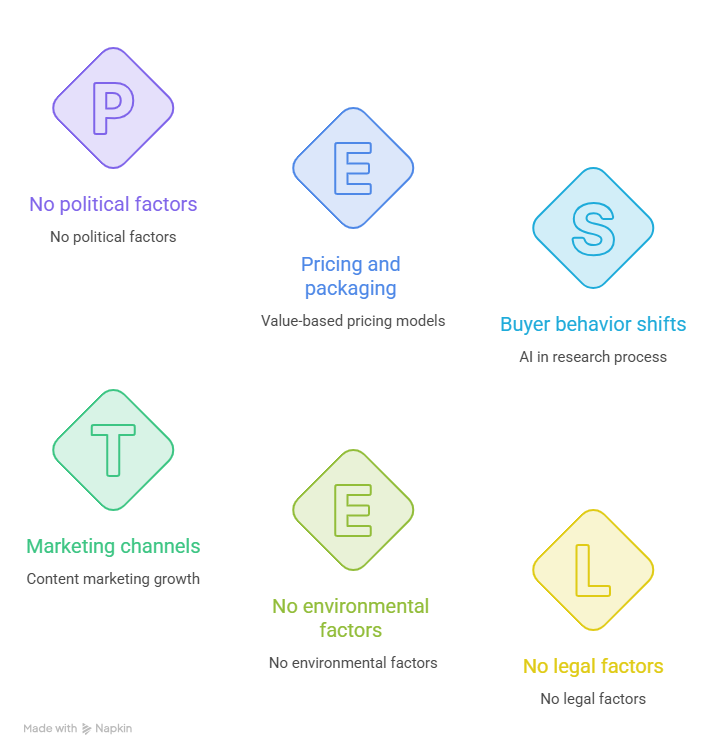
Strip away the jargon, and a GTM strategy really comes down to six interconnected decisions. Miss one and the whole thing gets shakier than it should be.
1. Ideal Customer Profile (ICP) and segmentation
This is a precise picture of who gets the most value from what you sell. company size, industry, tech stack, buying triggers, and who actually sits on the buying committee. Skip this step, and you end up running the same pitch at everyone, which usually means it lands with no one.
2. Positioning and messaging
Where do you sit in a prospect's head relative to the alternatives, including "doing nothing," which is always your quietest competitor? Good positioning ditches vague claims like "the leading platform" for specific, provable outcomes: "cuts implementation time from weeks to days" beats "best-in-class" every time.
3. Pricing and packaging
Pricing isn't just a number. It's a signal. Most SaaS companies have shifted from flat-rate pricing toward usage-based or value-based models that scale with how customers actually get value, because that tends to support long-term expansion revenue better than a flat annual fee ever could.
4. Marketing and distribution channels
Where does your buyer actually pay attention, and how do they prefer to shop? The smarter move is usually mastering one or two channels before spreading thin across five. HubSpot, for what it's worth, grew from roughly 8,200 customers to over 205,000 largely by doubling down on one channel, content.
5. Sales motion
Low-complexity, lower-price products tend to lean toward self-serve. Complex products with multiple stakeholders and custom implementation usually need a sales-led or account-based approach. Trying to force a $10k enterprise deal through a self-serve motion (or vice versa) rarely ends well.
6. Metrics and feedback loops
None of the above matters if you're not measuring it. Modern GTM strategies track post-sale numbers too, net revenue retention, churn, and time-to-value because in SaaS, the "sale" isn't really finished until the customer sticks around and expands.
Worth flagging: buyer behavior has shifted underneath all six of these. Buyers are now completing an estimated 80% of their evaluation before ever talking to a sales rep, and a large majority are using AI tools somewhere in that research process. That changes how positioning and channels need to work. More on that in a minute.
Who's on a GTM Team? (And What Each Function Owns)
Ask "what is a GTM team," and you'll get different answers depending on who you ask, which is kind of the point. A GTM team isn't one department. It's a cross-functional group that has to move like one, even though they report to different bosses.
- Product marketing owns positioning, messaging, and market research. Basically, they define the story everyone else tells.
- Demand generation/marketing owns top-of-funnel traffic, brand awareness, and lead nurture. They're measured on CAC and pipeline contribution.
- Sales (AEs, SDRs, sales engineers) own qualification, demos, objection handling, and closing. Their scoreboard is pipeline conversion and cycle length.
- Customer success owns onboarding, adoption, and renewal. In SaaS, they're often the ones actually accountable for revenue retention.
- RevOps owns the tech stack, data hygiene, and attribution, the unglamorous glue holding everyone else's numbers together.
The mix shifts as a company grows, too. Early-stage startups often run GTM with a handful of generalists still chasing product-market fit. By the scale-up stage, you'll see dedicated SDRs, AEs, CSMs, and a RevOps lead formalizing the handoffs. At the enterprise stage, teams get specialized vertical AEs, ABM marketers, and procurement specialists because the buying committees they're navigating have gotten a lot more complicated, too.
Where Demo Content Fits: The Value-Visibility Gap
Here's the uncomfortable truth buried in most GTM playbooks: you can nail all six components above and still lose deals for one simple reason. Prospects can't quickly see what your product actually does.
This is what's sometimes called the value-visibility gap, the space between what your software can do and how fast a buyer can actually perceive that. Static screenshots, generic sales decks, and "let's schedule a 30-minute call" don't close that gap; if anything, they widen it.
The data backs this up in a pretty striking way. Roughly two-thirds of B2B buyers say they'd prefer a rep-free buying experience. At the same time, buying committees have ballooned to an average of 10 to 13 stakeholders across IT, security, legal, and finance, and a large majority of those teams report real internal friction while trying to agree on a vendor. Put those two facts together, and you get sales cycles stretching past four months on average, with any single sales rep getting only a sliver of the buyer's actual attention.
Meanwhile, buyers are telling us exactly what they want: research shows the vast majority of B2B buyers prefer interactive or visual content over plain text, and buyers who try an interactive demo before purchase convert at meaningfully higher rates than those who just watch a canned recording.
The problem isn't that teams don't know demos matter. It's that building a good one is slow. Manually configuring a custom demo environment, data, branding, and use-case paths eats up somewhere around 30 to 45 minutes per session for a sales engineer. Multiply that across 20 demos a month, and you've quietly lost two full workdays to prep. Traditional video walkthroughs aren't much better, often taking a few hours each once you factor in scripting, recording, and editing.
That gap between "buyers want fast, personalized proof" and "our team can't produce it fast enough" is, honestly, the whole GTM bottleneck in a nutshell.
How AI-Personalized Demos Accelerate GTM
This is where automated demo creation earns its place in a modern GTM stack, not as a nice-to-have, but as infrastructure that touches every function on the GTM team.
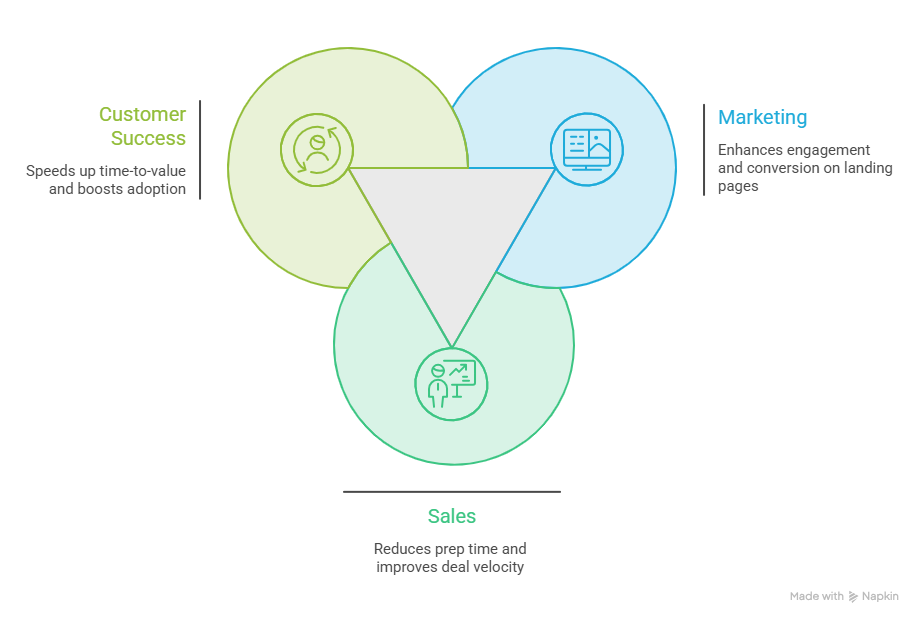
In marketing, a short, personalized product video on a landing page does what a wall of text can't — it delivers the "aha" moment before a visitor's attention drifts elsewhere. Given how much faster people process video than copy, this alone can lower bounce and lift conversion on top-of-funnel pages.
In sales, AI-personalized demos flip that 30-to-45-minute prep problem on its head. Instead of manually rebuilding a demo environment for every prospect, reps can generate a tailored, context-aware walkthrough in minutes and drop it straight into a shared deal room, letting internal champions sell the product to their own stakeholders without waiting on a live call. That matters a lot when your rep only gets a few percent of the buyer's total decision-making time.
In customer success, the same underlying tech shortens time-to-value after the deal closes. As product updates ship, walkthroughs and onboarding videos can update alongside them instead of going stale, which keeps support tickets down and adoption up.
This is exactly the gap PuppyDog's Product Demo Video Maker is built to close, turning screen recordings or even plain screenshots into polished, personalized demo videos without the usual production slog. Pair that with AI-powered product video personalization, and every stage of the GTM funnel from a cold landing page visitor to a customer three months into onboarding gets a version of the demo built for them, not a generic version built for everyone.
The net effect: a GTM strategy that's already solid on paper (right ICP, right pricing, right channels) actually gets to prove itself in the moment that matters most, the moment a prospect is deciding whether your product is worth their time.
FAQ
What does GTM stand for?
GTM stands for "go-to-market," the coordinated plan a company uses to bring a product to a defined audience and turn that introduction into revenue.
What is a GTM team?
A GTM team is a cross-functional group, typically marketing, sales, product marketing, customer success, and RevOps, responsible for launching and growing a product together rather than in separate silos.
What's the difference between a GTM strategy and a marketing strategy?
A GTM strategy covers the full launch-to-revenue motion across every team involved, while a marketing strategy is one piece of that puzzle focused specifically on demand generation and brand awareness. Marketing strategy is ongoing and portfolio-wide; GTM strategy is time-bound and built around a specific product or launch.
What is a GTM motion?
A GTM motion is the repeatable engine a company uses to acquire and convert customers, commonly product-led (self-serve), sales-led (rep-driven), or a hybrid of both, chosen based on product complexity and deal size.
The Bottom Line
A GTM strategy can be technically flawless, right ICP, sharp positioning, smart pricing, and still stall out if buyers can't quickly see what the product does. That's not a strategy problem. It's a visibility problem, and it's fixable.
If your team is losing deals in that gap between "interested" and "convinced," it might be worth looking at how fast and how personalized your demo content actually is. Try PuppyDog's Product Demo Video Maker free and see how quickly you can turn a screen recording into a demo that actually shows your value, instead of just describing it.

Sarah Thompson is a storyteller at heart and Business Developer at PuppyDog.io. She’s passionate about creating meaningful content that connects people with ideas, especially where technology and creativity meet.