AI Avatar vs. Voiceover for Product Demos: The 2026 Decision Guide


Published : 7th July 2026
For product demos, the AI avatar vs. voiceover question has a cleaner answer than most comparison posts are willing to give: AI voiceover paired with real screen recordings outperforms AI avatars for the large majority of SaaS product demos because buyers want to see your actual product UI, and a virtual presenter gets in the way of that. But "large majority" isn't "all," and the right format genuinely depends on what you're showing, where it lives, and who's watching it. Puppydog's AI voiceover feature automatically generates professional, multilingual narration synced directly to your screen recordings so your product is always the star of the show.
Why the Format Decision Actually Matters
Let's ground this in the buying reality before we compare formats.
According to Wyzowl's 2026 State of Video Marketing Report, 96% of B2B buyers prefer video for product education, and 73% specifically prefer seeing actual product UI footage and screen recordings over a talking-head presenter. That preference isn't aesthetic. Buyers are trying to evaluate whether your product is fast, intuitive, and worth their time. An avatar standing in front of your UI doesn't answer those questions. Your actual interface does.
Add to that: Gartner research confirms 75% of B2B buyers now prefer a completely rep-free purchase experience. Your demo video is effectively your first sales meeting. Which means getting the format wrong isn't just a production choice it's a pipeline choice.
And here's the piece most demo content conveniently ignores: silent viewing. Research from 3Play Media found that 80% of viewers react negatively to video that autoplays with sound. A separate finding from the same source shows 41% of videos are rendered completely incomprehensible without captions. Regardless of which format you choose, if the video doesn't communicate on mute, it doesn't communicate full stop.
What's the Real Difference Between AI Avatar and AI Voiceover?
They share a name category. In practice, they do completely different jobs.
AI voiceover for demos means an AI-generated narration track synchronized with a live screen recording of your actual product. The screen is the star. The voice guides and explains as the product moves. No presenter face, no overlay, no competing visual element. Just your software doing its thing, narrated clearly.
AI avatar video uses a synthesized human presenter generated by tools like HeyGen, Synthesia, or D-ID as the primary on-screen character. The avatar talks to the camera, explains features, and leads the content. Your product UI, if shown at all, typically appears as a background element or inset behind the presenter.
The critical difference is what fills the screen. In a voiceover demo, 100% of the visible frame belongs to your product. In an avatar video, a significant portion of that real estate goes to a virtual human who isn't your product. For a SaaS tool where the UI is the actual value proposition, that's not a stylistic trade-off. It's a strategic one.
The 4-Question Decision Flowchart
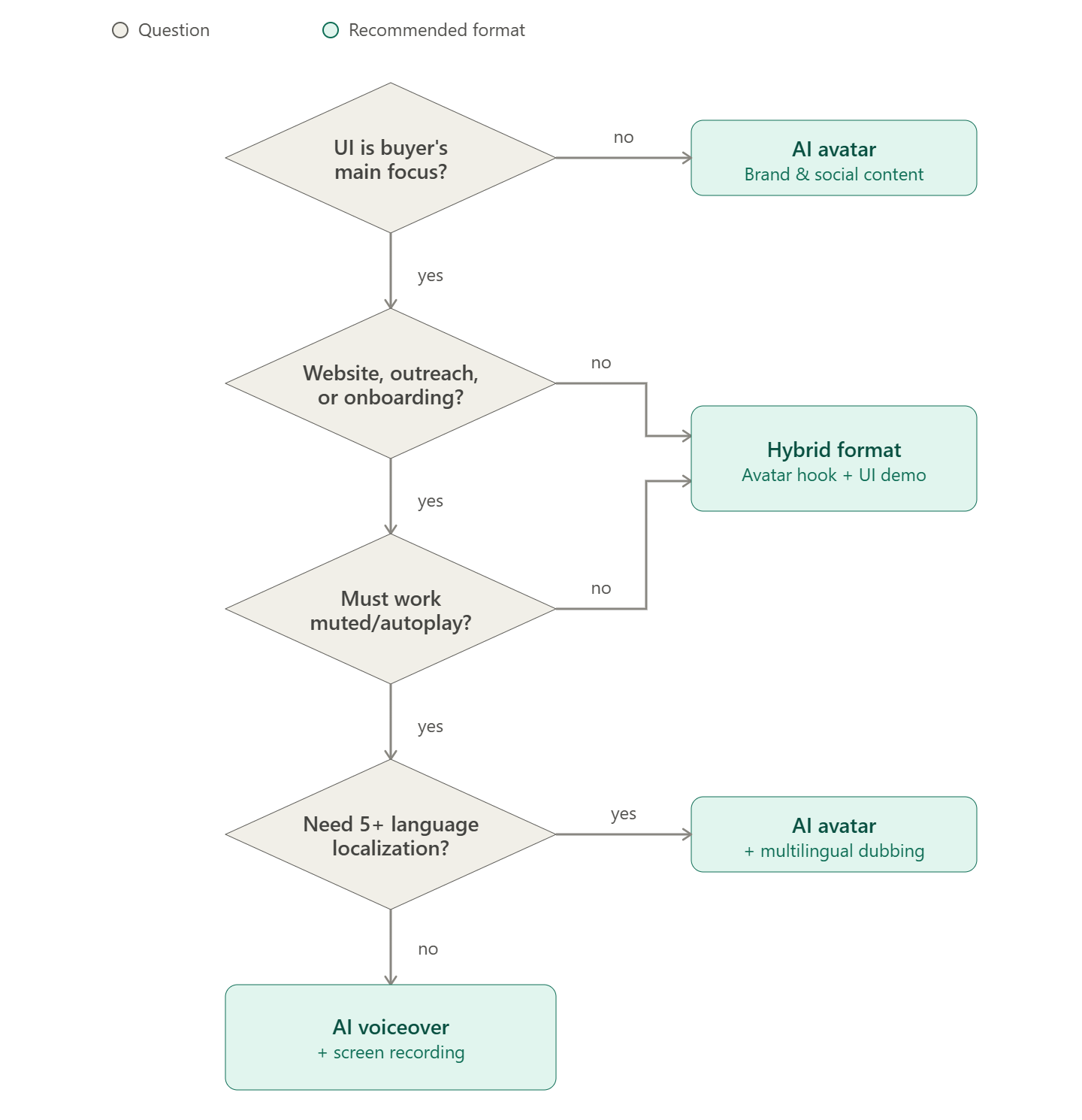
Q1: Is your product UI the primary thing the buyer needs to evaluate?
→ Yes: Go to Q2 | → No (brand content, training, social thought leadership): AI Avatar
Q2: Does this content live on your website, in sales outreach, or in onboarding flows?
→ Yes: Go to Q3 | → No (organic social, LinkedIn, TikTok): AI Avatar or Hybrid
Q3: Does the video need to work muted in an autoplay environment?
→ Yes: AI Voiceover + Screen Recording + Captions | → No (controlled playback, direct send): Hybrid Format
Q4: Do you need to localize this into 5+ languages?
→ Yes: AI Avatar with multilingual dubbing | → No: AI Voiceover (faster, leaner, UI-first)
Four questions. Clear outputs. No gut-feeling guessing.
When Does AI Voiceover Win for Product Demos?
Most of the time in the SaaS context. Here's when specifically.
Homepage and pricing page demos. This is peak purchase intent. Buyers are evaluating your product directly. Since 73% already prefer the actual UI, inserting an avatar between them and the software is working against what they came for.
Onboarding and activation flows. Narrated screen recordings help new users follow along without cognitive overload. Wrike embedded voiceover demos directly into their onboarding sequence and saw a 65% lift in onboarding conversion. The narration guides users through the interface without pulling attention away from it.
Sales follow-up sequences. An asynchronous, always-available demo beats a written recap email in the post-discovery phase almost every time. Zapier used narrated product walkthroughs in their sales follow-up process and reported a 70% increase in booked sales meetings.
Feature launch campaigns. When releasing something new, showing the feature in action beats describing it. RudderStack replaced passive launch assets with narrated interactive walkthroughs and generated a 2x pipeline increase.
Puppydog's AI voiceover generator automatically adds professional, realistic narration to your screen recordings across multiple languages, powered in part by a native ElevenLabs integration for voice quality. Custom voices are also available on all paid plans, so your demos sound on-brand from day one. Most teams have their first narrated demo live in under 10 minutes. SARC MedIQ used Puppydog's personalized video demos to generate 300 new qualified leads from 20,000 personalized demo sends driven entirely by AI-narrated, screen-recorded product walkthroughs tailored to each prospect.
The production economics also tilt sharply toward AI voiceover. Traditional studio-produced demo videos run $3,000–$15,000 per asset. AI-assisted production drops that to approximately $400 per finished minute, a 91% cost reduction. Standalone AI voice tools like ElevenLabs run ~$12 per hour of generated audio; Murf AI is approximately $10 per hour. Puppydog's Pro plan starts at $499/month for teams needing up to 5 personalized demos per month, with a Scale plan at $999/month for teams running up to 20 demos monthly, a fraction of what a single agency-produced demo used to cost.
When Does an AI Avatar Actually Win?
Let's be honest here, because most posts on this topic aren't.
Avatars genuinely earn their place in specific scenarios:
Corporate training and L&D at scale. BESTSELLER deployed Synthesia avatar-led videos to train over 20,000 employees globally and cut classroom training time by 50%. Teleperformance saved an average of $5,000 and 5 full production days per training video. These aren't product demos. They're educational assets with a different job to do.
Founder-brand and thought leadership video. If you're scaling executive presence on LinkedIn or maintaining a consistent brand face, digital twin tools from HeyGen and Synthesia let you publish content without the executive having to sit in a recording booth every week.
High-volume social content. On LinkedIn, TikTok, and Instagram Reels, where human presence signals authenticity and posting frequency matters, avatars let you maintain cadence without burning production hours.
Multilingual localization at scale. This is the clearest competitive advantage avatars hold. HeyGen and Synthesia support one-click translation and lip-sync across 170+ languages while preserving vocal quality. If you're localizing a single asset into eight regional versions, per-language voiceover re-recording is a much heavier lift.
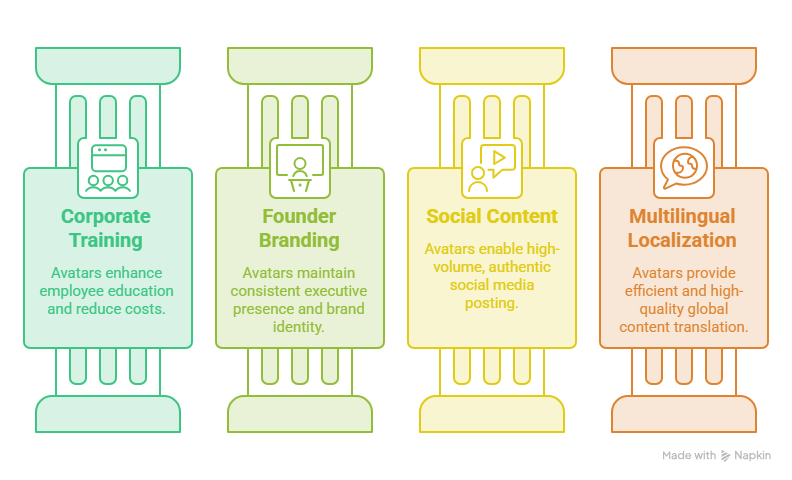
The honest framing: avatars belong in your brand lane. Voiceovers belong in your demo lane. Force either format to do the other's job, and you'll feel the drag in your conversion numbers.
What About Accessibility and Sound-Off Viewing?
This is the section Arcade's post skips entirely — and it's one B2B enterprise buyers increasingly cannot ignore.
The legal baseline: the Americans with Disabilities Act (ADA), Section 508, and WCAG 2.1 require that video content be accessible to users with auditory or visual impairments. For pre-recorded product demo videos, that means:
- WCAG SC 1.2.2 (Level A): Synchronized, accurate captions for all pre-recorded audio. Auto-generated captions don't meet this standard unless manually reviewed to 99% accuracy.
- WCAG SC 1.2.5 (Level AA): Audio descriptions for pre-recorded video — on-screen UI changes must be verbally described, not just shown visually.
- WCAG SC 1.4.3: On-screen text overlays must maintain a 4.5:1 contrast ratio.
Here's the practical shortcut for voiceover demos: if your narration script explicitly describes every UI action as it happens "I'm clicking the settings icon in the top right, selecting API Keys, then hitting Generate" you satisfy the Level AA audio description requirement within a single unified audio track. No separate description track needed. Avatar videos with visual-only UI transitions don't get that shortcut; they typically require an additional audio description layer to reach Level AA compliance, which adds production overhead.
Beyond compliance, the engagement case for captions is clear. 3Play Media research shows viewers are 80% more likely to watch a video to completion when captions are present. On YouTube, captioned videos generate 7.32% more lifetime views than uncaptioned equivalents. And digital accessibility lawsuits in the U.S. hit 4,187 in 2024, tracking 37% higher into 2025.
Caption everything in both formats, every time. It's not a nice-to-have.
Can You Combine Avatar + Voiceover? The Hybrid Done Right
Yes, and this is the format most demo video content mishandles. Arcade's post treats it as a compromise. It isn't. It's a deliberate format with its own best-practice structure.
The approach that consistently works:
- 0:00–0:15 (Hook): Avatar introduces the problem, establishes credibility, and earns the next minute
- 0:15–1:15 (Core demo): Full-screen UI recording with AI voiceover, 100% product, no presenter overlay
- 1:15–1:45 (Feature callouts): Motion graphics or visual annotations for concepts that don't show cleanly in live UI, API flows, backend processes, data structures
- 1:45–2:00 (CTA): Avatar returns to summarize and prompt the next step
Vidyard reports that over 50% of sales professionals using the combined screen-and-presenter approach rate it their highest-performing video format for response rates. The logic makes sense — human connection where it matters (hook and close), unobstructed product clarity where evaluation actually happens (the demo itself).
The practitioner consensus across Reddit's r/ProductMarketing and LinkedIn GTM communities confirms it: limit avatar segments to purposeful hooks and outros, never overlay the presenter on critical UI elements, and let the screen recording carry the core of the content.
AI Avatar vs. Voiceover for Product Demos: Verified Comparison Table (July 2026)
Honest Trade-offs: What Voiceover Demos Don't Always Do Well
Any post that doesn't acknowledge this part is trying to sell you something.
Voiceover demos can feel impersonal at the top of the funnel. If your brand depends on human connection for cold first impressions, a clean screen recording with narration can read as cold. That's the hybrid's natural home.
They're not built for social feeds natively. A narrated UI demo performs well embedded on a website or in a sales email. In a LinkedIn or TikTok feed competing with native talking-head content, it's working against the platform's format expectations.
UI changes make demos stale. Every significant product update means your demos need refreshing. AI tools make re-recording fast, but version control across a large demo library still requires a real process. On Puppydog's Pro plan, you get 5 demo videos per month, which is more than enough for most small teams, but teams running high-volume outbound campaigns may need the Scale plan (20 demos/month) to match their pace. Also worth noting: Puppydog is specifically built for software and SaaS demos. If your product isn't screen-recordable in a meaningful way, the platform's core value proposition doesn't apply.
Frequently Asked Questions
For product demos, should I use an AI avatar or AI voiceover?
For most SaaS product demos, AI voiceover paired with a real screen recording is the stronger format. Wyzowl's 2026 State of Video Marketing report shows 73% of B2B buyers prefer seeing actual product UI over a talking-head presenter. Voiceover keeps your product front and center where buyer attention needs to be. Reserve avatars for brand video, social content, and training, where human presence matters more than product visibility.
When is an AI avatar the better choice?
AI avatars win in three clear scenarios: high-volume social and brand content where human presence drives engagement, enterprise-scale training programs deployed across large workforces, and multilingual content localization where one-click lip-sync translation across 170+ languages (via HeyGen or Synthesia) is far more efficient than per-language voiceover re-recording.
Do AI voiceover demos need captions?
Yes, always. WCAG 2.1 Level A requires synchronized, accurate captions for all pre-recorded audio content, and 3Play Media data shows 41% of videos are completely incomprehensible without sound or captions. On LinkedIn and other professional platforms where autoplay defaults to muted, captions determine whether your demo communicates anything at all. Auto-generated captions need manual review to reach the 99% accuracy threshold required for compliance.
Can I combine an avatar with screen-recorded product footage?
Yes, and the hybrid format is more effective than most teams give it credit for. The structure that works best: avatar for a 10–15 second hook and closing CTA, then full-screen UI recording with AI voiceover for the core product walkthrough. Vidyard reports that over 50% of sales professionals using this combined format say it delivers their highest response rates of any video style they've tested.
What's the best AI demo voiceover tool in 2026?
For voiceover-first product demos, Puppydog automatically generates professional, multilingual narration from your screen recordings, with custom voice options, AI script generation, and CRM integration built in. Plans start at $499/month with a free trial (no credit card required). For avatar-led brand content, HeyGen and Synthesia are the category leaders. For standalone voice generation, ElevenLabs (~$12/hour) is widely used by practitioners.
The Bottom Line
The AI avatar vs. voiceover question has a real answer it just isn't the same answer for every use case.
For product demos, voiceover wins. Not because avatars are bad, but because buyers want to see your product. Seventy-three percent already told us that. The conversion results from Quantum Metric, Wrike, and Zapier show what happens when you act on it. SARC MedIQ generated 300 qualified leads from 20,000 personalized, AI-narrated video demos built with Puppydog that's the format doing exactly the job it was designed for.
Use avatars in the brand lane, social content, multilingual training, and founder thought leadership. Use voiceover in the demo lane homepage, onboarding, and sales follow-up. Use the hybrid when you need both jobs done in one asset. And add captions to everything, every time, without exception.
Try Puppydog's AI demo maker for free, no credit card required
See how SARC MedIQ secured 300 new qualified leads with Puppydog
Methodology and disclosure:
This post was produced by the Puppydog team as part of a content series covering AI demo video formats and tools. All third-party statistics are attributed to their primary sources. Customer outcomes for Wrike, Quantum Metric, Zapier, and RudderStack are published case study data cited by Arcade at arcade.software/post/ai-avatar-vs-voiceover-product-demos-2026. Puppydog platform data (pricing, features, SARC MedIQ case study) is sourced directly from puppydog.io. Competitor pricing verified April–July 2026. Confirm current rates on vendor websites. Last reviewed: July 2026.

Sarah Thompson is a storyteller at heart and Business Developer at PuppyDog.io. She’s passionate about creating meaningful content that connects people with ideas, especially where technology and creativity meet.