Video Marketing Trends 2026: What B2B SaaS Teams Need to Know


If you work in B2B SaaS marketing, you have probably felt it already: video is no longer the “nice extra” on the content plan. It is becoming the plan.
In 2026, video marketing is not just about brand awareness or a polished homepage hero clip. It is shaping how buyers discover products, how sales teams start conversations, how onboarding feels, and how customer success keeps users engaged after the deal is signed. And honestly, that makes sense. People do not want to read five paragraphs to understand a tool they could see in action in 45 seconds.
The bigger shift is this. Video marketing trends in 2026 are not being driven by production quality alone. They are being driven by speed, relevance, personalization, and AI-powered scale. For B2B SaaS teams, that means the winners will not be the brands making the fanciest videos. They will be the ones making the most useful ones, at the right moment, for the right audience.
Below is a practical look at the future of video marketing and what B2B SaaS teams should actually do with it.
The state of video marketing in 2026: from experiment to baseline
Video has moved far beyond experimentation. For many SaaS teams, it has become a core operating system for marketing, sales, and customer success.
According to the research, 91% of businesses now use video as a primary marketing tool, and 96% of marketers report positive ROI from video. That is not a trend line anymore. That is a signal.
In fact, many SaaS teams are already seeing strong pipeline impact by using video strategically for demand generation, something we’ve explored in detail in this guide on video for lead generation.
The reason is not hard to spot. AI has cut production time and cost dramatically, which means teams can create more videos without needing a giant studio setup or a full post-production crew. That shift has changed how marketing leaders think about video. It is no longer treated like a big campaign asset. It is increasingly treated like a repeatable system.
Key B2B video marketing statistics 2026
This matters because the question is no longer, “Should we use video?” The real question is, “How do we operationalize it across the funnel without burning out the team?”
That is where the next trend comes in.
AI is changing video marketing strategy for B2B companies
AI is no longer just helping with video. It is reshaping the entire production model.
A few years ago, creating a good product video meant planning, scripting, recording, editing, voiceover work, revisions, localization, and a decent amount of patience. Today, AI can speed up nearly every one of those steps. And in some cases, it can handle them almost end-to-end.
That does not mean the human role disappears. It means the human role shifts upward. Teams spend less time wrestling with timelines and more time deciding what message actually matters.
1. AI-powered production is now the foundation
The biggest change is speed. AI tools can generate scripts, create captions, produce voiceovers, remove backgrounds, and even clip long videos into short assets for social media. What used to take days can now happen in minutes.
For SaaS teams, this is a big deal. Why? Because B2B buyers do not respond to one polished video buried on a landing page. They respond to a steady flow of relevant video across ads, email, product pages, onboarding flows, help centers, and social channels.
AI makes that scale possible.
2. AI avatars are becoming part of the video stack
AI avatars are one of the more visible AI video trends for marketers in 2026. They are useful when you need consistency, speed, and localization across many markets. Think onboarding walkthroughs, feature explainers, internal training, or repeated product messaging.
The key is knowing when to use them. For broad educational content, they work well. For trust-heavy moments like executive thought leadership, customer testimonials, or high-stakes sales conversations, a real human still carries more emotional weight.
That balance matters. The smartest SaaS teams are not choosing between human and AI. They are choosing the right format for the right job.
3. Manual editing is losing its monopoly
A lot of the tedious stuff is now automated: subtitles, resized formats, thumbnails, highlight clips, and repurposing. That is good news, because one of the biggest bottlenecks in video marketing was never filming. It was all the work after filming.
When video creation gets easier, teams can do something better than just “make more.” They can test more. They can localize more. They can personalize more. And that is where the strategy starts to get interesting.
Video personalization trends are making 1:1 scale possible
Personalization used to mean adding someone’s first name to an email subject line and calling it a day.
That does not really cut it anymore.
In 2026, personalization is getting more specific, more contextual, and more useful. B2B buyers expect content that reflects their industry, their stage of buying, their role, and sometimes even their account history. Video is especially powerful here because it can feel personal without requiring a salesperson to manually record every single message.
Why personalized video is becoming mainstream in B2B marketing
Personalized video is no longer a novelty. It is becoming a practical part of ABM, outbound sales, onboarding, retention, and expansion.
This is one reason platforms like PuppyDog.io are gaining attention. They let teams turn screen recordings or screenshots into personalized demo videos, which makes scaling much easier. Instead of starting from scratch every time, teams can create tailored video experiences with far less manual work.
Personalized video use cases and impact
This is where video personalization trends become especially useful for B2B SaaS teams. Personalized video does not just feel better. It performs better.
The reason is simple: generic content is easy to ignore. Relevant content feels like it was made for me. And in a noisy market, that difference is huge.
A practical way to think about it is this: if your buyer can tell the video was created with their context in mind, you have already won half the battle.
Short-form video for B2B is the new attention economy
Short-form is not just for consumer brands anymore. In 2026, it has become one of the most effective formats for B2B SaaS as well.
LinkedIn, especially, is behaving less like a static business network and more like a fast-moving video platform. That does not mean every post needs to be flashy or trendy. It means attention spans are short, and B2B buyers are scrolling just like everyone else. Possibly while pretending they are “just checking one thing” between meetings.
What is working in short-form B2B video
The best short-form content does a few things well:
- It gets to the point immediately
- It opens with a strong hook
- It shows a real person or a real product in a context
- It offers one useful idea, not five
- It is easy to understand without sound
That last point matters a lot. Many viewers watch videos silently, especially on mobile. So captions, bold on-screen text, and visual clarity are not optional anymore.
LinkedIn has become a major video channel
For B2B teams, LinkedIn is now one of the most important places to publish video. Founder-led clips, product insights, customer tips, and “here’s what we learned” videos often outperform overly polished corporate creative.
Why? Because people trust clarity more than perfection.
A slightly raw video from a founder or product leader often feels more authentic than a glossy brand spot that sounds like it was approved by 14 committees and a nervous robot. That human voice matters.
The hook now matters more than ever
In short form, you do not get much time. Not even close.
The first second has become critical. If the opening does not create curiosity, signal relevance, or interrupt the scroll, the viewer is gone. That means hooks need to be direct, sharp, and useful. Ask a question. Name a pain point. Show the result first.
That is how short-form video wins in B2B.
What video content formats are getting the most engagement for B2B brands?
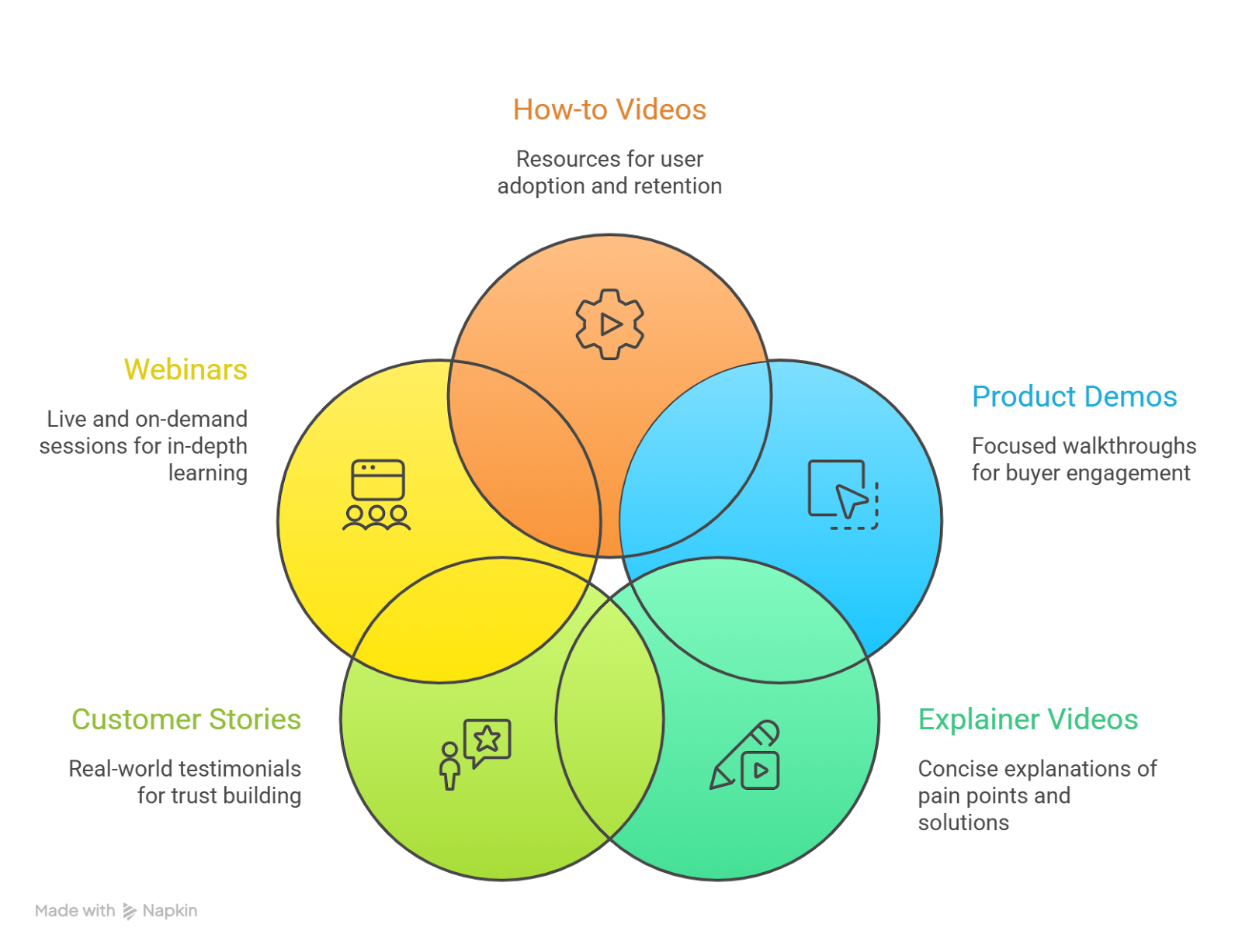
Not every format plays the same role. The strongest B2B SaaS video strategies use different content types for different funnel stages.
Here is a simple way to think about it.
1. Product demos
Product demos are still one of the most important formats in SaaS marketing. Buyers want to see the product, not just read about it. But the format is changing.
Long, broad product tours are less effective than modular demos. Smaller, focused walkthroughs work better because they answer one question at a time. That is more helpful for prospects and much easier to repurpose.
If you're new to this concept, it’s worth understanding exactly what makes a strong demo. Here’s a quick breakdown of what a video demo is and how it works in a SaaS context.
2. Explainer videos
Explainers are still one of the most universal formats. The best ones focus on one pain point, one transformation, and one next step. They are short, clear, and outcome-driven.
In other words, they do not try to say everything. They try to say the right thing.
3. Customer stories
Trust matters in B2B. A lot.
That is why customer stories and video testimonials remain powerful. In 2026, the best ones feel less scripted and more real. Buyers do not necessarily need cinematic polish. They need proof that someone like them got value from the product.
4. Webinars
Webinars still work, especially when they are thoughtfully packaged. The live session matters, but the on-demand version matters too. Searchable chapters, clips, and transcripts make webinars much more valuable after the event is over.
5. How-to videos
How-to content has become a retention machine. It helps users learn faster, reduces support tickets, and keeps customers from feeling lost. For SaaS companies, that is not a small thing. It is often the difference between adoption and churn.
What top marketing leaders say are the most important video trends to watch?
One of the clearest shifts in 2026 is that marketing leaders are moving away from pure volume thinking.
The old mindset was: publish more, test more, push more.
The new mindset is: make the content clearer, more useful, and more connected to revenue.
That sounds obvious, but it changes a lot in practice. It means marketing teams are paying more attention to attribution, lifecycle impact, and customer experience instead of chasing vanity metrics.
The big themes from top leaders
- Brand clarity matters more than content volume.
Buyers are surrounded by content. Clear positioning stands out. - Video needs to connect to revenue.
CMOs are under pressure to prove business impact, not just engagement. - Human authenticity is a differentiator.
AI can scale content, but a human point of view still builds trust. - Discovery is changing.
Brands are starting to think about Answer Engine Optimization, not just search engine optimization.
That last point is worth pausing on. As more discovery shifts into AI tools and conversational search, B2B brands need content that is easy for both humans and machines to understand. Video, especially when backed by transcripts, summaries, and strong context, can support that shift well.
How B2B SaaS teams should adapt in 2026
This is where the trends become actionable.
The smartest way to respond to video marketing trends is not to chase every new format. It is to build a system that makes video easier to create, easier to personalize, and easier to reuse.
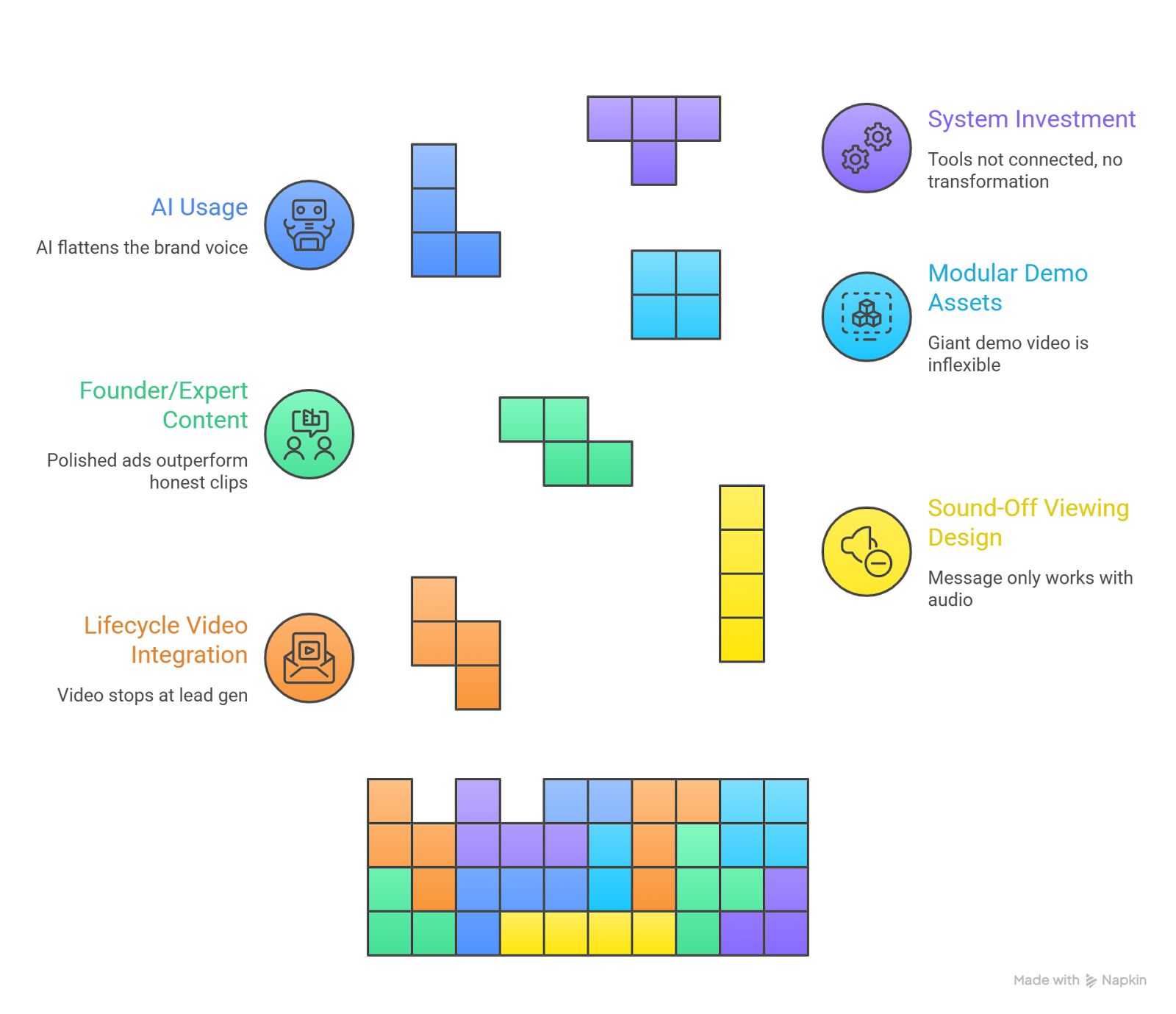
1. Build lifecycle video into the funnel
Video should not stop at lead generation. Use it for onboarding, feature education, retention, and expansion. A well-timed feature spotlight can do more than a generic email blast ever will.
2. Design for sound-off viewing
Most people are not sitting in a quiet room with headphones on. Captions, motion, and strong visual hierarchy matter. If your message only works with audio, it is not ready.
3. Use founder-led and expert-led content
People trust faces, opinions, and real insight. A good founder video or product leader clip can outperform a highly polished ad because it feels honest.
4. Break big demos into modular assets
Stop thinking only in terms of one giant demo video. Build a library of short, searchable modules that answer specific questions. That gives sales, marketing, and customer success a lot more flexibility.
5. Use AI to scale, not to flatten the brand
AI should help your team move faster. It should not make your content sound generic. Use it for production efficiency, localization, and repurposing, but keep the brand voice human.
6. Invest in systems, not just campaigns
One of the biggest mistakes teams make is buying one tool and expecting transformation. The real gain comes when video, CRM, analytics, and content workflows all connect.
That is how teams move from “we made some videos” to “video is part of how we grow.”
The future of video marketing: what comes next?
The next few years will likely bring even more automation, more personalization, and more immersive formats.
We are probably heading toward real-time AI-generated video, smarter video search, and more advanced digital demos that respond dynamically to buyer behavior. Over time, this may lead to more immersive experiences, including avatar-led walkthroughs and volumetric product previews.
That future may sound far off, but the direction is already clear.
The companies that win will be the ones that start building the habit now: shorter production cycles, deeper personalization, stronger video libraries, and tighter alignment between marketing and revenue.
Conclusion
Video marketing in 2026 is about more than content. It is about speed, trust, clarity, and relevance.
For B2B SaaS teams, the message is simple: use video to explain faster, personalize better, and support the buyer journey more intelligently. AI will keep making production easier, but the real advantage comes from using that efficiency to create videos that feel more human, not less.
Teams that adapt now will not just keep up. They will stand out.
Ready to turn your product demos into a scalable video engine? Start here: PuppyDog.io free trial
FAQs
1. What are the biggest video marketing trends for B2B SaaS in 2026?
The biggest trends are AI-powered production, personalized video, short-form vertical content, lifecycle video, and modular product demos. The common thread is speed with relevance.
2. How is AI changing video marketing strategy for B2B companies?
AI is reducing production time and cost, automating editing tasks, helping teams localize content faster, and making it possible to create more personalized videos at scale.
3. What video content formats are getting the most engagement for B2B brands?
Short-form videos, product demos, explainer videos, customer testimonials, webinars, and how-to videos are all performing well, but each works best at a different stage of the funnel.
4. Is personalized video becoming mainstream for B2B marketing in 2026?
Yes. Personalized video is moving from a niche tactic to a practical strategy for sales outreach, onboarding, customer success, and account-based marketing.
5. How can SaaS teams scale video production without losing quality?
The best approach is to use AI for scripting, editing, clipping, and localization, while keeping a strong human point of view in the message and brand strategy.

Sarah Thompson is a storyteller at heart and Business Developer at PuppyDog.io. She’s passionate about creating meaningful content that connects people with ideas, especially where technology and creativity meet.