SaaS Product Marketing: The 2026 B2B Playbook (Frameworks, Tools, Examples)


Date: 26th May 2026
Product marketing in B2B SaaS has changed dramatically. If you're still running your PMM function like it's 2022, you're probably wondering why your launches feel flat, your sales team keeps asking for "better collateral," and your win rates are slipping.
Here's what's different now: the era of growth-at-all-costs is over. Boards care about CAC payback, not vanity metrics. Buyers are more skeptical, and committees are larger. And AI has fundamentally reshaped how we do everything from positioning to demos to competitive intelligence.
The good news? Product marketing has evolved from a "make it pretty" support function into a strategic revenue driver. PMMs who understand this shift and master the frameworks, tools, and tactics we'll cover here are the ones leading high-performing GTM teams.
If you're looking for AI-powered tools to accelerate your product marketing workflows, explore our product marketing solutions designed specifically for B2B SaaS teams.
This playbook gives you everything you need: proven positioning frameworks, real-world examples from companies like Slack and Figma, 2026 benchmarks, AI-powered tools, and actionable strategies you can implement this week.
Why Product Marketing Matters More Than Ever in 2026
The role of product marketing has fundamentally shifted. You're no longer just writing launch emails and updating battle cards. Modern PMMs sit at the intersection of product, marketing, and sales, acting as strategic orchestrators of the entire go-to-market engine.
Here's why PMM has become critical:
- Capital efficiency is the new growth metric. Investors scrutinize CAC payback periods, net revenue retention, and lifetime value more than ever. PMMs directly influence these numbers through better positioning, sharper messaging, and more effective enablement.
- Products compete on clarity, not features. When every SaaS tool has similar capabilities, the company that explains its value most clearly wins. That's positioning, and it's your job.
- Sales cycles are longer and more complex. With larger buying committees and tighter budgets, sales teams need strategic support, not generic PDFs. They need persona-specific playbooks, objection handling frameworks, and personalized demo content.
According to recent data, sales enablement ownership by PMMs jumped from 64% in 2024 to nearly 79% in 2026. Why? Because companies finally realized that positioning and messaging only matter if sales can actually use them in deals.
The 5 Essential Product Marketing Frameworks Every PMM Should Master
You might be wondering: Do I really need frameworks? Can't I just figure it out as I go?
Sure, you could. But frameworks give you a repeatable process that works across products, segments, and launches. They prevent you from reinventing the wheel every quarter and help you make strategic decisions faster.
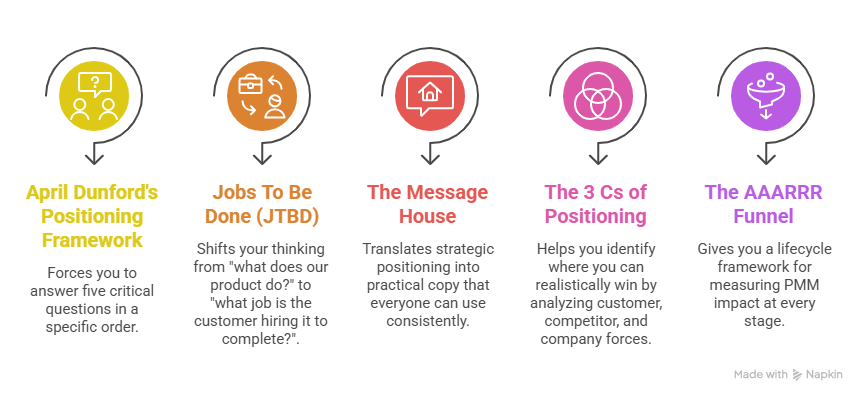
Here are the five frameworks that elite B2B SaaS teams use to crush positioning, compress sales cycles, and capture market share.
April Dunford's Positioning Framework
If you only learn one positioning framework, make it this one. April Dunford's approach forces you to answer five critical questions in a specific order:
- Competitive alternatives: What would customers use if your product didn't exist? This isn't just direct competitors; it's spreadsheets, manual processes, or doing nothing at all.
- Unique attributes: What capabilities do you have that alternatives don't? Be specific. "Better UX" isn't an attribute; "real-time collaborative editing in the browser" is.
- Value and proof: What quantifiable outcomes do those unique attributes deliver? Don't just claim value; back it up with customer data, case studies, or benchmarks.
- Target market (ICP): Who cares most about that specific value? Define them by firmographics, technographics, and buying triggers, not vague demographics.
- Market category: What mental "box" do buyers use to classify your software? This sets expectations for pricing, features, and competitors.
Here's the key insight most teams miss: you need to do these in order. If you start with a category before understanding your unique value, you'll default to generic positioning that sounds like everyone else.
- When to use it: During product pivots, when entering new markets, or when win/loss data shows deals stalling in "no decision" because buyers are confused.
- Pro tip: For companies targeting multiple segments, use a core-plus-layer model. Keep your core positioning stable, then add segment-specific layers that emphasize different proof points, pain points, or time-to-value claims depending on who you're talking to.
Jobs To Be Done (JTBD)
The JTBD framework shifts your thinking from "what does our product do?" to "what job is the customer hiring it to complete?"
This matters because customers don't buy software; they hire it to solve a problem. Understanding the job helps you craft messaging that resonates at a deeper level than feature lists ever could.
A good Job Story follows this structure:
When [situation], I want to [motivation], so I can [desired outcome].
Example: "When I'm preparing for a board meeting, I want to quickly pull revenue data without pestering my finance team, so I can feel confident and in control during the presentation."
Notice how this captures three dimensions:
- Functional job: Pull revenue data quickly
- Emotional job: Feel confident and in control
- Social job: Not bother the finance team (and look competent to the board)
- When to use it: In mature, crowded markets where features look identical across competitors. JTBD helps you uncover unmet workflow needs and reframe your messaging from feature-led to outcome-driven.
The Message House
The Message House translates strategic positioning into practical copy that everyone, from sales to PR to your website team, can use consistently.
Think of it like an actual house:
- The Roof (Core Value Proposition): One sentence that captures the transformation your product delivers. This is what goes on your homepage hero section.
- The Walls (3-5 Value Pillars): Supporting benefits that explain how you deliver that transformation. These become your feature page headlines.
- The Foundation (Proof Points): Specific data, customer quotes, and features that validate each pillar. These are what sales reps pull into pitch decks.
- When to use it: Before any major launch (Tier 1 or Tier 2) to align everyone on messaging. It prevents the dreaded scenario where your website says one thing, sales says another, and your CEO goes rogue with a third narrative in press interviews.
The 3 Cs of Positioning
This classic framework helps you identify where you can realistically win by analyzing three forces:
- Customer: Deep dive into target profiles, buying criteria, workflows, and decision-making committees.
- Competitor: Evaluate direct and indirect competitors' positioning, pricing, features, and market penetration, then find the gaps.
- Company (and Channels): Honest assessment of your capabilities, differentiators, and constraints, plus your distribution channels (self-serve, partners, enterprise sales, etc.).
The magic happens when you overlay all three in a Venn diagram. Your sweet spot is where customer needs, competitive gaps, and your unique capabilities overlap.
- When to use it: During initial market entry, annual strategy reviews, or when facing a sudden drop in win rates to a new competitor.
The AAARRR Funnel (Pirate Metrics)
The AAARRR funnel (Awareness, Acquisition, Activation, Retention, Referral, Revenue) gives you a lifecycle framework for measuring PMM impact at every stage.
Here's what PMM owns at each stage:
- Awareness: Problem-focused guides, category positioning, thought leadership
- Acquisition: Solution pages, product tours, conversion copy
- Activation: Onboarding guides, welcome sequences, "aha moment" design
- Retention: Feature release notes, change logs, continuous education
- Referral: Customer stories, community templates, advocate programs
- Revenue: Pricing optimization, expansion messaging, upsell collateral
- When to use it: Continuously in PLG and hybrid GTM environments to identify conversion drops and optimize lifecycle campaigns.
What Does a SaaS Product Marketer Actually Do? (The Modern PMM Job Structure)
If you ask ten people what product marketing does, you'll get twelve different answers. Let's clear this up.
Modern PMMs own six core responsibility areas, and the ownership percentages have shifted dramatically in the past two years:
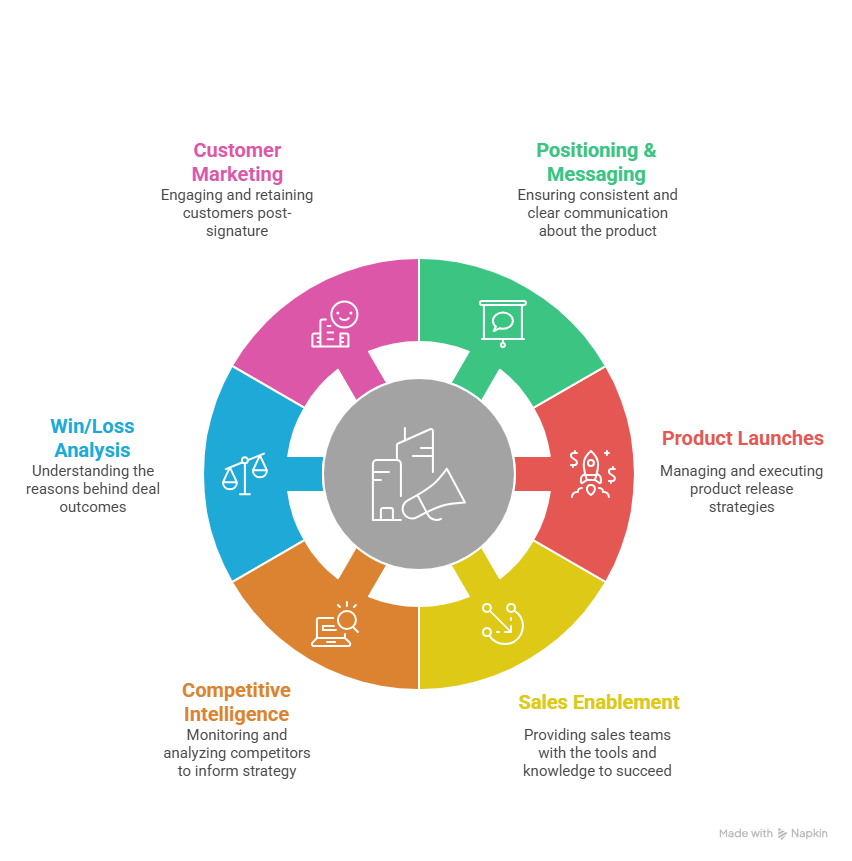
Positioning & Messaging (91% ownership)
This is the foundation. You're responsible for maintaining a single source of truth for how the company talks about itself across the website, pitch decks, sales conversations, and campaigns.
You're translating technical capabilities into business outcomes. You're making sure that when someone lands on your homepage, they instantly understand what you do and why it matters.
Product Launches (81% ownership, increasing)
Launches have evolved from one-time events into continuous, tiered processes. Here's how modern teams structure them:
- Tier 1 (Scream): Company-defining releases like platform pivots, category-creating features, or major pricing overhauls. Full press cycle, analyst briefings, custom landing pages, and multi-channel campaigns.
- Tier 2 (Shout): Significant improvements for specific segments. Targeted emails, in-app notifications, and sales enablement updates.
- Tier 3 (Cheer): Competitive parity features. Release notes, change logs, and minor tooltips.
- Tier 4 (Chirp): Backend improvements and stability patches. Automated documentation for transparency.
The key is matching launch intensity to actual impact, not treating every feature like it's going to change the world.
Sales Enablement (79% ownership, surging from 64% in 2024)
This is the fastest-growing area of PMM responsibility, and for good reason. Sales teams don't need more slides; they need strategic support.
You're building:
- Discovery playbooks that guide reps through qualification
- Objection handling matrices for common pushback
- Competitive battlecards updated in real-time
- Persona-specific pitch decks
- Interactive buyer hubs for multi-threaded deals
The PMMs who treat enablement as a strategic revenue partnership (not a ticket queue) are the ones getting promoted to VP.
Modern sales enablement solutions go beyond static PDFs. They deliver personalized, interactive content that helps reps win deals faster.
Competitive Intelligence (65% ownership, increasing)
With the barrier to building software lower than ever, new competitors pop up constantly. Your job is to act as an internal intelligence agency, monitoring competitor messaging, tracking product releases, analyzing pricing changes, and feeding defense strategies to sales and marketing.
The best teams use AI tools to automate this, so they're not manually checking competitor websites every week.
Win/Loss Analysis
Win/loss programs uncover the real reasons deals close or fall apart, not the sanitized version sales reps enter into CRMs.
When you run structured win/loss interviews, you learn what actually matters to buyers: Was our pricing off? Did a specific competitor feature sway them? Was our proof insufficient?
The data is clear: 63% of companies report win-rate increases from implementing structured win/loss programs, rising to 84% for programs running continuously for over two years.
Customer Marketing & Onboarding (38% ownership, surging from 19% in 2024)
This is the biggest structural shift in modern SaaS: PMMs taking direct ownership of post-signature metrics.
Why? Because in PLG and hybrid models, the sale doesn't end when someone signs up. You need to activate them quickly, show value fast, and prevent early churn.
PMMs are designing onboarding sequences, lifecycle campaigns, and expansion playbooks that directly impact time-to-value and net revenue retention.
Reducing early-stage churn requires strategic planning. Explore our breakdown of Gartner's churn prevention strategies to protect your retention metrics.
Real-World SaaS Product Marketing Examples (What We Can Learn from the Best)
Theory is nice. But let's look at how actual B2B SaaS companies used product marketing to scale.
Slack: Bottom-Up Viral Loops
Slack bypassed traditional enterprise IT procurement by building a viral, product-led growth engine from day one.
Their positioning was brilliant: "Where work happens" is outcome-focused, non-technical, and immediately understandable. They didn't talk about "enterprise messaging infrastructure"; they talked about getting work done.
The GTM strategy relied on a generous freemium model with zero friction. Anyone could create a workspace in seconds. And because Slack's value increases with team size, every new user became a mini sales rep pulling in colleagues.
Takeaway: If your product has network effects, design your positioning and pricing to encourage bottom-up adoption.
Figma: Designing in Public
Figma entered a market dominated by desktop-based incumbents (Adobe, Sketch) with one major differentiator: real-time browser-based collaboration.
Their PLG strategy targeted the design community with a robust free tier for individuals and students. These users became internal champions, convincing their teams to switch.
But here's the genius part: Figma encouraged designers to "design in public" by sharing templates and work via public links. Every shared design file was a viral acquisition opportunity.
Takeaway: Turn your product usage into a distribution channel. What can users share that naturally introduces non-users to your product?
Notion: Community-Driven Templates
Horizontal productivity tools often struggle with vague positioning. Notion solved this by letting the community build, share, and monetize templates.
These templates acted as long-tail landing pages, each one targeted at a specific use case (project planning, CRM, meeting notes). Instead of one generic homepage, they had thousands of entry points matching specific user intents.
They also seeded future demand by offering free premium workspaces to students. When those students graduated and entered the workforce, Notion was already part of their workflow.
Takeaway: If your product is horizontal, let your community create vertical use cases for you.
Linear: Opinionated Product-First GTM
Linear launched into a saturated market (project tracking) dominated by Jira. But instead of trying to be everything to everyone, they built for a specific user: developers who value speed, keyboard shortcuts, and beautiful design.
Their positioning is unapologetically opinionated. The "Linear Method" educates teams on running efficient sprints. They enforce keyboard-driven workflows. They integrate deeply with developer tools (GitHub, Figma, Slack).
Takeaway: In crowded markets, narrow positioning beats broad positioning. Serving one audience exceptionally well beats serving everyone poorly.
HubSpot: Category Creation Through Education
HubSpot didn't just build marketing software; they created the "Inbound Marketing" category and educated the entire market through HubSpot Academy.
Their free certifications built massive brand equity among practitioners. When those practitioners needed tools, HubSpot was the obvious choice because they'd already invested in learning the methodology.
Takeaway: Educational content that teaches a methodology (not just product features) builds category authority and a long-term pipeline.
Gong: Revenue Intelligence Repositioning
Gong started as "call recording software," a commodity feature. They repositioned themselves as "Revenue Intelligence," targeting VPs of Sales and CROs instead of individual reps.
The message shifted from compliance ("record your calls") to strategic value ("predict pipeline, coach teams, improve forecasting with objective data").
They backed this up with original research and data-driven sales insights, establishing themselves as the authoritative voice in sales execution.
Takeaway: Reframing your category and targeting higher-level buyers can completely transform your positioning and deal sizes.
Loom: Asynchronous Video Virality
Every Loom video is inherently shareable. When a user sends a video to a non-user, that recipient gets introduced to the product in the most contextual way possible, by seeing it solve a real problem.
Loom targeted specific use cases (engineering handoffs, design reviews, async education) and made sharing frictionless. Recipients often became creators within a single session.
Takeaway: If your product output is inherently shareable, lean into that as your primary acquisition channel.
If you're evaluating async video tools for your team, we've compared the top options in our Loom alternatives guide.
How AI Is Transforming Product Marketing in 2026
If you're not thinking about AI's impact on your PMM workflows, you're already behind. Here's what's changed and what you should be doing about it.
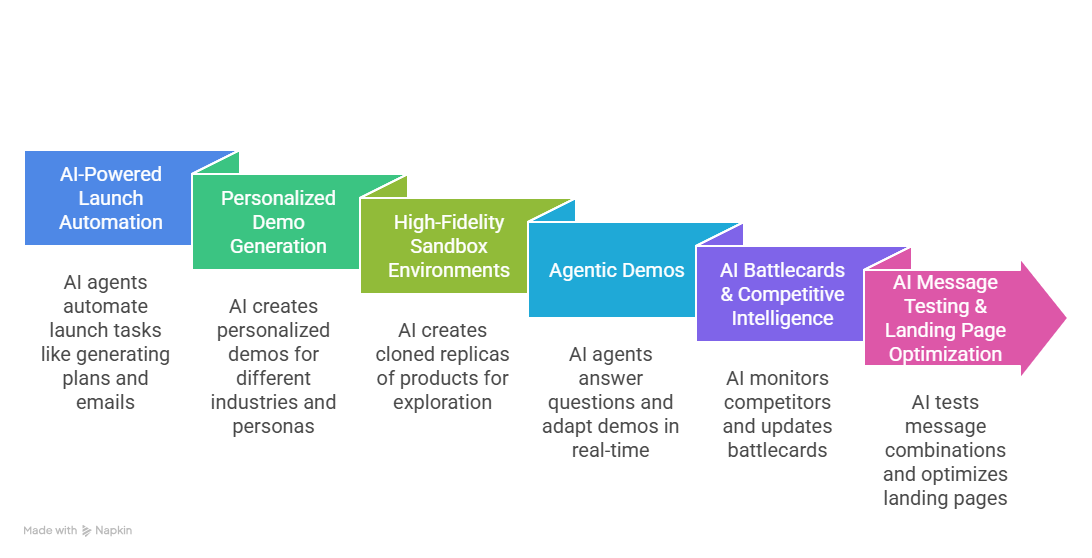
For a deeper dive into how AI is reshaping go-to-market execution, check out our guide on AI-powered GTM strategies.
AI-Powered Launch Automation
AI agents can now ingest product requirement docs (PRDs), generate launch plans, draft email sequences, and localize collateral across multiple languages in minutes.
This doesn't replace strategic thinking; it compresses execution timelines so you can focus on positioning, pricing strategy, and buyer journey design.
Personalized Demo Generation (This Is the Big One)
One of the biggest GTM bottlenecks in B2B SaaS has always been demos. Sales engineering teams can't scale personalized demos to every prospect. Static product tours don't convert because they're generic.
Enter AI-powered demo automation. There are three categories emerging:
- Generative AI Video Demos (like Puppydog.io)
- Here's how this works: You record one product walkthrough. The AI analyzes it, adds professional narration with custom avatars, generates multi-language scripts, and creates personalized versions for different industries or personas.
- The game-changer is layered editing. You can update individual frames, text overlays, or audio without re-recording everything. And when you integrate with your CRM, it auto-generates demo playlists tailored to each viewer's pain points and routes engagement data back to sales.
- Real-world impact: Companies using AI demo tools report faster pipeline velocity and higher trial-to-paid conversions because prospects see personalized value immediately, not a generic tour.
- High-Fidelity Sandbox Environments
- Tools like Demostack and Reprise create cloned replicas of your product with fake data. Buyers can explore complex workflows and run simulated processes without touching production.
- These are powerful for enterprise technical validation but cost significantly more ($55K+ annually) and require dedicated sales engineering support.
- Agentic Demos
- The newest category uses AI agents embedded directly in demo interfaces. Instead of pre-recorded paths, the AI acts as a virtual sales engineer, answering custom questions in real-time and adapting the demo based on user inputs.
Which one should you use? For most teams, generative video demos offer the best balance of scalability, personalization, and cost. Save sandbox environments for complex enterprise deals with heavy technical evaluation.
AI Battlecards & Real-Time Competitive Intelligence
Manual battlecards go stale the moment you create them. Modern teams use AI to continuously scrape competitor websites, monitor pricing changes, and analyze G2 review sentiment, then automatically update battlecards.
Even better: conversational intelligence platforms like Gong run real-time analysis during sales calls, surfacing the exact counter-arguments and proof points your rep needs to handle objections as they happen.
AI Message Testing & Landing Page Optimization
Instead of A/B testing two landing page variants, AI-driven platforms test dozens of message combinations simultaneously, analyzing engagement patterns to generate persona-specific value propositions at scale.
The data backs this up: AI-mature advertisers testing high volumes of creative variants see a 14% reduction in CAC year-over-year.
B2B SaaS Benchmarks Every PMM Should Know (2026 Edition)
Strategy without data is guesswork. Here are the benchmarks that matter.
Customer Acquisition Costs & Payback Periods
CAC has risen across the board, forcing tighter payback expectations:
Key insight: The median blended CAC payback for mid-sized private SaaS companies ($5M-$50M ARR) is now 18 months, indicating longer buyer consideration cycles.
Trial-to-Paid Conversion Rates
Conversion rates vary dramatically based on friction:
The takeaway: Requiring a credit card upfront filters for high-intent buyers, increasing median conversion from 3% to 34%. And product-qualified leads (PQLs) convert 5-6x better than marketing-qualified leads (MQLs).
Understanding how to identify and prioritize product-qualified leads is crucial. Learn more in our ultimate guide to lead qualification.
Win Rates & Demo Performance
Average B2B SaaS win rates have declined to 19%, down from 23% in 2022. But there are massive variance drivers:
- Advocate-led deals (where the buyer previously used your product elsewhere): 49% win rate, a 2.6x multiplier
- Product-qualified leads: 20-30% close rate vs. 2-5% for MQLs
- Deals with personalized demos: Significantly higher conversion than generic tours
PMM Team Ratios
The median PMM-to-Product Manager ratio is 1:4. But here's what matters: top-quartile revenue growth companies run 25-30% higher PMM density, closer to 1 PMM for every 1.6 PMs.
This translates to roughly 1 PMM per 13 engineers at high-growth companies, vs. 1 per 32 engineers at average performers.
Translation: High performers invest more in product marketing relative to engineering, enabling deeper strategic work instead of treating PMMs as a "launch factory."
The Essential PMM Tech Stack for 2026
You can't run modern product marketing with spreadsheets and Slack. Here's the stack that high-performing teams use.
Analytics & Research
- Userpilot: In-app user tracking, cohort segmentation, and onboarding guide creation. Best for PLG and mid-market SaaS, minimizing time-to-value.
- Gainsight: Customer health scoring, expansion triggers, LTV forecasting. Built for enterprise SaaS with dedicated CS teams.
- ChurnZero: Real-time engagement dashboards, churn risk triggers, usage-based upselling. Perfect for PLG with high-volume accounts.
Competitive Intelligence & Collaboration
- Kompyte: Automated competitor tracking, feature monitoring, dynamic battlecard compilation. Essential in saturated markets.
- Slack: Cross-functional collaboration, decision logging, system alerts. Still the default for GTM team coordination.
- Notion: Living documentation, template libraries, launch trackers. Great for mapping GTM sequences and sharing competitive intel.
Demo Automation (Where Puppydog.io Shines)
Why Puppydog.io stands out: Unlike sandbox tools that require heavy engineering support, Puppydog turns one screen recording into unlimited personalized video demos. The AI handles narration, multi-language scripts, and CRM integration, making it accessible for teams without dedicated demo engineers.
Use it for product launches (create tailored videos for each segment), sales enablement (arm reps with persona-specific demos), and customer marketing (show different use cases to different accounts).
Ready to transform your product demos? Start creating personalized, AI-powered demo videos with our product demo video maker today.
Actionable Takeaways: What to Do This Week
Theory is great. Here's what you should actually do:
- Audit your positioning using April Dunford's framework. Block two hours and answer the five questions in order. If you can't clearly articulate your unique attributes or the value they deliver, you have a positioning problem.
- Check your PMM-to-PM ratio. If it's worse than 1:4, you're probably spread too thin to do strategic work. Make the case for additional headcount by showing how PMM density correlates with revenue growth.
- Implement AI demo automation. Start with one use case, like creating personalized demo videos for your top three buyer personas. Tools like Puppydog.io let you test this without a heavy engineering lift.
- Set up a continuous win/loss program. Interview 3-5 recent wins and 3-5 losses every month. Track themes. Adjust positioning and enablement based on what you learn.
- Shift content budget toward bottom-of-funnel search. Stop writing generic "what is [category]" posts. Create comparison pages, vertical-specific solutions, and interactive tools (ROI calculators, templates) that capture high-intent buyers.
Frequently Asked Questions
Q: What does a SaaS product marketer actually do day-to-day?
A: A SaaS product marketer wears many hats, but the core responsibilities include positioning and messaging (making sure the company has a clear, consistent story), managing product launches (from major releases to minor updates), creating sales enablement materials (battlecards, pitch decks, objection handlers), running competitive intelligence, conducting win/loss analysis, and increasingly, owning customer onboarding and lifecycle marketing. Day-to-day, you're probably writing messaging, meeting with product and sales teams, analyzing market data, or building launch plans.
Q: How do I build a B2B SaaS go-to-market strategy from scratch?
A: Start with positioning: understand your competitive alternatives, unique attributes, and target ICP using frameworks like April Dunford's model. Then map your buyer journey and identify which GTM motion fits (PLG, sales-led, or hybrid). Build your Message House to align all teams on core value props. Choose your launch tiers and sales enablement approach. Set up tracking for key metrics (CAC, win rate, trial-to-paid conversion). And continuously test and iterate based on win/loss data and market feedback.
Q: What's the difference between product marketing and product management?
A: Product managers decide what to build and prioritize the roadmap based on user needs and business goals. Product marketers take what's been built and position it, message it, and enable sales and marketing teams to actually sell it. PM owns the product; PMM owns how the market understands and buys the product. Both roles collaborate closely, but PM is product-focused while PMM is market-focused.
Q: How do I write effective SaaS positioning that differentiates my product?
A: Effective positioning answers five questions clearly: What would customers use instead of you? What unique capabilities do you have that alternatives lack? What quantifiable value do those capabilities deliver? Who cares most about that specific value? What category does your product fit into? Use April Dunford's framework, avoid generic claims, back up every value statement with proof, and test your positioning with real customers through win/loss interviews.
Q: What are the best product marketing tools for B2B SaaS in 2026?
A: The essential stack includes: analytics tools like Userpilot or Gainsight for tracking activation and retention, competitive intelligence tools like Kompyte for automated competitor monitoring, collaboration platforms like Notion and Slack for team coordination, and demo automation tools like Puppydog.io for creating personalized product videos at scale. Add conversational intelligence platforms like Gong for sales enablement and win/loss analysis.
Q: How do I measure product marketing success and impact?
A: Track these metrics: win rate (are deals closing at higher rates after positioning changes?), sales cycle length (is enablement compressing deal velocity?), trial-to-paid conversion (is onboarding working?), CAC payback period (is positioning attracting the right buyers?), and sales engagement with your materials (are reps actually using what you create?). Also run regular win/loss analysis and NPS surveys to get qualitative feedback.
Q: What skills does a product marketing manager need in 2026?
A: Core skills include strategic positioning and messaging, market research and buyer psychology, sales enablement and storytelling, data analysis and metrics tracking, cross-functional collaboration, and increasingly, AI fluency. You need to understand how to use AI tools for demo creation, competitive intelligence, and content generation. Strong writing, presentation skills, and the ability to translate technical features into business outcomes are non-negotiable.
Q: How is AI changing product marketing?
A: AI is automating time-consuming tasks like creating personalized demo videos, updating competitive battlecards in real-time, generating multi-language launch materials, and testing dozens of message variants simultaneously. This frees PMMs to focus on strategic work like positioning, buyer journey design, and revenue enablement. AI-powered demo tools like Puppydog.io let you create unlimited personalized product walkthroughs from a single recording, while competitive intelligence platforms automatically track competitor changes.
Q: How do I run a successful product launch in B2B SaaS?
A: Use a tiered launch framework: Tier 1 for major releases (full press cycle, custom landing pages, multi-channel campaigns), Tier 2 for significant segment-specific improvements (targeted emails, sales enablement updates), Tier 3 for competitive parity features (release notes, change logs), and Tier 4 for backend improvements (automated documentation). Build your Message House first, align cross-functional teams, create role-specific enablement materials, and set clear success metrics before launch day.
Q: What's the ideal PMM-to-PM ratio for a SaaS company?
A: The median is 1 PMM for every 4 product managers, but high-growth companies run closer to 1:1.6 or 1:2, about 25-30% higher PMM density. This translates to roughly 1 PMM per 13 engineers at top performers vs. 1 per 32 at average companies. Higher PMM density enables deeper customer research, more strategic enablement, and prevents product marketing from becoming just a "launch factory."

Sarah Thompson is a storyteller at heart and Business Developer at PuppyDog.io. She’s passionate about creating meaningful content that connects people with ideas, especially where technology and creativity meet.