Build a SaaS Video Marketing Funnel Around Customer Questions


A video marketing funnel works best when each video answers one question a buyer has at that moment. Make a short video for first visits, a workflow video for evaluation, and a quick task video for trial activation. Then link each one to the next logical step and measure each stage on its own.
You probably have a few videos already. A brand clip on the homepage, a demo on the pricing page, a help video buried in your docs.
Then a first-time visitor lands on a six-minute walkthrough, and a new trial user gets a brand teaser. Good videos, wrong audience. A video marketing funnel fixes that by starting with the questions buyers ask, not the videos you want to make.
How do you define a SaaS video funnel?
A SaaS video funnel is a small set of videos, each built for one stage of the buyer's path and one question. This guide covers three stages: first visit, evaluation and trial activation. Paid customer retention is a different job, so it stays out of this article.
Why start with questions? Buyers don't walk in a straight line. Gartner describes the B2B buying journey as non-linear, with buyers revisiting tasks, and it recommends content that helps them finish those tasks on their own.
The three questions look like this:
- First visit: What problem does this fix, and what could my result look like?
- Evaluation: How does it work, and will it fit what we need?
- Trial activation: What do I do right now to get my first win?
For the broad case for demos across the funnel, read our Related guide. Here we stick to the map and the rules.
What should an awareness product video answer?
One question: what problem does this fix, and what could a better day look like?
Open on the pain, not your logo. Then show one visible result in the first few seconds, like a finished report or a paid invoice. Skip the full walkthrough. No settings menus, no pricing tiers, no long feature list.
Picture a fictional invoicing tool called LedgerLeaf. Its first-visit video opens on a freelancer chasing a late payment, then cuts to an invoice marked paid. Two scenes, one result. (Illustrative, not a tested example.)
A new visitor wants to know you understand their problem, not to study your interface. I'd keep this video under a minute, though that's my rule of thumb, not a proven number.
What should an evaluation product video prove?
That the product can do the job. The buyer's question is sharper now: can it do this specific thing we need?
Show the core workflow from start to finish, on real screens. Pick one buying question and answer it. For LedgerLeaf, that might be setting up recurring invoices without a spreadsheet. For extras like pricing or security, link to the product page instead of cramming it all in.
This is where PuppyDog fits. You give it approved source assets, like screen recordings or screenshots, and it builds a product video with a script you review and narration. It's professional product videos without a production team. You still decide what the video must prove.
What should a trial activation video help users do?
Finish one real task, the first one that delivers value. ProductLed calls that moment the First Strike, and it defines straight-line onboarding as the fewest steps needed to reach it. Its piece on AI onboarding sets 60-seconds-to-value as the bar.
So pick that first task and list what users need before they start, like a file, a connected account or sample data. Then make a short video for just that task. Skip the general product tour. Tours feel helpful, but they rarely get anyone to a first win.
For LedgerLeaf, the task is sending a first invoice. The prerequisites are a client name and one line item. The video runs about 45 seconds. Illustrative again.
How do you design the video funnel handoff?
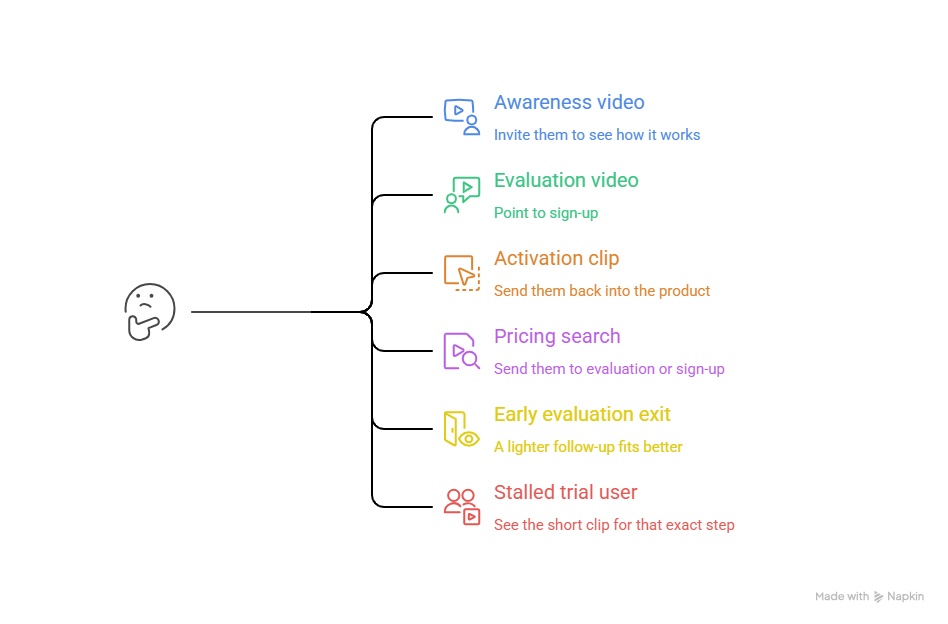
A handoff is what happens when the video ends. Match each call to action to the viewer's next question and a real destination. After the awareness video, invite them to see how it works. After the evaluation video, point to sign-up. After the activation clip, send them back into the product.
Then add skip rules. Someone who arrives from a pricing search doesn't need the problem video, so send them to evaluation or sign-up. Someone who leaves an evaluation video early shouldn't get a hard sales push. A lighter follow-up fits better. A trial user who stalls on the first task should see the short clip for that exact step.
These are starting points to test, not proven rules. Honestly, I'd write the skip rules before filming anything. They tell you how many videos you really need.
How do you handle video funnel measurement?
Use a different denominator at each stage, or the numbers will mislead you.
- Visitors: play rate, which is plays divided by page loads. It shows whether the video earns a click on that page.
- Viewers: call-to-action click-through, which is clicks divided by the people who actually saw the call to action. Divide by all page visitors and you'll blame the button for a pacing problem.
- Trial users: activation rate, which is users who finish the first task divided by all new trial accounts. Don't divide by video viewers only. People who watch help videos tend to be the most motivated, which skews the result.
Also keep two ideas apart. Assisted engagement means viewers also converted. That's a useful clue. Incrementality asks whether the video added conversions that wouldn't have happened without it. You find that out by comparing similar traffic with and without the video.
Here is the whole journey for LedgerLeaf. It's illustrative, not a set of tested results.
FAQ
Does every funnel stage need a separate video?
Mostly yes, because each stage answers a different question and one video can't do all three jobs well. You don't have to start with three, though. Begin with the stage where buyers drop off, then add the rest.
Can one product video serve awareness and evaluation?
It can for a small team, if it opens on the problem and one result, then shows one core workflow. The risk is length, since a first-time visitor may leave before the good part. If play rates are low, split it in two.
What should happen after someone watches an evaluation video?
Send them to the step that matches their intent, usually sign-up. If they may still have questions, offer product details. Put that next step on the same page as the video.
How do I avoid measuring the whole funnel with view counts?
Give each stage its own measure and denominator: play rate for visitors, click-through for viewers who saw the call to action, and activation rate for all new trial accounts. View counts only show how often someone pressed play.
Create your first video
Your video marketing funnel doesn't need ten videos to start. Pick the one stage where buyers get stuck and build that first. With the AI product video maker, you can turn approved screen recordings or screenshots into a professional product video, with a script you review and narration, and no production team. Learn more about Product video creation, then create your first video.

Sarah Thompson is a storyteller at heart and Business Developer at PuppyDog.io. She’s passionate about creating meaningful content that connects people with ideas, especially where technology and creativity meet.


