Sales Engineer Demo Workflow: 2026 Step-by-Step Guide

Published: 15th June 2026
If you have ever spent five hours building a demo environment for a call that got rescheduled, you know the pain. The sales engineer demo workflow in 2026 does not have to look like that anymore.

What a Sales Engineer Actually Does in 2026
The sales engineer role has grown way past "the person who clicks through the product." SEs now act as technical architects. They work with product teams, security teams, customer success, and sales reps, often on the same day.
Here is the problem. The average SE spends only 56% of their time on direct sales activities like demos, discovery calls, and POCs. The other 44% goes to admin work: RFP responses, manual database setup, and technical documentation.
That workload adds up. According to a Vivun benchmark report hosted on HubSpot, companies are shifting Account Executive to SE ratios to 4:1 to protect technical bandwidth. In tougher technical spaces like cybersecurity or data pipelines, that ratio drops to 2:1 or 3:1.
The result of all this admin overload? Burnout. The share of SEs reporting zero burnout symptoms fell from 20% in 2025 to just 11.8% in 2026, while almost 30% report ongoing burnout or job dissatisfaction. A tighter sales engineer workflow is not just nice to have. It is what keeps good people from quitting.
If you want a deeper look at what the role demands day to day, check out our guide on sales engineer skills.
The 5-Step Sales Engineer Demo Workflow
A modern technical demo process runs in five connected steps. Skip one, and the rest gets harder. Here is how each stage works.
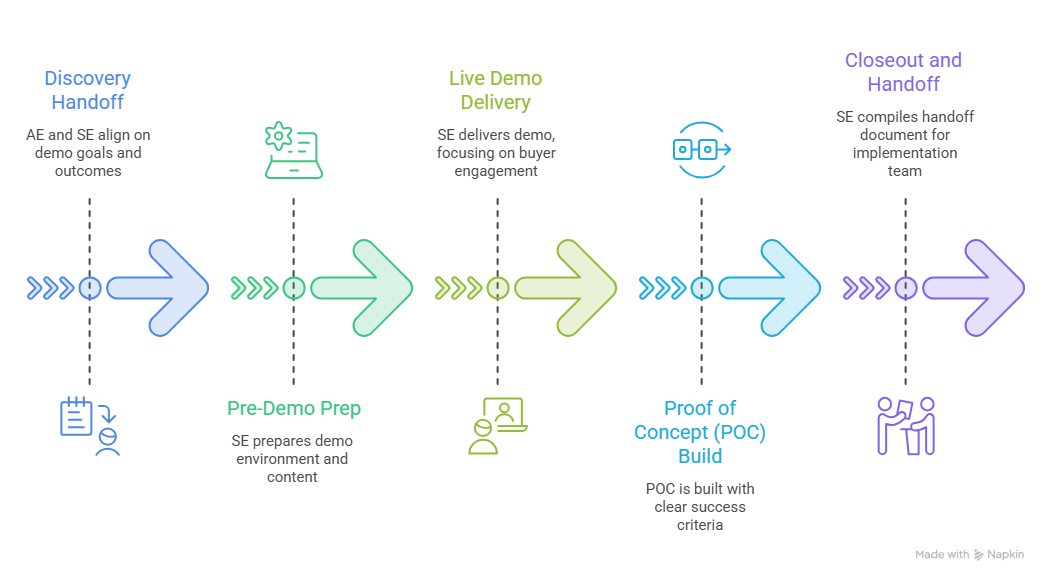
Step 1: Discovery Handoff
Snippet: Most demo failures start before the demo even begins.
Nearly 37% of enterprise demos get shown to leads that are not actually qualified. That is a lot of wasted hours.
Before any demo gets built, the AE and SE should hold a short pre-call to align on three things:
- Purpose and goals: What does a "win" look like for this meeting?
- Expected outcomes: What is the minimum result, and what is the best case?
- Core message: What is the one thing the buyer needs to remember after the call?
This sounds basic, but 73% of sales cycles run on thin or informal discovery. That gap is a major reason deals stall later. This stage should take 30 to 60 minutes, combining the AE/SE sync with a quick CRM review.
Step 2: Pre-Demo Prep
Snippet: This is where most SEs lose their time, and where AI tools save the most of it.
Up to 28% of SEs spend six or more hours preparing for a single demo. Most of that time goes to building fake data, swapping logos, and configuring environments by hand.
There are two main ways to build a demo environment:
- Screenshot or HTML capture (Walnut, Storylane): Takes 15 to 20 minutes. Great for visual customization like swapping in a prospect's logo or company name.
- Full frontend cloning (Demostack, Guideflow): Best for complex products like data pipelines or security tools, where buyers need to see live data and real backend responses.
This is also where Puppydog.io fits in. For a SaaS demo for sales engineers that needs to feel personal at scale, Puppydog.io generates pixel-perfect, personalized demo videos from screen recordings or screenshots, without manual editing for every prospect.
Want to know what skills make this step go faster? Our post on presales engineer skills covers the tools and habits that matter most.
Step 3: Live Demo Delivery
Snippet: You have about 90 seconds to earn the buyer's attention. Use them well.
Here is a stat that should change how you open every call: the average demo runs 15.23 minutes, but buyers only stay engaged for 5.23 minutes. That is a huge gap.
The fix is a method called "Do the Last Thing First." Instead of starting with setup screens, open by showing the finished result. A clean dashboard. A completed report. The thing the buyer actually wants.
Then work backward, and connect every feature to a number. For example:
"You mentioned your team spends 10 hours a week on manual data entry. This automation removes that completely, giving your team back 40 hours a month."
Build in checkpoints every 3 to 5 minutes too. Ask things like, "Does this match how your team works today?" This turns a one-way presentation into a real conversation. Plan for 30 to 45 minutes of live delivery.
Step 4: Proof of Concept (POC) Build
Snippet: A POC without written success criteria is just a free trial with extra steps.
The POC stage is the longest part of the cycle, often running 4 to 8 weeks. It is also where deals slip the most.
To keep things on track, lock in written, measurable success criteria before you provision anything. Skip vague goals like "test performance." Instead, write something like: "The system scans and classifies 10,000 files in under 30 minutes."
Set a strict timeline (2 to 4 weeks works well), and use guided sandbox platforms like Instruqt or TestBox to track engagement. If a buyer stops logging in, you want to know fast, not three weeks later. Plan for 3 to 5 hours of oversight per week during this stage. This is the heart of any solid POC for sales teams.
Step 5: Closeout and Handoff
Snippet: The sale is not done until the implementation team knows what was promised.
A lot of post-sale friction happens because delivery teams have no idea what the SE promised during the sales process. To prevent that, compile a handoff document that includes:
- Technical assumptions, data schemas, and architecture notes
- Integrations, API endpoints, and security requirements
- The exact success criteria validated during the POC
Also map "contract trace links," which connect contract commitments to the actual configurations you built. This step usually takes 1 to 2 hours, and it can save weeks of confusion down the road. For more on where things tend to break down, see our piece on presales team challenges.
The Best Tools at Each Stage
A quick note on Puppydog.io: it sits in a useful spot between simple screenshot tools and full sandbox clones. It works well for outbound personalization, with reported response rates up to 55% on cold campaigns, according to G2 reviews.
How to Cut Demo Prep From 5 Hours to 30 Minutes
The old workflow looks like this: manual database setup (120 minutes), data cleanup (90 minutes), script writing (60 minutes), and handoff alignment (30 minutes). That is 5 hours, easy.
The new workflow looks more like this: AI deal brief (5 minutes), CRM variable sync (5 minutes), modular demo playlist (20 minutes). That is 30 minutes total.
Here is how teams get there:
- Use async product tours first. Let prospects self-educate with tools like Consensus or Storylane before an SE ever joins the call. This protects your most skilled people for late-stage work.
- Automate personalization with CRM variables. Instead of manually swapping logos and company names, use dynamic fields like {{companyName}} that auto-fill across templates. This alone can lift conversion by 40% to 50%.
- Build a library of micro-demos. Create 30 to 60-second clips tagged by feature, industry, and persona. Mix and match them into a custom playlist for each deal.
- Ground your AI tools in real data. Platforms like SiftHub can auto-fill security RFPs with a 90% completion rate, saving 8 or more hours per week.
One Instruqt benchmark found teams cut prep time by 60% and doubled their POC completion rate using this approach. Another study from Consensus reported over 240,000 hours reclaimed across enterprise accounts, worth roughly $40 million in cost-per-demo savings.
The Sales Engineer Demo Checklist
Before the demo:
- Map the stakeholders attending (economic buyer, technical evaluator, champion)
- Confirm discovery fields are filled in your CRM
- Agree on the single "win" for this meeting
- Check that your sandbox has no live customer data
- Review your objection guide for security and integration questions
During the demo:
- Show the end result first, within 90 seconds
- Tie every feature to a specific business outcome
- Pause every 3 to 5 minutes to check in with the buyer
- Tell a story, not a feature list
- End with a clear next step and a date
During the POC:
- Write down success criteria before you start
- Set a hard deadline, 2 to 4 weeks max
- Set up guided milestones for the buyer's team
- Monitor sandbox activity and follow up if usage drops
- Schedule weekly check-ins
At handoff:
- Finish your architecture documentation
- Log all assumptions and unresolved issues
- Map contract terms to actual product configurations
- Hold a formal sync with customer success
- Send a complete package: demos, docs, and compliance sheets
FAQs
How do interactive product tours compare to live technical sandboxes?
Interactive tours (Guideflow, Storylane, Walnut) use screenshots or HTML captures and take 15 to 20 minutes to build. They work well for early-stage outbound and self-guided qualification. Live sandboxes (Instruqt, Demostack, Reprise) replicate real databases and APIs with live latency. These are needed for mid-to-late stage technical evaluations, like security tools or data platforms, where buyers need to test with real data.
How can SE teams reduce scope creep during a POC?
Lock in written success criteria before provisioning anything. Make them specific and measurable, like "cut processing time from 5 days to under 48 hours." Set a strict window of 14 to 30 days, and use guided milestones so the evaluation stays focused.
What metrics measure the ROI of demo automation platforms?
Track win rate multiplier (early demo exposure averages a 72% win rate versus 59% without), sales cycle velocity (up to 19 days faster), POC completion rate (often doubles with guided sandboxes), RFP auto-fill efficiency (70-90% with tools like SiftHub), and cost per demo.
How does "Do the Last Thing First" work?
This method, from the Great Demo! framework, skips the usual intro and onboarding screens. The SE opens by showing the final result, like a finished dashboard, in the first 90 seconds. Everything after that is framed as the steps needed to reach that outcome.
How long should sales engineer demo prep take in 2026?
With modular templates, CRM-driven personalization, and AI tools, prep should take under 30 minutes per demo. Without these tools, prep often takes 5 hours or more, especially for technical products.
What is the difference between a pre-sales demo and a POC?
A pre-sales demo is a guided walkthrough, usually 30 to 45 minutes, meant to show value and build interest. A POC is a longer technical evaluation, typically 2 to 4 weeks, where the buyer's team tests the product against written success criteria in their own environment.
What ratio of AEs to SEs is normal in 2026?
A 4:1 ratio is becoming the baseline. In more technical sectors like cybersecurity or data infrastructure, companies often run 2:1 or 3:1 to give buyers deeper technical support throughout the cycle.
Conclusion
The sales engineer demo workflow has changed a lot, and honestly, it had to. Burnout was climbing, demo prep was eating entire days, and unqualified leads were draining hours that could go toward real deals. The five-step process here, from discovery handoff through closeout, gives your team a repeatable path that protects time and builds trust with buyers.

Sarah Thompson is a storyteller at heart and Business Developer at PuppyDog.io. She’s passionate about creating meaningful content that connects people with ideas, especially where technology and creativity meet.