B2B Go-to-Market Strategy: A 2026 Guide


Published 24 July 2026
Go-To-Market strategy has become one of those phrases that gets slapped on everything from a slide deck to a launch email. But a real B2B go-to-market strategy is a lot more specific than that, and in 2026, getting it wrong is expensive in ways it wasn't five years ago.
Buying committees are bigger. Buyers do most of their research before they'll even take your call. And the sales rep who used to control the narrative? They're now competing for maybe 5% of a prospect's attention. So what actually works this year, and how does something as simple as a personalized demo fit into it? Let's dig in.
What Is a B2B Go-to-Market Strategy?
A B2B go-to-market strategy is the operational blueprint for commercializing a product to a defined business audience. It's not a marketing plan, and it's not a sales playbook. It's the connective tissue between the two, plus product, customer success, and pricing.
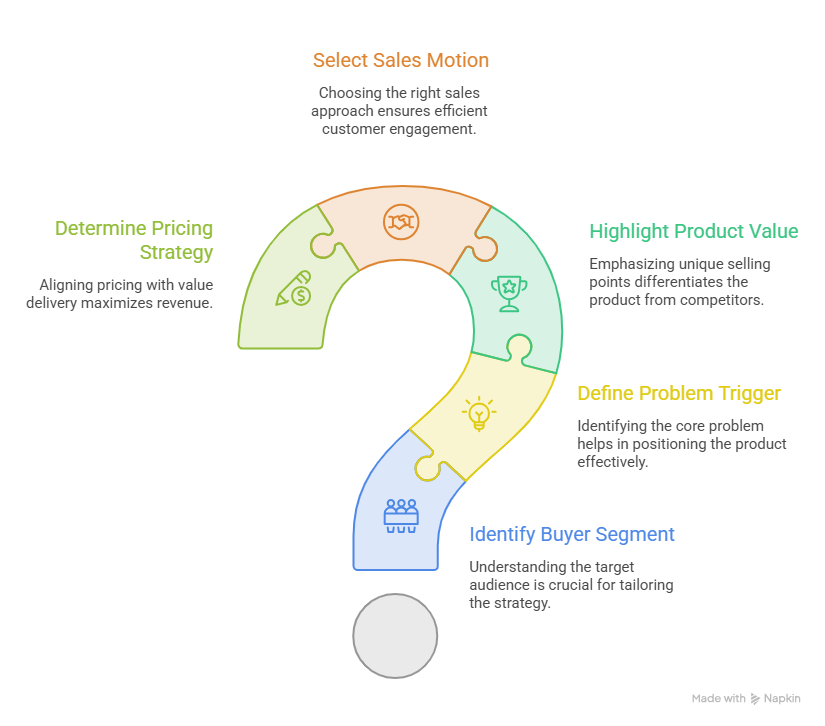
At its core, a solid GTM strategy answers five questions:
- Who is the buyer segment?
- What problem triggers the purchase?
- Why is your product the best answer, versus the alternatives?
- Which sales motion fits the complexity of that purchase?
- How does pricing capture and deliver value?
That's really the go-to-market meaning in a nutshell. It's the system, not the department. Traditional marketing strategy chases long-term brand equity and top-of-funnel visibility. Traditional sales strategy is transactional, focused on this quarter's quota. GTM marketing ties both to product and revenue outcomes, which is exactly why it can't live in one silo.
Here's the uncomfortable part: most of what breaks a GTM motion doesn't happen at launch. It happens in the handoffs the gap between what marketing promises and what sales can actually deliver.
If you're specifically running SaaS GTM, this guide digs into the nuances.
Sales-Marketing Alignment: The Make-or-Break Factor
If there's one variable that predicts whether a B2B GTM strategy will work, it's alignment between sales and marketing. The data on this is almost too dramatic to be believable, except it keeps showing up study after study.
Companies with genuinely integrated sales and marketing functions see 208% higher revenue from their marketing programs and grow revenue about 20% a year. Stretch that out three years, and aligned organizations post 24% faster revenue growth and 27% faster profit growth than their disjointed competitors. On the pipeline side, aligned teams are 67% more effective at closing deals and see win rates jump 38%.
Now flip it around. Misalignment isn't just a minor inefficiency. It's a leak in the hull. Siloed sales and marketing functions drain more than $100 billion a year in lost B2B revenue. Roughly 79% of marketing-qualified leads never convert to sales, and sales teams simply never follow up on about 73% of the leads marketing hands them, mostly because nobody agreed on what "qualified" actually means.
The knock-on effects pile up fast:
- Customer acquisition costs rise by up to 36%
- Sales cycles stretch by roughly 30%
- Reps burn half their prospecting time chasing accounts that were never going to buy
When teams are asked why alignment breaks down, the answers are refreshingly unglamorous: 41% blame poor communication, 39% point to disconnected tools, and 34% say they simply can't share customer data cleanly between systems. None of that requires a genius fix. It requires shared definitions, shared metrics, and content both teams can actually use (including, yes, demos).
Mapping the Buying Committee and Their Demo Needs
Here's where B2B GTM starts to look nothing like B2C. You're not selling to a person. You're selling to a committee, and that committee has gotten a lot bigger.
The average B2B purchase now involves 13 internal stakeholders and 9 external participants. If the deal involves generative AI capabilities, that buying group roughly doubles again. And these aren't rubber-stamp approvals. 74% of buying committees report real internal conflict during the decision process, largely because each stakeholder does their own research and shows up with a different mental model of the solution. Unsurprisingly, 86% of enterprise purchases stall at some point, and 81% of buyers end up dissatisfied with whatever vendor they eventually pick.
You might be wondering: who exactly are you supposed to be talking to on one of these committees? A few recurring personas:
- The CFO, who holds final sign-off in nearly 8 out of 10 deals and rejects anything without a defensible ROI case
- Procurement, involved from the earliest stages in over half of all B2B deals, focused on compliance and contract terms
- Technical evaluators / IT, who care about security, data privacy, and whether your product plays nicely with existing systems
- End users and internal champions, who need to build consensus fast and often can't articulate your value to skeptical colleagues without real collateral in hand
Here's the twist that makes GTM in 2026 genuinely different: buyers now complete 60% to 70% of their evaluation on their own, before a rep is even looped in. They spend only about 17% of their total evaluation time actually meeting with vendors, and when they're comparing multiple options, each rep gets maybe 5% to 6% of their attention. It's not that buyers don't want help. 75% actually say they'd prefer a rep-free experience for at least part of the journey. They just want proof, on their own schedule, that they can hand to the rest of the committee.
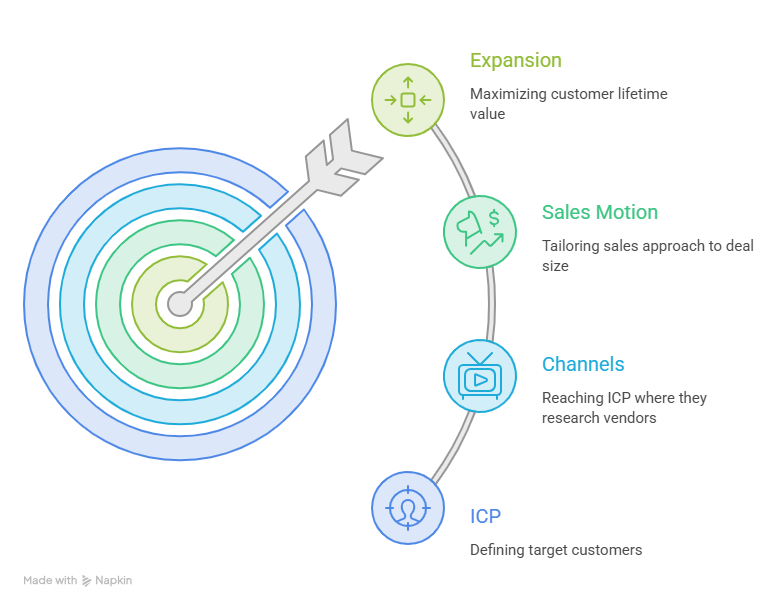
The B2B GTM Framework: ICP → Channels → Sales Motion → Expansion
A workable GTM framework doesn't need to be complicated, but it does need to move in order. Skip a step and the whole thing gets shaky.
1. Ideal Customer Profile (ICP).
Everything downstream depends on this. Frameworks like GTM Partners' MOVE system start here for a reason. You can't scale demand generation or pick a sales motion until you know exactly who you're targeting and what "good fit" looks like on paper.
2. Channels.
Where does your ICP actually go to research vendors? In 2026, that increasingly includes AI chatbots. 17.1% of B2B buyers now say a GenAI tool influenced their vendor shortlist, edging out traditional vendor websites at 12.8%. Ignoring that shift is like ignoring Google search was in 2010.
3. Sales motion.
Self-serve (PLG), sales-led, or a hybrid the right motion depends on deal size and buying complexity. This is also where the Bowtie Model from Winning by Design is genuinely useful: it treats the customer lifecycle as symmetrical, with acquisition (lead gen through close) on one side and retention/expansion (onboarding through renewal) on the other, connected by a single "commitment knot" the moment the deal closes. Want to see this play out in practice? Check out these real GTM strategy examples.
4. Expansion.
This is the part legacy GTM thinking underweights. Under old perpetual-license software, 60% of lifetime revenue landed at the initial sale. In today's subscription world, that number flips. Only 18% of customer lifetime value is captured at the initial win. The other 82% comes from renewal, adoption, and expansion. If your GTM strategy stops at "closed-won," you're leaving most of the value on the table.
Personalized Demos for Every Stakeholder
This is where a lot of GTM strategies quietly fall apart in execution. You've mapped the committee, you understand the framework. But how does one AE actually reach a CFO, a procurement lead, an IT evaluator, and three end users, all without cloning themselves?
The honest answer for most teams right now: they don't. Live demos are expensive to produce. Solutions Engineers spend an average of 3.6 hours prepping a standard customized demo, and up to 7 hours for a custom sandbox proof-of-concept. With one SE typically supporting 3 to 5 AEs, and 94% of SEs saying they're stuck delivering repetitive, generic walkthroughs, something has to give. Usually, it's stakeholder coverage. Reps just don't have the bandwidth to demo to everyone who needs to see the product.
This is exactly the gap personalized demo automation closes. Interactive, self-serve product tours drive a 32% average lift in conversion versus a static screen share. Placed at the top of the funnel, they lift conversion 18% to 24%; used as personalized, account-specific flows during active evaluation, they push close rates up 38% to 45%.
And the multithreading effect is where the real win shows up. Single-threaded deals with one contact, no committee coverage, close at just 5%. Deals with five or more engaged stakeholders close at 30%, a 6x improvement. Since 83% of buyers have already defined their technical requirements before they ever talk to a rep, giving your champion something personalized and shareable to send to the rest of the committee isn't a nice-to-have anymore. It's how deals actually get won.
This is precisely the problem PuppyDog was built to solve. Instead of one generic demo for everyone, you record a screen walkthrough once and generate a personalized demo video for each persona. A financial-impact cut for the CFO, a security-and-integration cut for IT, a workflow cut for the end user. All from the same source material. It plugs directly into your sales enablement motion, letting champions multithread the committee without your SEs pulling another all-nighter, and it works just as well for upsell and cross-sell motions once the account is live.
Measuring B2B GTM Success
You can't manage what you don't measure, and B2B GTM has a specific set of metrics worth tracking beyond the usual MQL count.
- Pipeline velocity: how fast revenue actually moves through your funnel, combining opportunity count, win rate, deal size, and cycle length into one number. Shortening your sales cycle by even 10% can lift daily pipeline velocity by more than 11%.
- CAC payback period: how many months it takes to recoup what you spent acquiring a customer. Benchmarks vary a lot by segment: under 12 months for SMB/PLG motions, 14–18 months mid-market, 18–24 months enterprise.
- Net Revenue Retention (NRR): the percentage of recurring revenue retained (and expanded) from an existing customer cohort. Enterprise teams should be targeting 115–125%.
- CAC-to-ACV ratio: sanity-checks whether your acquisition spend actually fits your sales motion. A PLG company spending $500 to acquire a $5,000 customer is in great shape (10% ratio). A sales-led team spending $20,000 to land that same $5,000 customer is structurally broken. That math takes four years just to break even.
None of these metrics live in a vacuum, either. RevOps exists precisely to keep them consistent across marketing, sales, and customer success, which loops right back to the alignment problem we started with.
FAQs
What is a B2B go-to-market strategy?
A B2B GTM strategy is the plan for selling a product to other businesses, aligning sales and marketing around a defined ICP and buying committee. It connects product positioning, channel selection, sales motion, and pricing into one coordinated system rather than treating each as a separate function.
How is B2B GTM different from B2C?
B2B involves longer cycles, multiple decision-makers, and higher-touch sales, making personalized demos and alignment more important. Where a B2C purchase might be decided by one person in minutes, a B2B deal can involve 20+ stakeholders across months, each with different priorities and objections.
How do you align sales and marketing in GTM?
Align them with a shared ICP, shared metrics, and shared content, including demos both teams can send. That last part matters more than it sounds: a personalized demo a marketer builds for a campaign should be the same asset an AE can hand off mid-deal, not two disconnected pieces of content.
The Bottom Line
A B2B go-to-market strategy in 2026 isn't won by whoever produces the most content or books the most demos; it's won by whoever gets the right proof in front of the right person on the buying committee, fast, without burning out their sales engineering team in the process.
If your reps are still trying to cover a 13-person committee with one generic demo, you already know how that story ends. Give every stakeholder their own personalized version instead. Try PuppyDog's Product Demo Video Maker and see how fast a multithreaded deal actually moves.

Sarah Thompson is a storyteller at heart and Business Developer at PuppyDog.io. She’s passionate about creating meaningful content that connects people with ideas, especially where technology and creativity meet.