How-To Video vs Product Demo: Which One Should You Send and When


There's a mistake a lot of SaaS teams make, and it costs them more than they realize.
They spend weeks perfecting a product demo. The script is tight, the visuals are polished, and it converts like a dream. New users sign up. The pipeline grows. Everyone's happy.
Then, three months later, churn creeps in. Users aren't adopting features. Support tickets pile up. Customers who seemed excited during the demo are now quietly canceling.
Here's what went wrong: the demo got people in the door, but nobody showed them around the house. The fix isn't complicated. It starts with understanding the difference between a product demo and a how-to video and knowing exactly when each one belongs in your customer journey.
The Core Difference: Persuasion vs. Proficiency
Let's be honest, these two formats get lumped together all the time. Both involve a screen recording. Both show your product. But their jobs are completely different.
A product demo is a sales asset. It's built for prospects who haven't bought yet. Its entire job is to show why your product matters, to create desire, reduce skepticism, and move someone closer to a "yes." It's narrative-driven, polished, and focused on outcomes, not instructions.
A how-to video is a customer success asset. It's built for users who have already bought and need to know how to do something specific. Think: "How do I invite my team?" or "How do I connect this to my CRM?" It's direct, task-focused, and designed to reduce friction, not sell anything.
One is about desire. The other is about competence. Confuse the two, and you'll either bore your prospects with step-by-step instructions or overwhelm your new users with features they weren't ready for.
Quick Comparison: Demo vs. How-To Video
Mapping Each Format to the Customer Journey
Pre-Sale: Close the Gap Between Curiosity and Confidence
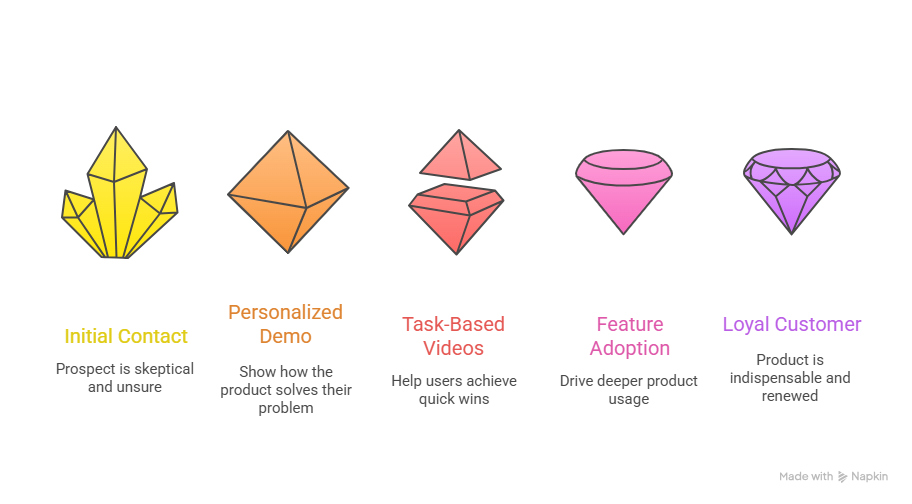
When a prospect first encounters your product, they're skeptical. They've seen a dozen SaaS tools that promised the world. What they need isn't a tutorial. They need proof that your product solves their problem.
This is where a personalized product demo earns its keep. A sharp, 90-second video that shows the prospect's pain point, then walks through exactly how your tool addresses it, does more than a sales call ever could. Research backs this up: buyers are 2.3x more likely to move forward after watching a relevant product demo.
And "relevant" is the keyword. Generic demos don't cut it anymore. If you can drop in the prospect's company name, their industry, or even a specific use case they mentioned during discovery, you've just made it personal.
Onboarding: Reduce Time-to-Value Before They Lose Interest
Here's a sobering stat: most SaaS products lose the majority of new users within the first 90 days. Not because the product is bad, but because the user never figured out how to make it work for them.
This is where how-to videos become essential. Not a long onboarding tour. Not a 20-minute walkthrough of every feature. Just short, specific, task-based videos that help the user hit their first "aha!" moment as fast as possible.
Something like: "How to Create Your First Project in 2 Minutes." That's it, one task, one video, one win. Task-specific videos at this stage improve activation rates by 25% compared to text-only guidance.
Feature Adoption: Keep Them Coming Back
Once a user gets past onboarding, the real retention battle begins. If they only use 10% of what your product can do, they're one competitor email away from churning.
How-to videos embedded inside your app, tied to specific features, are one of the most effective tools for driving depth of usage. Research shows that in-app tutorial videos can boost feature adoption rates by up to 50%. That's not just a nice-to-have. That's the difference between a user who sees your tool as "fine" versus one who sees it as indispensable.
Renewal and Upsell: Show Them What's Next
When renewal time rolls around, your customer needs to feel like the product has grown with them. A well-timed "What's New" video or a short feature spotlight for a higher-tier plan does exactly that.
This isn't a sales demo, it's educational upselling. You're not pushing them toward a plan; you're showing them a specific problem they're currently facing and how one upgrade solves it. That framing matters.
The Silent Killer: Why Most SaaS Teams Neglect How-To Videos
Here's the uncomfortable truth: most SaaS companies are dramatically over-invested in pre-sale demos and almost completely neglect post-sale video content.
It's understandable. Demo ROI is visible. You can trace a closed deal back to a video. But the ROI of how-to videos is "preventative.” It shows up in lower churn, fewer support tickets, and better retention numbers. Those metrics don't get celebrated in the same way, so the budget doesn't follow.
The result? A leaky bucket. You're pouring leads in at the top while customers quietly exit at the bottom. Companies that invest in post-sale video education see a 30% drop in basic support queries and a 40% improvement in how quickly new users become confident in the product.
You can't demo your way out of a churn problem. At some point, customers need to know how to use the thing you sold them.
4 Scenarios: What to Send and When
1. After a discovery call → Send a personalized product demo that mirrors exactly what you discussed. Name the pain points. Show the fix. Make it feel like it was made just for them — because it should be.
2. When a new user stalls during onboarding, → Send a task-specific how-to video targeting the exact step where they got stuck, One problem, one video, one solution. Don't overwhelm them.
3. After a new feature launch → Send a hybrid: open with the why (the problem it solves), then show the how (a quick setup walkthrough). Existing customers need both.
4. When a user goes quiet → Send a re-engagement demo that shows what they're missing. Behavioral data + a personalized video reminder of the value they're leaving on the table works better than a generic "we miss you" email.
Scale Both, Without a Production Team
The reason most companies neglect how-to videos isn't laziness. It's that video production is expensive, slow, and hard to maintain when your product is constantly evolving.
That's exactly the problem PuppyDog.io was built to solve. Upload a screenshot or a raw screen recording, PuppyDog's AI turns it into a polished, narrated video complete with script, voiceover, and visuals. No editor. No studio. No waiting a week for a single asset.
Sales reps can spin up personalized demos in minutes. Customer success teams can build an entire how-to library without a production budget. And when the UI changes? You update one scene, not the whole video.
The Bottom Line
Product demos get people in the door. How-to videos keep them there.
If your video strategy stops at the sale, you're only doing half the job. The customers who stick around, expand, and refer others are the ones who actually know how to use your product, and that doesn't happen by accident.
Take five minutes and audit what you currently have. How many sales demos do you have ready to go? Now count your how-to videos. If the first number is significantly higher than the second, you've found your churn problem.
Start filling that gap with PuppyDog.io, and turn every screen recording into a video your customers will actually use.

Sarah Thompson is a storyteller at heart and Business Developer at PuppyDog.io. She’s passionate about creating meaningful content that connects people with ideas, especially where technology and creativity meet.