Discovery Call to Demo Handoff: The 2026 Playbook


Published: 17th June 2026
Most sales teams treat the handoff as a formality. It is not.
When an SDR passes a lead without context, the AE walks into the demo blind. The buyer repeats their pain points. The demo feels generic. The deal stalls.
Here is what the data shows. The average SaaS demo-to-close rate sits between 22% and 30%. Top-quartile teams hit above 30%. The gap is not about product quality. It is about preparation.
A few failure modes drive most of the damage:
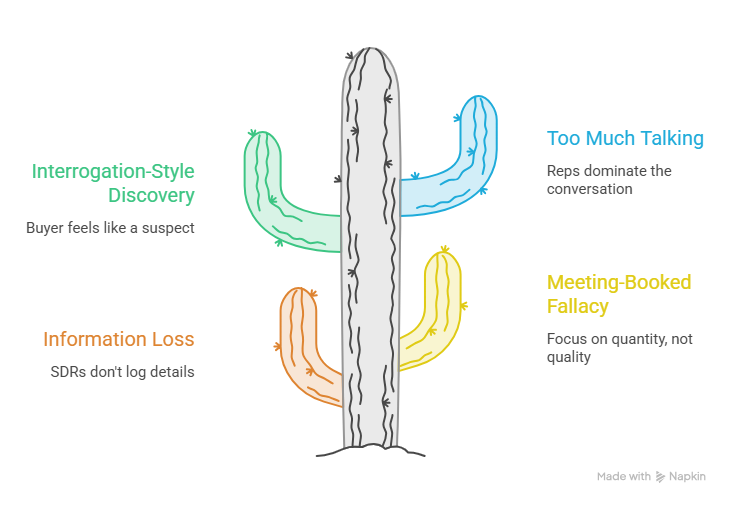
- Information loss. SDRs gather discovery details on the call but never log them. The AE gets nothing useful.
- The meeting-booked fallacy. SDRs are rewarded for booking meetings, not for booking the right ones. Pipeline fills up. Close rates drop.
- Interrogation-style discovery. Reps fire all their questions at the start of the call. The buyer feels like a suspect, not a partner.
- Too much talking. Low-performing reps talk 68% to 72% of the time. The best reps talk 43% and listen 57%.
The Discovery Call Checklist (10 Fields to Capture)
Before any lead moves forward, the SDR must fill in 10 required fields in the CRM. If any field is missing, the meeting does not get booked.
This is not busywork. It is the foundation for a personalized demo.
For a deeper look at how these fields connect to pipeline health, check out our lead qualification guide.
How to Score and Qualify Before Booking the Demo
Not every lead who fills out a form deserves a live demo. Demo qualification keeps your AEs focused on deals that can actually close.
Pick the Right Qualification Framework
Different deal types need different models. Here is how the main frameworks compare:
Many top teams run a hybrid. They use SPICED during early discovery to uncover pain and urgency. Then they translate findings into a MEDDPICCR scorecard in the CRM for forecasting and deal control.
Use a Lead Scoring Model
A point-based scoring system removes guesswork. Leads must reach a set threshold before AE assignment triggers automatically.
- Fit Score (30 points max): Company size, industry, geography
- Engagement Score (30 points max): Email opens, link clicks, meeting attendance
- Intent Score (40 points max): Pricing page visits, content downloads, third-party signals
Set 50 points as your minimum threshold. Below that, the lead returns to nurture. Above that, the demo gets booked.
The 7-Step Discovery Call to Demo Handoff Framework
Here is how top B2B sales teams structure the discovery call to demo transition in 2026.
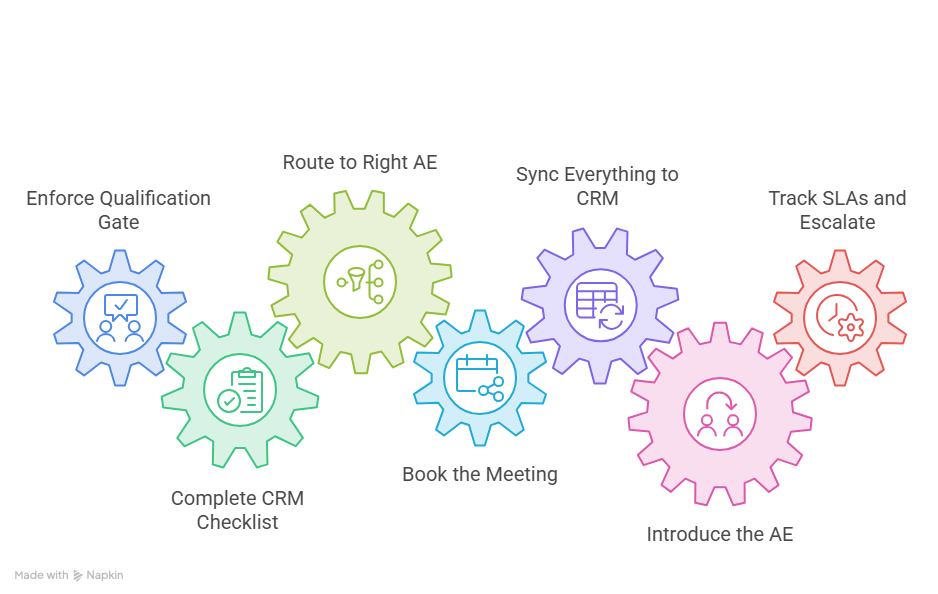
Step 1: Enforce the Qualification Gate
The SDR confirms the lead fits the ICP, has a real pain point, and has a reason to act now. If those three things are not present, the handoff stops here.
Step 2: Complete the CRM Checklist
All 10 discovery fields are filled in before anything else moves. Structured notes make the data searchable and immediately useful for the AE.
Step 3: Route to the Right AE
Automated routing rules handle assignment. Named accounts go to their designated owner first. Territory and segment rules apply next. Unassigned leads use a structured round-robin fallback.
Step 4: Book the Meeting
Use scheduling software to book directly on the AE's calendar. The system should write the invite back to the CRM automatically and apply the right meeting duration for the deal segment.
Step 5: Sync Everything to the CRM
Update ownership, log the meeting status, and stamp the timestamp. The opportunity stage only advances once all qualification gates are cleared.
Step 6: Introduce the AE
The SDR sends a formal intro email or joins the first two minutes of the demo call. The goal is continuity. The buyer should never feel like they are starting the process over again.
Step 7: Track SLAs and Escalate When Needed
- Hot leads: AE contact within 24 hours
- Warm leads: AE contact within 48 hours
- Cool leads: AE contact within 7 days
If the AE misses the window, the CRM alerts the manager. If the meeting stays unconfirmed for 3 consecutive days, the lead gets reassigned.
SDR to AE Handoff Template (Script)
You need two versions: one for email and one for live meetings.
Option 1: Email Introduction (Mid-Market Deals)
Subject: Next Steps: [Prospect Company] and [Your Company] - Introduction to [AE Name]
Hi [Prospect Name],
Great speaking with you on [date]. I wanted to connect you with [AE Name], who will lead your demo on [date and time]. [AE Name] works with teams in [industry] on [core pain point].
Here is a quick summary of what we covered:
- Core challenges: [Pain Point A], [Pain Point B]
- Technical environment: [Tools currently in use]
- Target timeline: [Date or business event]
[AE Name] will be your main contact from here. Looking forward to the next conversation.
Option 2: Live Meeting Handoff (Enterprise Deals)
The SDR joins the first two minutes of the demo call and says:
"Hi everyone, thanks for joining. Quick check: do we still have 30 minutes today? Great.
I want to introduce [AE Name], who will lead today's session. Based on our last call, our focus is [core pain point] and how we help you reach [outcome] before [critical event]. I have shared all of this with [AE Name] so we can skip the recap and get straight to what matters.
Anything else you want us to make sure we cover? [AE Name], the floor is yours."
How to Personalize the Demo Based on Discovery
A clean discovery call to demo process means the AE already knows what to show. The demo should not open with a product tour. It should open with the buyer's pain.
Three things work well here:
- Lead with the most important feature. Skip the standard menu path. Start with the capability that directly solves the buyer's biggest problem. This captures attention and sets the right tone early.
- Use a "What We Heard" slide. For group demos, open with a slide that summarizes the buyer's challenges. It shows active listening and invites other stakeholders to speak up before the demo runs.
- Frame the pain before showing the feature. Say what the problem is before demonstrating how you solve it. Business value lands better than a list of technical specs.
The format of your demo also matters more than most teams realize.
Generic screenshares close at 18%. Interactive demos close at 38%. That is more than double. Learn how to qualify product demos to match the right format to each deal type.
According to HubSpot sales research, personalized demos consistently outperform generic walkthroughs across every deal segment, and that gap is widening as buyer expectations rise in 2026.
Want to go further? Learn how to tailor product demos to connect with every stakeholder in the room.
FAQs
What is the discovery call to demo handoff?
It is the process of passing a qualified lead from the SDR who ran the initial discovery call to the AE who will deliver the product demo. A good handoff transfers all business context so the AE can personalize the demo without re-qualifying the buyer from scratch.
What fields should an SDR capture before handing off a lead?
Ten fields: contact profile, firmographic data, tech stack, core pain, quantifiable impact, urgency, buying committee, budget alignment, known objections, and demo goal. All fields must be logged in the CRM before the meeting is scheduled.
What is demo qualification?
Demo qualification is the process of evaluating whether a lead is ready for a live product demo. It uses a scoring model based on fit, engagement, and intent. Leads below a set threshold return to nurture instead of moving to an AE.
What is the difference between SPICED and MEDDPICCR?
SPICED works best for mid-market SaaS deals. It focuses on customer pain, business impact, and urgency. MEDDPICCR is better for enterprise deals where you need to map the full buying committee and procurement process. Many teams use both together.
Should the SDR attend the demo call?
It depends on deal size. For enterprise deals, yes. The SDR should run the first two minutes to introduce the AE and confirm the agenda. For mid-market or high-velocity deals, a formal email introduction is enough.
What is a good demo-to-close rate?
The average SaaS demo-to-close rate falls between 22% and 30%. Top teams exceed 30%. If your rate drops below 8% to 10%, the sales model becomes hard to sustain. A rep would need to run more than 50 demos per month just to hit standard quota.
How long should an AE wait to contact a new lead after handoff?
Hot leads need contact within 24 hours. Warm leads within 48 hours. Cool leads within 7 days. Missing these windows raises no-show risk and weakens deal momentum.
What is the right talk-to-listen ratio for a discovery call vs. a demo?
For discovery, aim for 43% talking and 57% listening. For a demo, the ratio shifts to 65% talking and 35% listening. Even in demos, keep individual pitches under 76 seconds. Short bursts with regular buyer interaction beat long monologues every time.
Conclusion
The discovery call to demo handoff is not a handshake. It is a structured process that either sets your AE up to win or sends them into a demo without a map.
Get the checklist right. Score your leads before booking. Follow the 7 steps. Use a real introduction template. And let discovery data shape every part of the demo.
In 2026, buyers expect sellers to already know their pain. The teams that build that expectation into their process will run shorter cycles, close more deals, and build stronger pipelines.
Ready to see what a personalized demo looks like in action? Try PuppyDog.io and turn your discovery notes into a demo that closes.

Sarah Thompson is a storyteller at heart and Business Developer at PuppyDog.io. She’s passionate about creating meaningful content that connects people with ideas, especially where technology and creativity meet.