Demo to Close Rate: The 2026 B2B SaaS Benchmark

Published: 12 May 2026
You ran the demo. The prospect seemed engaged. And then, nothing!
Sound familiar? You are not alone. Demo-to-close rate is one of the most watched numbers in B2B SaaS sales. It tells you whether your product presentation is actually doing its job. And in 2026, with buyers more cautious than ever and buying committees growing larger, that number has become harder to move.
This post breaks down exactly where the benchmark stands today, why so many teams are falling short, and what the top performers are doing differently. No fluff. Just data and a clear action plan.
What Is Demo to Close Rate?
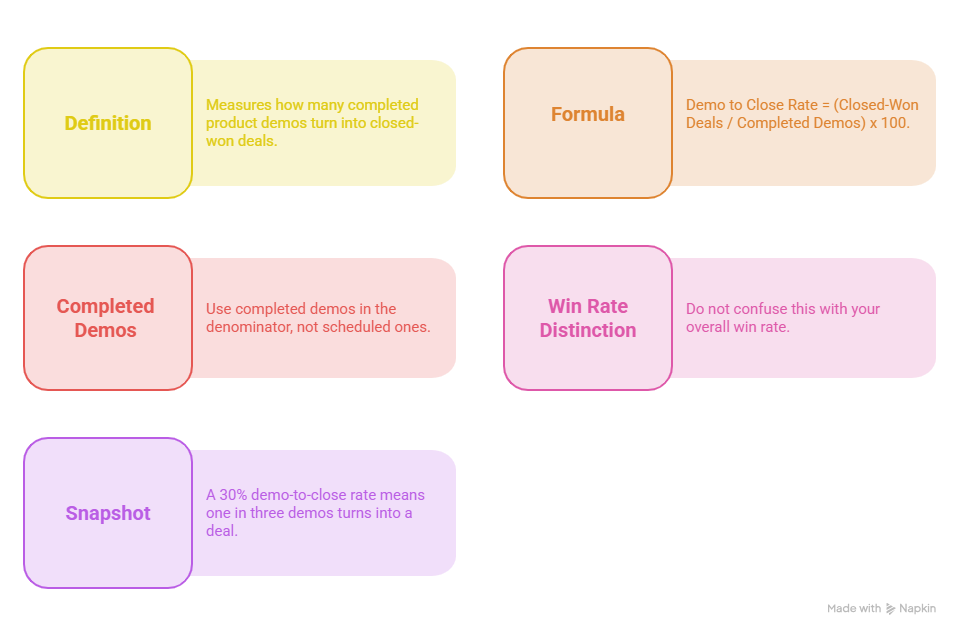
Demo to close rate measures how many completed product demos turn into closed-won deals. The formula is simple:
Demo to Close Rate = (Closed-Won Deals / Completed Demos) x 100
Note the word "completed." You use completed demos in the denominator, not scheduled ones. That matters because it isolates your sales presentation performance from no-show problems, which is a separate issue worth tracking on its own.
Do not confuse this with your overall win rate. Your basic win rate covers the full opportunity lifecycle. Demo-to-close rate zooms in on a specific, high-intent stage: after the product has been shown and the conversation gets commercial.
Snapshot: A 30% demo-to-close rate means one in three demos turns into a deal. For top performers in 2026, the target is 40% or higher.
2026 B2B SaaS Demo Close Rate Benchmarks
Let's get into the numbers. Here is where things actually stand across segments, industries, and deal sizes.
By Segment: SMB, Mid-Market, and Enterprise
Buying complexity drives conversion rates down as you move upmarket. More stakeholders, longer cycles, and more procurement friction all eat into your close rate.
SMB deals move fast because one person usually makes the call. Enterprise deals stall because 8 to 12 stakeholders need to align. That is not a flaw in your pitch. That is the reality of enterprise buying. Your job is to navigate it, not fight it.
Snapshot: SMB closes at nearly double the rate of enterprise. If your rates are reversed, you have a qualification problem.
By Industry
Not all verticals convert the same way. Cybersecurity, for example, faces low top-of-funnel volume but a strong 39% opportunity-to-close rate once a lead is qualified. The pain is critical and non-discretionary, so buyers move with urgency once they are in.
Snapshot: Industry benchmarks shift based on how critical your product is to daily operations. The more essential, the higher the close rate tends to be.
By Deal Size (ACV)
As contract value goes up, close rates go down. More money means more scrutiny, more sign-offs, and more risk for the buyer.
Snapshot: At $100K+ ACV, a 15% close rate is normal. Do not benchmark yourself against SMB rates if you are selling enterprise.
Why Your Demo Close Rate Might Be Low
Before you overhaul your pitch deck, it is worth diagnosing the actual problem. Here are the five most common reasons B2B SaaS teams underperform on demo conversion in 2026.
1. Buyer caution is at an all-time high. Buying committees have expanded. Enterprise deals now average 13 decision-makers. That consensus drag is the primary driver behind the 5 to 10 percentage point year-over-year decline in demo-to-close rates across the industry.
2. Poor pre-demo qualification. When SDRs prioritize meeting volume over meeting quality, unqualified leads flood the pipeline. This inflates your denominator and drags your close rate down. You end up burning sales engineering resources on prospects who were never going to buy.
3. Stale CRM data. B2B contact data decays at an estimated 30% or more per year. Chasing bounced emails and departed contacts costs an estimated $32,000 per sales rep annually in wasted effort. It also inflates your pipeline with dead opportunities.
4. Slow inbound response. Responding to inbound demo requests within 5 minutes correlates with a 21% higher win rate. Most teams are nowhere close to that. Warm leads go cold fast, especially when a competitor responds first.
5. Generic, static demos. The traditional screen-share-and-talk demo converts at just 18%. Prospects watch passively. They leave without understanding how the product fits their specific workflow. If you are still running the same canned demo for every prospect, this is likely your biggest lever to pull.
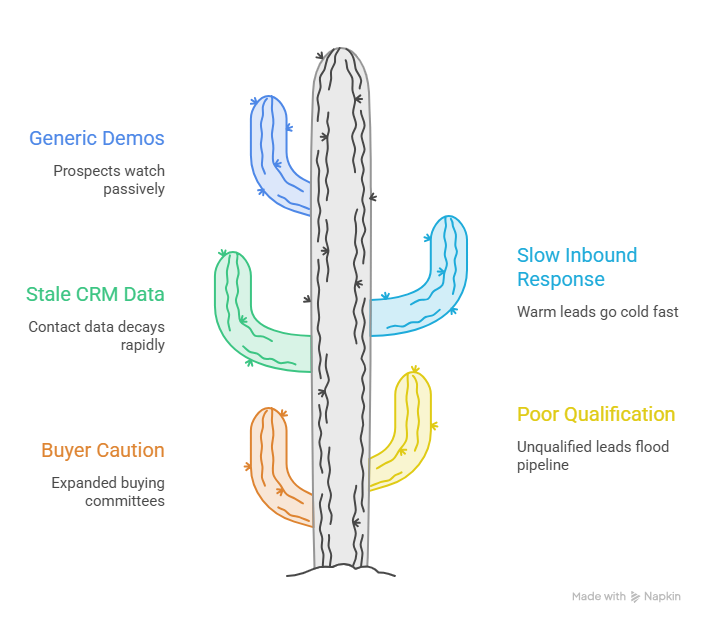
Snapshot: Most low close rates trace back to one of these five problems. Fix the root cause before changing your pricing or pitch.
7 Ways to Boost Your Demo to Close Rate
Here is what top-performing SaaS sales teams are actually doing in 2026.
1. Enforce strict qualification before every demo. Use MEDDIC (Metrics, Economic Buyer, Decision Criteria, Decision Process, Identify Pain, Champion) as a hard filter. No qualification, no demo. It sounds aggressive, but it concentrates your team's energy on deals that can actually close.
2. Always run a discovery call first. Never go into a demo cold. A dedicated 30-minute discovery call lets you map the prospect's exact pain points before you show them anything. Then you only demo what matters to them. This alone can lift conversion significantly.
3. Multi-thread every deal. Single-threaded deals die. Get at least three stakeholders on the demo: the champion, the economic buyer, and an end user. High-velocity outbound to known contacts and past champions delivers a 37% win rate compared to 19% for cold outreach.
4. Use interactive, personalized demos. Interactive product experiences drive a 32% average increase in conversion rates compared to static presentations, according to Forrester and Walnut platform data. At the decision stage, personalized demos deliver a 38% to 45% lift in close rates. Show the prospect their data, their use case, their industry language.
5. Book the next meeting during the demo. Do not let the calendar invite slip. Book the follow-up before the call ends. Deals that close within 50 days hold a 47% win rate. Once a deal drags past that threshold, win rates fall below 20%.
6. Use AI to personalize at scale. AI-heavy pipelines close demos at 40% compared to 37% for teams with low AI adoption, per the January 2026 ICONIQ State of Go-To-Market report. AI tools handle pipeline research, follow-up drafting, and call summaries, freeing your reps to focus on high-value conversations.
7. Align sales comp to durable revenue. In 2026, 33% of SaaS companies now tie AE compensation to Net New Recurring Revenue, up from 25% in 2025. When reps are paid for retention and not just signatures, they focus on qualified, high-fit deals instead of rushing weak ones through.
Snapshot: Personalization and qualification are the two biggest conversion levers. Everything else amplifies them.
How AI-Powered Demos Improve Close Rate
Let's be honest: building a customized demo from scratch for every prospect is painful. A standard customized demo takes a Sales Engineer an average of 3.6 hours. A highly customized sandbox takes 7 hours. With 7 demos per week, that adds up to 25 hours of prep time. Weekly.
That is where AI demo tools change the game. Platforms like Puppydog.io let you generate personalized product demo videos directly from screen recordings or screenshots. No manual sandbox setup. No hour-long prep sessions. You create a polished, buyer-specific demo in a fraction of the time.
The results are backed by data. Organizations that personalize 50% or more of their demos record 40%+ higher conversions compared to teams using generic templates. And demos shared during active evaluations deliver a 38% to 45% lift in close rates at the decision stage.
AI-powered demo tools also solve the async problem. Approximately 83% of B2B buyers define their technical requirements before speaking to a rep. With Puppydog, you can send a personalized video demo before the live call, so by the time your rep shows up, the buying committee is already halfway sold.
Want to understand the full ROI of this approach? Check out our demo ROI guide to see how to measure the impact on your pipeline.
Already using interactive demos but not seeing results? It might be a cycle-length problem. Read how teams shorten sales cycle with personalized, buyer-led experiences.
And if you want to go deeper on measuring impact, our post on demo performance metrics breaks down exactly what to track and why.
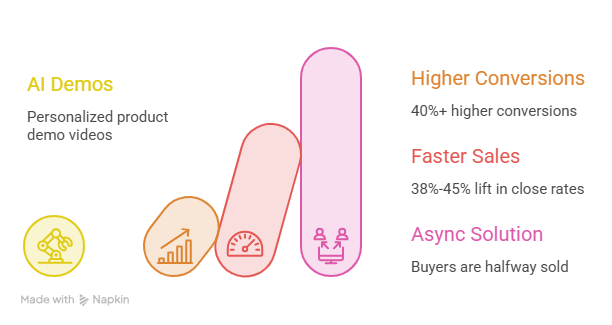
Snapshot: AI demo personalization is not a nice-to-have in 2026. It is the primary variable separating 18% close rates from 40%+ ones.
FAQs
What is a good demo-to-close rate in B2B SaaS?
A good demo-to-close rate in 2026 is 30% or higher. That marks the entry point into top-quartile performance. The industry median is 22% to 30%, based on data from 939 B2B companies.
What is the average demo close rate for enterprise SaaS?
Enterprise SaaS averages an 18% demo-to-close rate, reflecting the complexity of 8 to 12 stakeholder buying committees and sales cycles that can stretch 90 to 180 days.
How do I calculate my demo to close rate?
Divide your closed-won deals by your completed demos, then multiply by 100. Use completed demos, not scheduled ones, to get an accurate read on sales performance.
What is the difference between win rate and demo to close rate?
Win rate covers all opportunities from creation to decision. Demo to close rate focuses only on the stage after a product has been demonstrated. A company can have a 20% overall win rate and a 30% demo-to-close rate at the same time.
Why is my demo close rate dropping?
The most common causes in 2026 are expanded buying committees, poor pre-demo qualification, slow inbound response times, and generic, non-personalized demos.
Does demo personalization actually improve close rates?
Yes. Interactive, personalized demos deliver a 38% to 45% lift in close rates at the decision stage, per Forrester and Walnut platform data. Organizations personalizing 50%+ of demos record 40%+ higher conversions.
What is the B2B sales demo conversion rate by deal size?
Under $10K ACV: ~35%. $10K to $50K: ~28%. $50K to $100K: ~22%. $100K and above: ~15%. Rates decrease as deal size and stakeholder complexity increase.
How long should a sales demo take to close?
Deals that close within 50 days of the demo hold a 47% win rate. Win rates drop below 20% once a deal stalls past that point. Speed and momentum are critical.
How do AI tools improve demo close rates?
AI-heavy pipelines achieve a 40% demo-to-close rate compared to 37% for low-AI teams, per the 2026 ICONIQ report. AI handles research, follow-ups, and personalization at scale.
What is the b2b saas demo conversion rate for self-guided demos?
Sales processes using automated, self-guided demos close 19 days faster on average and record a 6% higher overall win rate compared to live-only formats, according to G2 category data.
Conclusion
Your demo-to-close rate is one of the clearest signals of GTM health in 2026. A 30% rate means you are in the top quartile. Below 22%, something is broken. And in most cases, it traces back to qualification gaps, generic presentations, or slow follow-up rather than the product itself.
The fix is not a new pitch deck. It is better qualification, faster response, and personalized demos that speak directly to each buyer's situation.
Puppydog.io helps you get there. Turn screen recordings and screenshots into polished, AI-personalized demo videos that your buyers can watch on their schedule, share with their team, and return to before the final decision. No 7-hour sandbox builds. No last-minute scrambling.
Start a free trial and see how it works.

Sarah Thompson is a storyteller at heart and Business Developer at PuppyDog.io. She’s passionate about creating meaningful content that connects people with ideas, especially where technology and creativity meet.