Best AI Product Demo Software 2026 (Compared)

Not long ago, the typical SaaS buying journey started with a sales call. A prospect would book a meeting, sit through a presentation, and only then see the product in action. Fast forward to 2026, and that playbook feels a bit outdated.
Today, buyers want to explore software on their own terms. They want to click around, test features, and understand the product before ever speaking to a salesperson. This shift has given rise to a new growth strategy many SaaS teams are embracing: Demo-Led Growth (DLG).
Here’s the reality driving this change: nearly 80% of the software buying journey now happens asynchronously. In other words, most evaluation happens long before a prospect schedules a live demo. Buyers research, compare tools, watch product walkthroughs, and explore interactive demos independently.
For SaaS companies, this changes everything. The product demo is no longer just a step in the sales process. It’s becoming the front door of the revenue engine.
That’s where modern demo platforms come in. The best AI product demo software allows companies to create personalized, interactive, and scalable product experiences that prospects can access anytime. Instead of repeating the same introductory demo dozens of times, teams can let buyers explore the product whenever curiosity strikes, whether that’s during a late-night research session or right after clicking a marketing email.
But with so many tools entering the market, choosing the right platform can be tricky. Some focus on interactive click-through tours. Others specialize in AI-generated video demos. A few even create full sandbox environments or autonomous AI-driven demonstrations.
In this guide, we’ll break down the best AI product demo tools 2026 has to offer and help you decide which one fits your go-to-market strategy.
What you’ll learn in this guide
- The biggest product demo trends shaping SaaS sales in 2026
- The different types of AI demo automation software and when to use each
- A comparison of the best product demo tools for SaaS teams
- How interactive demos, AI video demos, and sandbox environments differ
- Which platforms work best for marketing, sales, and customer success teams
- What features to look for in an AI-powered demo platform
- How demo tools integrate with CRM systems like Salesforce and HubSpot
By the end, you’ll have a clear understanding of which platforms truly deserve a spot on the list of the best sales demo software in 2026, and how to choose the one that aligns with your team’s workflow.
Why Demos Are the New Front Door of SaaS (Context & Trends)
For years, SaaS companies treated product demos as a mid-funnel sales activity, something that happened after a prospect filled out a form or spoke with a sales rep. But that model has quietly flipped.
In 2026, product demos are often the first meaningful interaction a buyer has with a product. Instead of waiting for a scheduled call, prospects expect to explore the software immediately, sometimes within seconds of landing on a website or opening an email.
This shift is commonly referred to as Demo-Led Growth (DLG). Similar to how Product-Led Growth (PLG) changed onboarding and trials, Demo-Led Growth focuses on letting buyers experience value before talking to sales.
Several powerful forces have converged to push SaaS companies toward this model.
The Five Forces Driving Demo-Led Growth
1. Webinar and meeting fatigue
Let’s be honest, most people don’t want another scheduled demo call. Decision-makers already juggle packed calendars, and sitting through a 45-minute generic walkthrough often feels inefficient. Interactive demos or AI-generated demo videos allow buyers to explore the product without scheduling friction.
2. Privacy changes and weaker intent signals
With the decline of third-party cookies and stricter privacy regulations, marketers now have less behavioral data about prospects. Demo engagement, what features someone clicks, watches, or replays, has become a powerful first-party signal of real buying intent.
3. The rise of Product-Led Growth
PLG taught buyers to expect instant product access. Even in enterprise SaaS, where free trials may not be practical, interactive demos provide a trial-like experience without exposing live infrastructure.
4. Generative AI reducing content creation costs
AI has dramatically lowered the barrier to creating demos. What once required video editing, scripting, and repeated recordings can now be produced quickly using AI-powered demo platforms that generate personalized walkthroughs and demo videos automatically.
5. Executive impatience with slow sales cycles
Leadership teams increasingly want faster pipeline velocity and clearer buyer signals. Demo automation helps qualify prospects earlier, so sales teams spend time only with people who already understand the product’s value.
What This Means for Revenue Teams
The shift toward Demo-Led Growth is changing how marketing, sales, and presales teams operate.
- Higher conversion rates: Interactive demos often convert far better than static landing pages or PDFs.
- Faster pipeline generation: Buyers reach their “aha moment” earlier in the journey.
- Better lead qualification: Demo analytics reveal which features prospects care about most.
- More efficient SDR workflows: Instead of cold pitches, SDRs can send personalized demo links in outreach.
- Reduced presales workload: Automated demos filter out unqualified prospects before a live demo is scheduled.
In short, demos are no longer just a sales presentation tool. They’re becoming a core part of the SaaS growth engine.
And that raises an important question: what kind of demo experience should you actually build?
Not all demo platforms work the same way. Some create interactive click-through tours, others generate AI-powered video demos, and a few replicate full product environments.
Demo Software Taxonomy: Which Type Fits Your GTM Motion?
If you’ve started researching the best AI product demo software, you’ve probably noticed something confusing: not all demo tools actually work the same way.
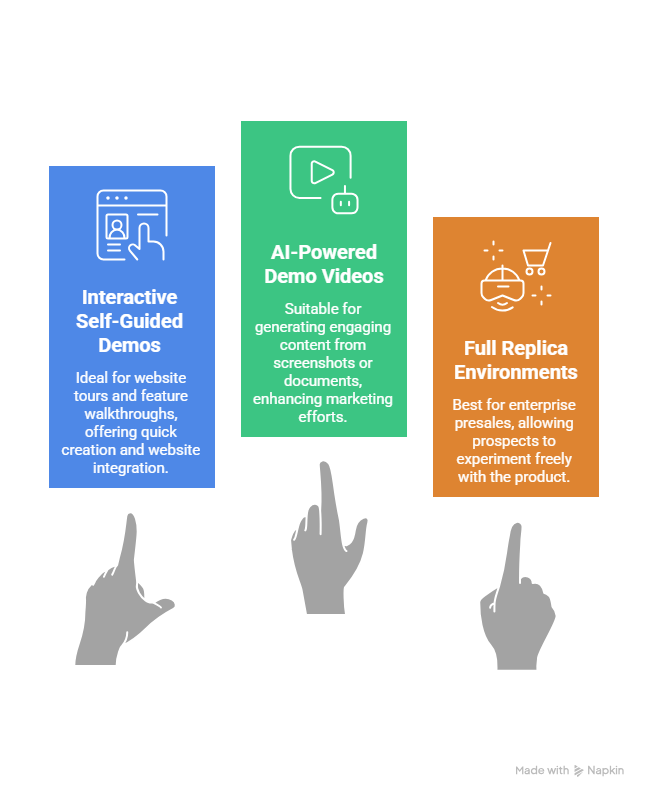
Some platforms create interactive product tours that mimic your interface. Others generate AI-powered demo videos from screenshots or documents. A few tools go even further, building full replica environments where prospects can experiment freely.
Each category solves a different problem in the go-to-market (GTM) motion. Choosing the right one often depends on how your team sells—whether that’s marketing-led, PLG-driven, or enterprise presales.
Let’s break down the main categories shaping the best AI product demo tools in 2026.
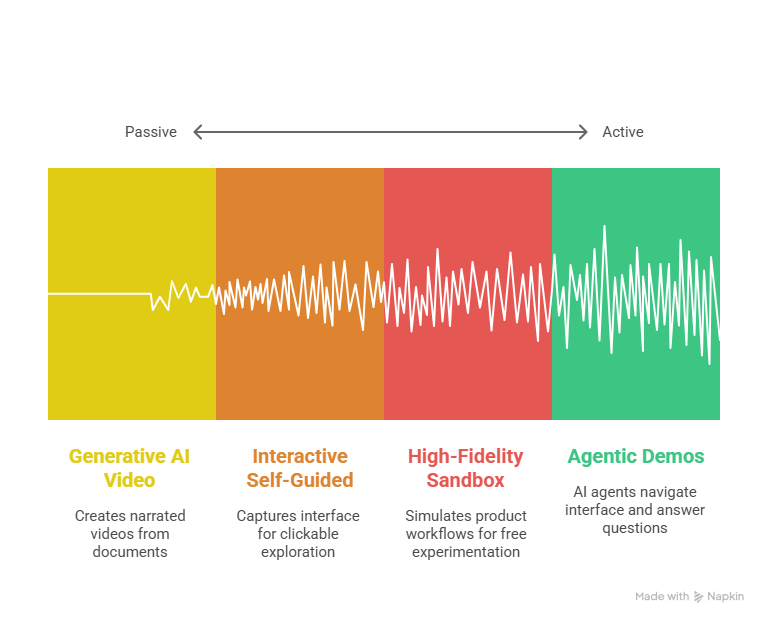
Interactive Self-Guided Demos (HTML/CSS Capture)
Interactive demos are probably the most recognizable type of modern product demo. These tools capture the HTML and CSS of your product interface, creating a clickable version that prospects can explore.
Instead of watching a video, users can click buttons, navigate screens, and follow guided walkthroughs. It feels like using the product, but without touching the real backend.
That’s why many SaaS companies place these demos directly on their website, so visitors can experience the product instantly.
Typical use cases
- Website product tours for inbound leads
- Demand generation landing pages
- Feature walkthroughs for product marketing
- Conference or trade show demos
- Email follow-ups after webinars
Ideal teams
- Product marketing
- Demand generation
- Growth teams focused on website conversion
The big advantage here is speed. Non-technical teams can usually create and publish demos quickly using no-code editors.
The tradeoff? Since these demos replicate only the front-end interface, they may not capture complex backend workflows or integrations.
Generative AI Video Demo Software (Doc-to-Video)
Another fast-growing category is AI-generated demo video software. Instead of capturing an interactive interface, these tools transform documents, screenshots, or screen recordings into narrated demo videos.
Some platforms even add AI voiceovers, subtitles, and localized scripts automatically.
This approach works especially well for teams that need to produce large volumes of demo content quickly, for example, product marketing campaigns or outbound sales sequences.
Tools like puppydog.io focus on turning product screenshots or recordings into polished demo videos that can be personalized for different audiences.
Pros
- Fast demo production without video editing
- Easy to personalize for different industries or roles
- Ideal for outreach, marketing campaigns, and product launches
- Updates can often be made without re-recording the entire video
Cons
- Viewers remain passive compared to interactive demos
- Not ideal when prospects need to explore features themselves
Still, for many SaaS teams, video demo automation has become the easiest way to scale product storytelling across marketing and sales channels.
High-Fidelity Sandbox & Replica Environments
For complex SaaS products, especially enterprise platforms, simple interactive tours may not be enough.
That’s where sandbox demo environments come in.
These platforms create isolated replicas of the product, allowing prospects to experiment freely without touching real customer data or production systems.
Unlike HTML capture demos, sandbox environments simulate actual product workflows, including integrations, data flows, and configuration steps.
Typical use cases
- Technical proof-of-concept (POC) sessions
- Enterprise sales cycles
- Pre-sales engineering demonstrations
- Product trials with controlled data sets
Ideal teams
- Sales engineers (SEs)
- Solutions consultants
- Enterprise sales teams
The main benefit is technical realism. Prospects can test complex workflows safely.
However, these environments typically require more setup and maintenance than simpler demo tools.
Agentic Demos (AI Agents That Run the Demo)
The newest category emerging in 2026 is agentic demos.
Instead of static recordings or guided paths, these systems use AI agents that navigate the product interface autonomously while answering questions in real time.
Think of it as a virtual sales engineer embedded in the demo experience.
These AI agents can interpret the interface, explain features, and even adapt the walkthrough based on user questions.
Early use cases include:
- AI-guided demos on websites
- Autonomous demos during video calls
- AI assistants embedded inside product walkthroughs
- Interactive demos for global audiences in multiple languages
Because the technology is still evolving, agentic demos are most commonly used in innovation-focused GTM teams experimenting with AI-driven sales workflows.
But the potential is enormous, especially for companies that want to scale demos globally without expanding presales teams.
Quick Decision Guide
If you’re unsure which type of demo platform fits your GTM strategy, here’s a simple rule of thumb:
- Interactive demos: Best for website conversion and inbound marketing
- AI video demos: Best for scalable storytelling and outbound outreach
- Sandbox environments: Best for enterprise POCs and technical validation
- Agentic demos: Best for experimental AI-driven demo experiences
Understanding these categories makes it much easier to evaluate the best product demo tools for SaaS teams.
How We Evaluated These Tools (Methodology)
Choosing the best AI product demo software isn’t just about shiny features or flashy demos. To provide a fair, practical ranking, we focused on how each platform performs in real-world GTM scenarios.
Here’s the framework we used to evaluate the tools:
Evaluation Criteria
- Demo Fidelity – How accurately the tool represents the product interface, workflows, and functionality. High-fidelity demos matter when buyers need to see real product behavior, not just screenshots or videos.
- Personalization & AI Features – Ability to tailor demos to specific buyer roles, industries, or languages, and leverage AI for voiceovers, branching logic, or autonomous navigation.
- CRM Integration – How well demo engagement data flows into Salesforce, HubSpot, or other CRM platforms to inform sales follow-ups and nurture sequences.
- Analytics & Intent Scoring – Insight into prospect behavior, including feature interaction, time spent, and predictive intent scoring that helps prioritize leads.
- Implementation Effort – Ease of setup, required technical resources, and time-to-live for demos.
- Security & Compliance – Measures such as SOC 2, GDPR, HIPAA, and enterprise access controls that ensure demos are safe for internal and external users.
- Pricing Model – Transparency, scalability, and alignment of cost with team size and usage.
- Fit for Team Size – Whether the platform suits small startups, mid-market teams, or enterprise organizations with complex GTM motions.
Sources of Insight
To create a grounded, actionable comparison, we pulled information from multiple channels:
- Vendor documentation and product walkthroughs
- Independent market research and analyst reports
- Real-world use cases from GTM practitioners in sales, marketing, and product teams
Scoring Emphasis
While each criterion matters, our scoring prioritized two key dimensions:
- Buyer Experience – Does the platform help prospects discover value quickly, intuitively, and in a way that drives engagement?
- Integration Depth – How seamlessly does demo data connect with the GTM tech stack, enabling measurable revenue impact?
By applying this methodology, we ensured that our recommendations reflect both practical usability and strategic ROI, rather than just marketing hype.
Top AI Product Demo Platforms to Consider (Ranked List)
Here’s a curated list of the top AI product demo tools in 2026, starting with puppydog.io at the top. Each platform is broken down into features, pros, and cons to help you compare quickly and choose what fits your GTM motion.
1. Puppydog.io
Features:
- AI-generated personalized demo videos from screen recordings or screenshots
- Layered editing: update individual elements without re-recording
- Multi-language support and localized scripts
- Scalable for outbound and marketing campaigns
- Integration with CRM tools for tracking engagement
Pros:
- Fast production of polished, personalized demos
- Ideal for product marketers and outbound sales teams
- Reduces repetitive video creation effort
- High scalability without expanding headcount
Cons:
- Viewer experience is passive (not interactive)
- Less suited for complex enterprise workflows requiring sandbox environments
2. Consensus
Features:
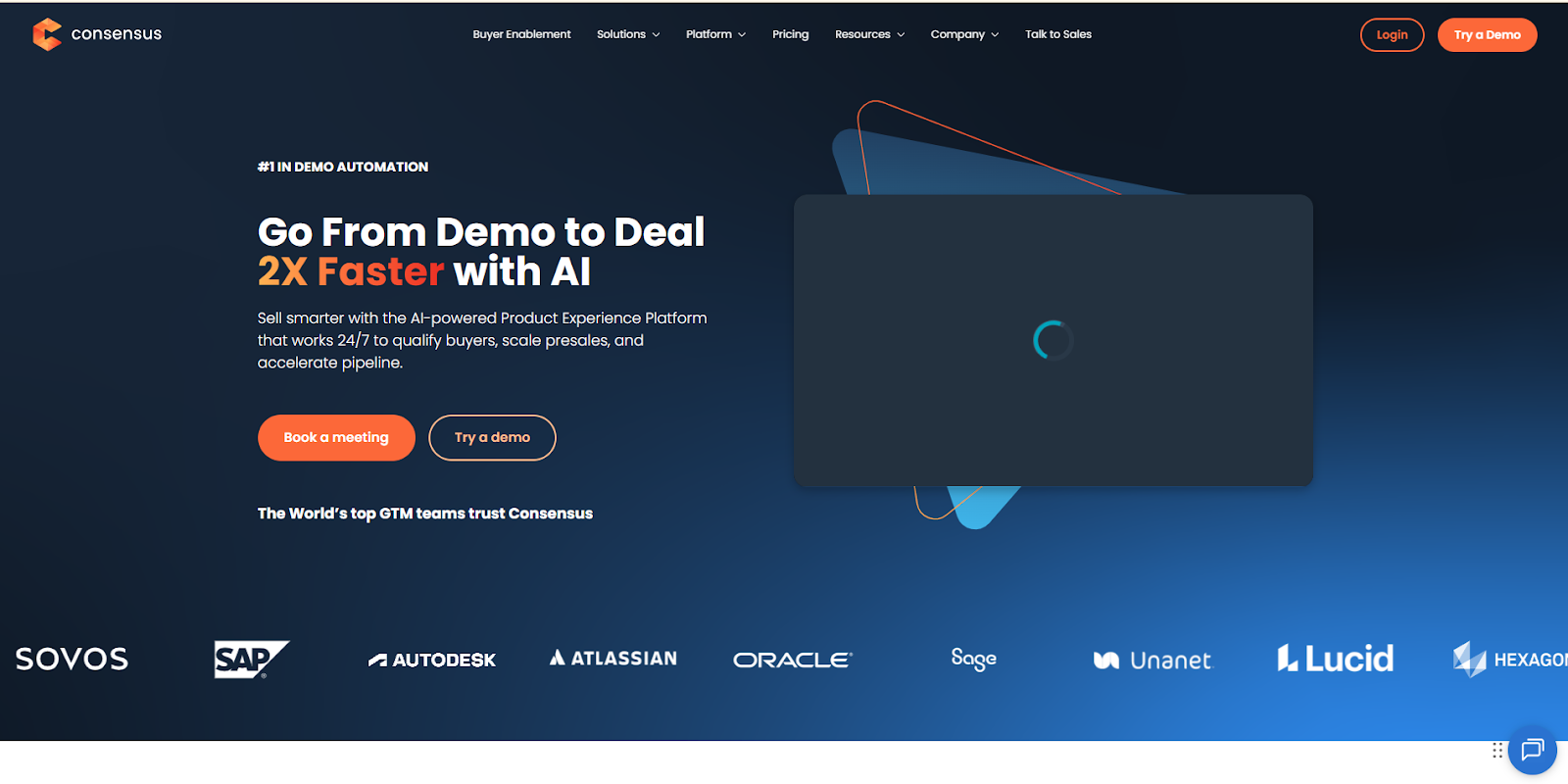
- Multi-modal demo platform: interactive tours, video, and simulations
- Buyer hubs for collaborative evaluation
- AI-driven content studio for script and voiceover generation
- Analytics and intent scoring to prioritize leads
Pros:
- Strong for enterprise presales at scale
- Provides rich insights into buyer behavior
- Supports multi-stakeholder collaboration
Cons:
- Implementation can require technical resources
- Higher cost compared to small-team tools
3. Storylane
Features:
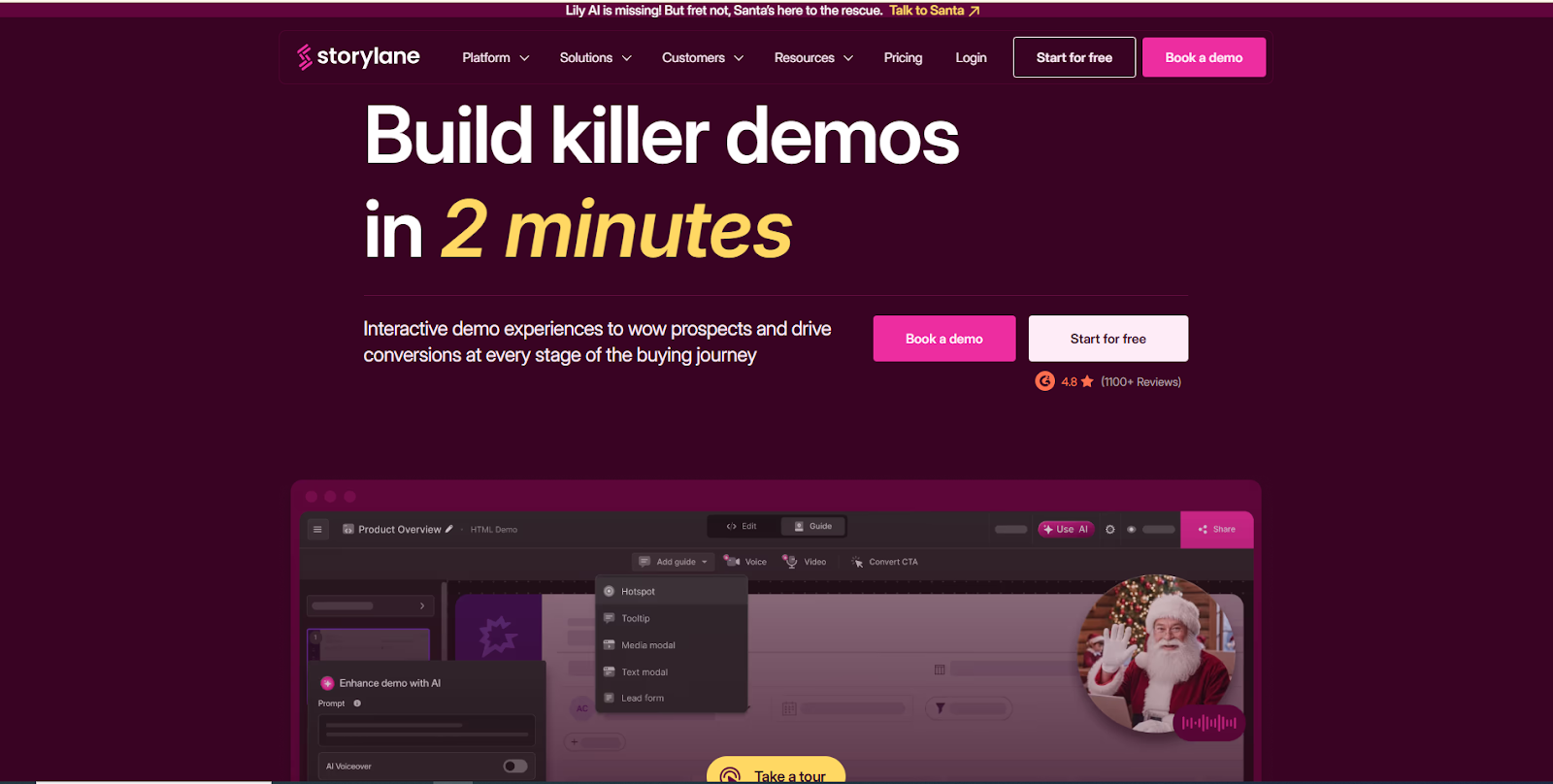
- No-code interactive tours
- Supports image, video, and HTML formats
- Multi-language voiceover automation (Lily AI)
- Quick publishing for marketing landing pages and email campaigns
Pros:
- Marketing-friendly, excellent for PLG motions
- Fast creation of demos without engineering help
- Good for mid-market teams
Cons:
- Less suitable for technical POCs
- Limited support for fully replicated environments
4. Navattic
Features:
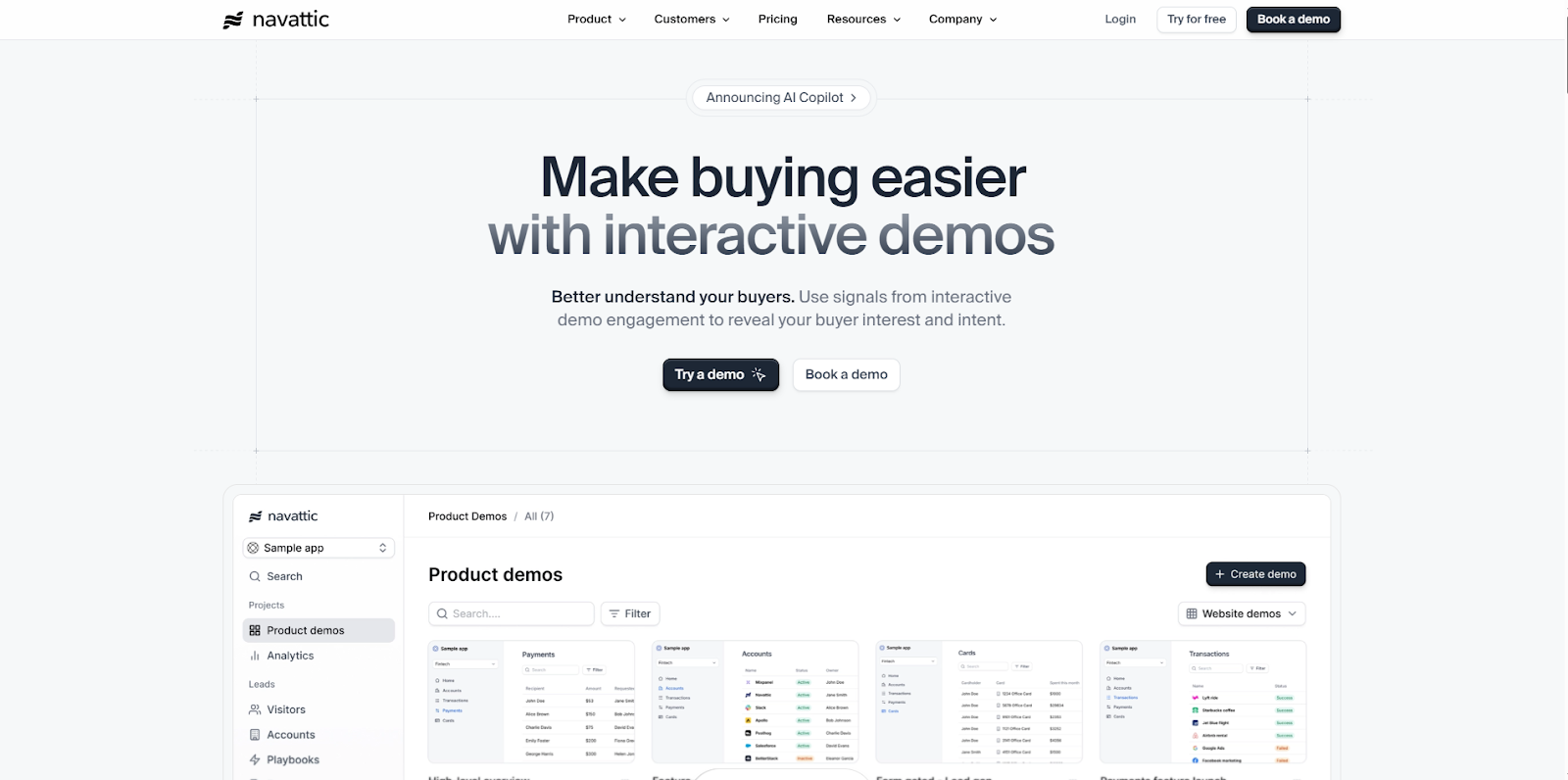
- Interactive demos with A/B testing capabilities
- Offline player for trade shows or kiosks
- Granular demo analytics
- Conversion benchmarking against industry standards
Pros:
- Great for marketing and growth teams
- Offline functionality enables demos in low-connectivity environments
- Data-driven insights for optimization
Cons:
- Not designed for complex enterprise POCs
- Limited AI personalization features compared to newer platforms
5. Walnut
Features:
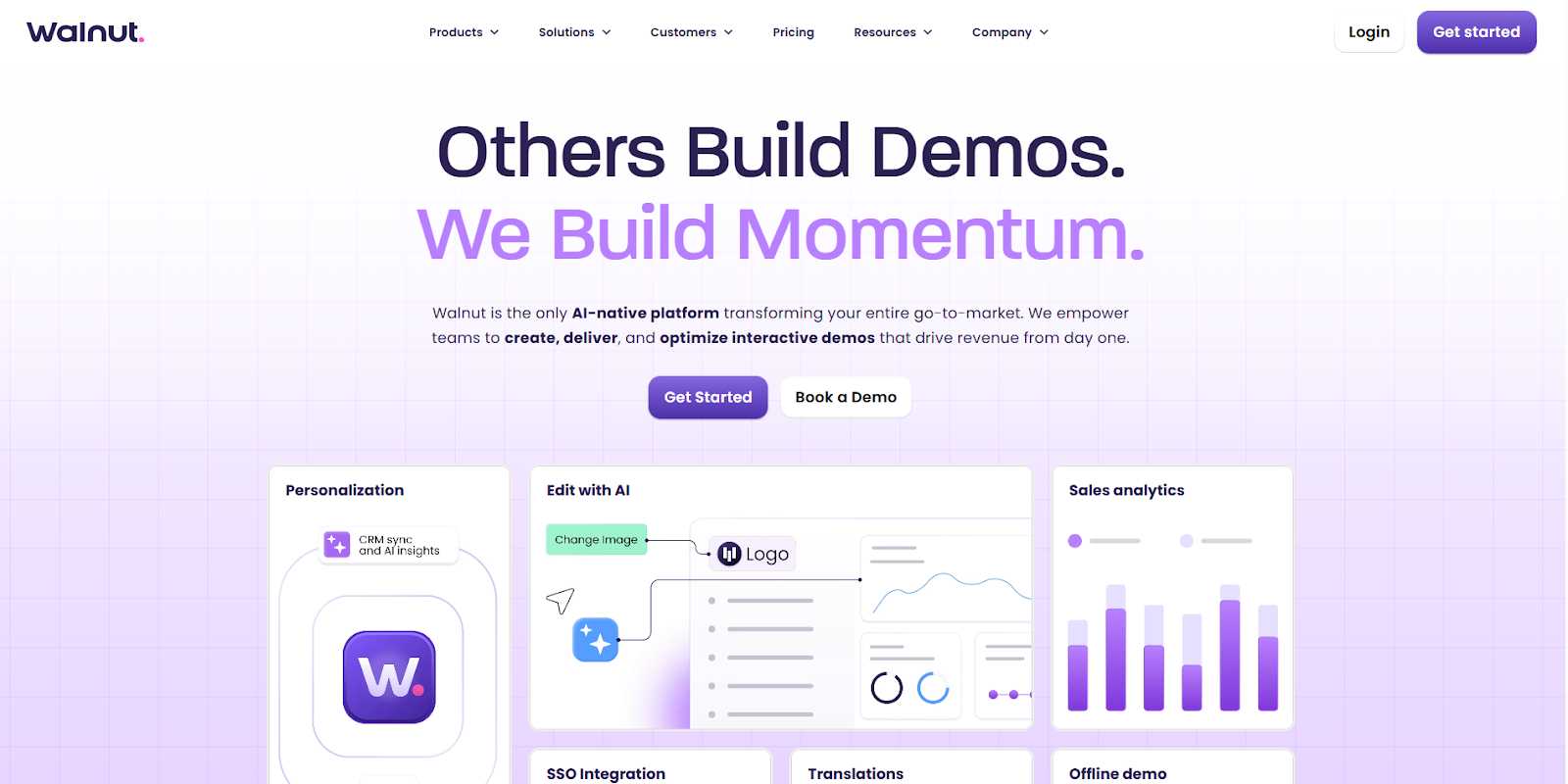
- Enterprise-grade interactive walkthroughs
- Advanced security and compliance (SOC 2, GDPR)
- Role-based branching and guided flows
- Integration with CRM and analytics platforms
Pros:
- Strong for enterprise workflows and regulated industries
- Flexible branching logic for complex demos
Cons:
- Requires higher implementation effort
- Steeper learning curve for non-technical users
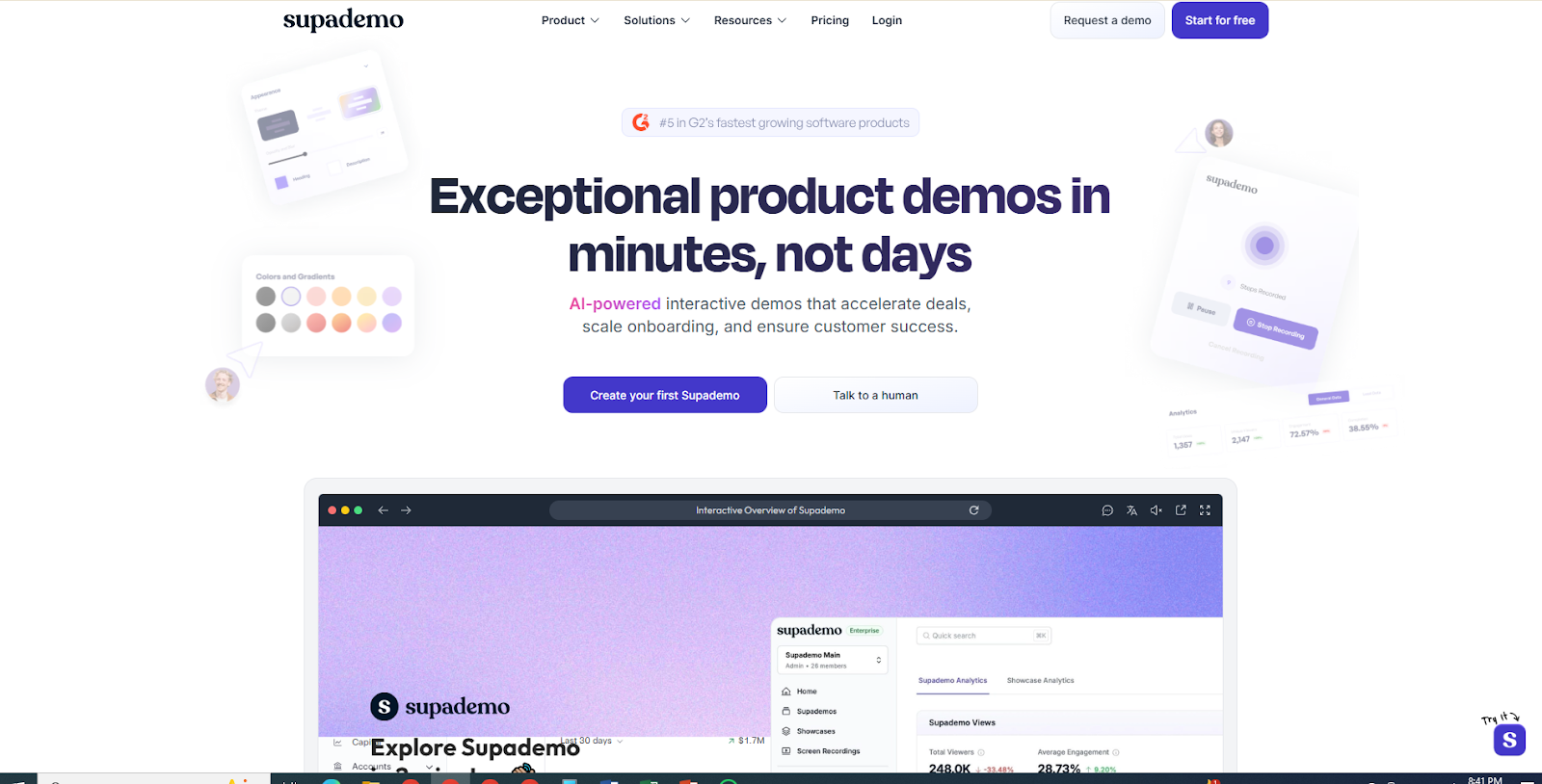
6. Supademo
Features:
- Rapid setup with low barrier to entry
- Interactive tours and basic video creation
- Suitable for small teams or individual creators
Pros:
- Affordable and easy to implement
- Fast demo production for small SaaS teams
Cons:
- Limited advanced features or analytics
- Not ideal for enterprise-scale demos
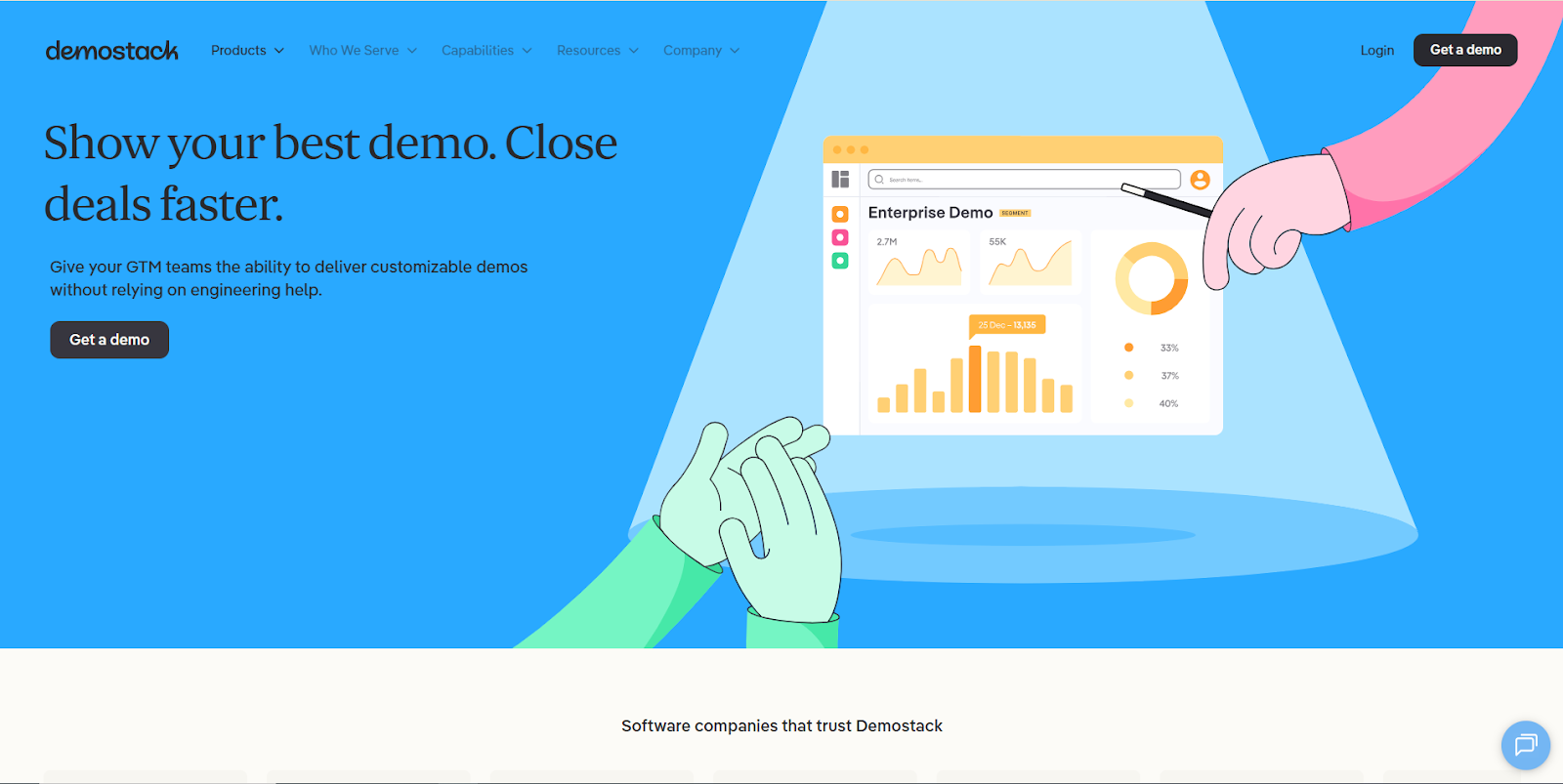
7. Demostack
Features:
- High-fidelity replica environments
- Full POC workflows and simulations
- Multi-step scenarios and complex data handling
Pros:
- Excellent for enterprise-level technical validation
- Enables safe experimentation with real workflows
Cons:
- High implementation effort and cost
- Requires Sales Engineering support
8. Reprise
Features:
- Sandbox-focused demos for enterprise use
- Replicate and Reveal modes for controlled environments
- Supports technical POCs and workflow simulations
Pros:
- Technical depth ideal for SE-led demos
- Safe testing without impacting production
Cons:
- Steeper onboarding and setup
- Less marketing-friendly for website or outbound demos
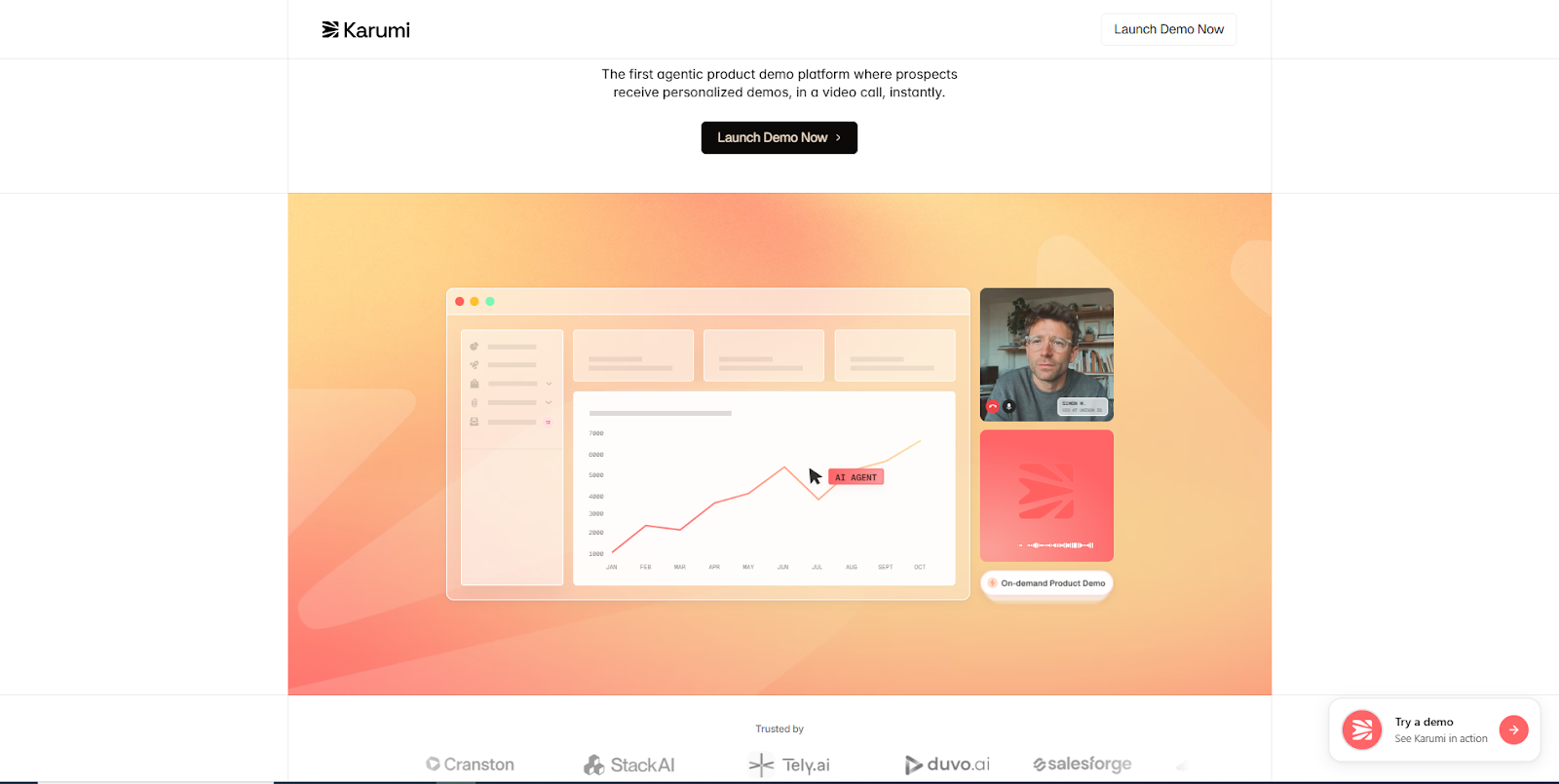
9. Karumi
Features:
- AI agents autonomously demo products in real time
- Bilingual support and multi-language reasoning
- Self-updating agents for evolving software interfaces
Pros:
- Reduces dependency on live SEs
- Scales global demos without additional headcount
- Engages prospects dynamically
Cons:
- Emerging technology; not yet mainstream
- Implementation can be experimental and complex
Feature Comparison Snapshot
To help you see the differences at a glance, we’ve broken the most important capabilities of the top AI demo tools into multiple comparison tables, organized by demo type, CRM/analytics & personalization, and implementation/security. After each table, we’ll explain what the data suggests about which tool works best in different scenarios.
1) Demo Type & Pricing
What this table tells you:
- Video‑first tools like Puppydog.io sit in a lower budget range with transparent pricing, ideal for early‑stage and mid‑market teams.
- Interactive tour tools (Storylane, Navattic, Supademo, Walnut) offer flexible pricing from free/freemium up to mid‑tier.
- Sandbox and high‑fidelity environments (Demostack, Reprise) belong in the enterprise segment with custom pricing or high annual costs.
- Consensus and Karumi typically target enterprise or advanced GTM use cases, with pricing that isn’t listed publicly and varies by deal.
2) Personalization, CRM & Analytics
What this table tells you:
- Enterprise platforms like Consensus, Walnut, and Demostack provide deep CRM integration plus rich analytics and intent scoring, critical if you want data‑driven follow‑ups.
- Marketing‑friendly tools such as Storylane and Navattic offer solid analytics and personalization tokens, useful for inbound demos and nurture sequences.
- Puppydog.io’s strengths lie in personalized, video demo engagement tracking and CRM tie‑ins, making it ideal for campaigns and outbound sequences where you want to track who watched what.
- Supademo covers basics with a lower learning curve but doesn’t have the same analytical depth as enterprise options.
3) Implementation, Security & Scale
What this table tells you:
- No‑code and quick tools (Puppydog.io, Storylane, Supademo, Navattic) are easiest to implement with minimal technical overhead, ideal for marketing and small sales teams.
- Enterprise options need more setup and sometimes Sales Engineering involvement, but they offer stronger security, roles, and compliance controls.
- Sandbox tools and agentic demos (Reprise, Demostack, Karumi) require technical effort yet deliver the deepest buyer interactions and simulations.
Integration & CRM Mapping: Turning Demo Data into Pipeline Signals
AI-powered demos are not just a marketing or sales asset—they’re a critical source of actionable data. The right platform can track who interacts with your demos, what they engage with, and for how long. By integrating this data into Salesforce, HubSpot, or your CRM of choice, you turn engagement into pipeline signals that drive revenue decisions.
Demo Data Fields and Their Uses
Here are key metrics most platforms capture and how GTM teams can leverage them:
Use Cases for CRM-Integrated Demo Data
- Lifecycle Updates
- Automatically move contacts through lifecycle stages based on demo engagement (e.g., MQL → SQL)
- Helps ensure sales teams focus on qualified prospects
- Automatically move contacts through lifecycle stages based on demo engagement (e.g., MQL → SQL)
- Nurture Triggers
- Set up email sequences or personalized follow-ups when a prospect completes specific demo sections or clicks certain features
- Keeps prospects engaged with relevant content without manual intervention
- Set up email sequences or personalized follow-ups when a prospect completes specific demo sections or clicks certain features
- SDR Handoffs
- Provide Sales Development Representatives with behavioral context before outreach
- Helps SDRs personalize conversations and reduce repetitive discovery calls
- Provide Sales Development Representatives with behavioral context before outreach
- Account-Based Insights
- Aggregate demo activity across stakeholders in the same account
- Identify which features are driving interest and inform the multi-stakeholder GTM strategy
- Aggregate demo activity across stakeholders in the same account
RevOps Implementation Checklist
To ensure your demo-to-CRM mapping drives measurable impact, RevOps teams can follow these steps:
- Define Engagement Metrics – Decide which demo actions matter most for qualification (time spent, completion, feature clicks).
- Set Up CRM Fields – Create custom objects or properties in Salesforce/HubSpot to capture demo metrics.
- Map Demo Events – Ensure bi-directional sync where possible, or one-way event push for marketing triggers.
- Automate Lifecycle & Scoring Rules – Build workflows that update lead status, assign tasks, or trigger nurture campaigns based on demo behavior.
- Validate Data Accuracy – Test sample contacts and demos to ensure fields populate correctly and metrics reflect real engagement.
- Monitor & Iterate – Regularly review reporting dashboards to refine which behaviors best predict conversion and pipeline contribution.
By following this approach, demo platforms don’t just show your product. They actively feed the sales engine, creating a measurable bridge between prospect interaction and pipeline acceleration.
Use Cases: Who Should Buy Which Tool?
Not every AI demo platform is built for every team. Understanding your role, goals, and GTM motion will help you pick the tool that delivers maximum ROI. Here’s a breakdown by function:
Product Marketing
Primary Goals: Storytelling, release communications, multi-language content
- Recommended Tools: Puppydog.io, Storylane, Navattic
- Why:
- Puppydog.io enables fast creation of personalized video demos, perfect for launch campaigns and multi-language localization.
- Storylane and Navattic allow interactive tours embedded on landing pages and emails, helping marketing teams drive engagement without heavy technical support.
- Puppydog.io enables fast creation of personalized video demos, perfect for launch campaigns and multi-language localization.
- Use Cases:
- Launching new features with engaging video walkthroughs
- Creating multi-language demo content for global audiences
- Using demo insights to refine messaging based on engagement
- Launching new features with engaging video walkthroughs
Sales & Presales
Primary Goals: Scale SE coverage, reduce unqualified demos
- Recommended Tools: Consensus, Demostack, Reprise
- Why:
- Consensus automates multi-modal demos and buyer hubs, letting presales engineers focus on complex opportunities.
- Demostack and Reprise offer high-fidelity sandbox environments for technical POCs, ensuring prospects see realistic product behavior.
- Consensus automates multi-modal demos and buyer hubs, letting presales engineers focus on complex opportunities.
- Use Cases:
- Automating repetitive SE-led demos
- Providing prospects with failure-free, interactive environments
- Shortening sales cycles while increasing deal size
- Automating repetitive SE-led demos
Outbound & AI SDRs
Primary Goals: Personalization at scale, increase response rates
- Recommended Tools: Puppydog.io, Karumi, Storylane
- Why:
- Puppydog.io produces personalized demo videos that can be attached to outbound emails for immediate “Aha!” moments.
- Karumi uses agentic AI demos to autonomously qualify prospects in real time.
- Puppydog.io produces personalized demo videos that can be attached to outbound emails for immediate “Aha!” moments.
- Use Cases:
- Hyper-personalized outreach with a demo link instead of static PDFs
- AI-driven SDR campaigns targeting hundreds of prospects efficiently
- Multi-language personalization for global outreach
- Hyper-personalized outreach with a demo link instead of static PDFs
Customer Success
Primary Goals: Onboarding, adoption, training, churn reduction
- Recommended Tools: Puppydog.io, WalkMe, Pendo
- Why:
- Puppydog.io helps create on-demand video guides for end-users.
- Digital Adoption Platforms (DAPs) like WalkMe and Pendo provide behavior-triggered guidance within the product.
- Puppydog.io helps create on-demand video guides for end-users.
- Use Cases:
- Accelerating new-user onboarding
- Driving feature adoption through contextual demos
- Reducing churn by enabling self-serve learning and support
- Accelerating new-user onboarding
Key Takeaway: Selecting the right tool depends less on brand hype and more on your team’s objectives, workflow needs, and scale requirements. Puppydog.io shines across multiple functions due to its fast, editable, and personalized video capabilities, making it a versatile choice for marketing, sales, and outbound initiatives.
Quick Decision Guide: Choose the Right Tool for Your Team
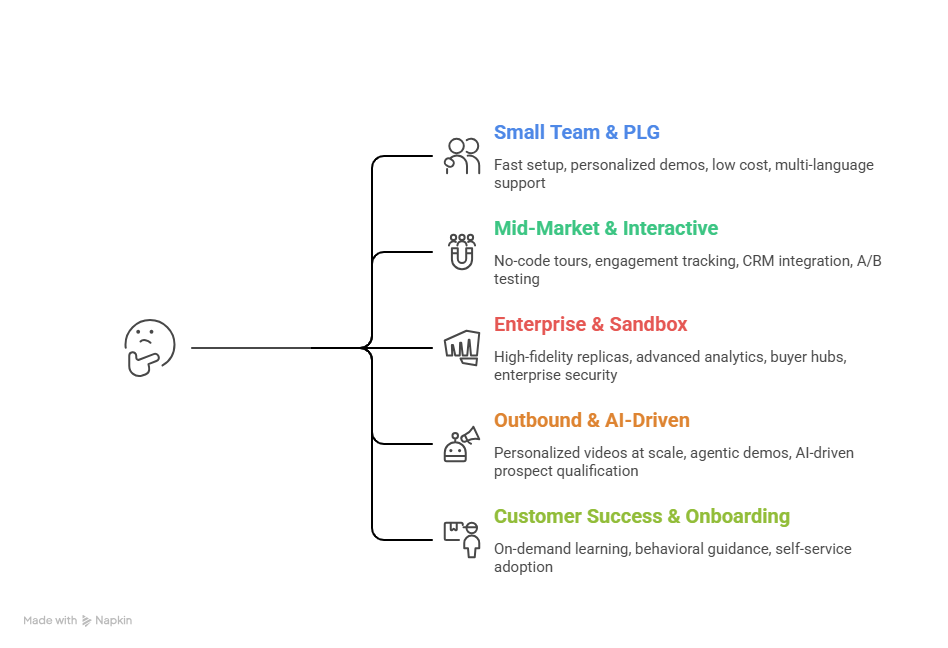
Choosing the right AI product demo software doesn’t have to be overwhelming. Use this one-page checklist and decision flow to align your team’s needs with the right platform.
One-Page Checklist
Team & Workflow
- Team size: Small (1–10) | Mid (10–50) | Large (>50)
- Function: Product Marketing | Sales & Presales | Outbound/SDR | Customer Success
- GTM Motion: Product-Led Growth (PLG) | Enterprise
Technical Needs
- Type of demo: Interactive | Video | Sandbox / Replica | Agentic AI
- Level of personalization required: Basic | Role-based | Multi-language / localized
- Integration: Salesforce | HubSpot | Other CRMs
Operational Considerations
- Implementation ease: Quick no-code | Moderate setup | Technical/SE-heavy
- Budget: <$500/mo | $500–1,500/mo | Enterprise/custom pricing
- Security & compliance: Standard | SOC 2 / GDPR / HIPAA
Decision Flow: Recommended Tool Families
Scenario 1: Small marketing or outbound team, PLG focus, low technical setup
- Tools: Puppydog.io, Storylane, Supademo
- Why: Fast setup, personalized demos, low cost, multi-language support
Scenario 2: Mid-market teams needing interactive demos and moderate analytics
- Tools: Storylane, Navattic, Walnut
- Why: No-code tours, engagement tracking, CRM integration, A/B testing
Scenario 3: Enterprise presales / technical validation/sandbox environments
- Tools: Consensus, Demostack, Reprise
- Why: High-fidelity replicas, advanced analytics, buyer hubs, enterprise security
Scenario 4: Outbound teams or AI-driven SDRs needing hyper-personalized demos
- Tools: Puppydog.io, Karumi
- Why: Personalized videos at scale, agentic demos, AI-driven prospect qualification
Scenario 5: Customer Success/onboarding/training
- Tools: Puppydog.io, Pendo, WalkMe
- Why: On-demand learning, behavioral guidance, self-service adoption
Implementation Playbook: 30-Day AI SDR + Demo Rollout
Launching an AI-powered demo and SDR workflow requires a structured approach to ensure smooth adoption, data accuracy, and measurable impact. Here’s a 30-day playbook to get your team up and running efficiently.
Days 1–14: Foundation
Key Activities:
- CRM Cleanup: Remove duplicates, stale contacts, and ensure data hygiene.
- Define ICP & Segmentation: Identify your Ideal Customer Profile not only by firmographics but also by trigger events that indicate buying readiness.
- Content Plan: Decide which demos, scripts, and collateral will be used for outbound campaigns and nurture sequences.
Week 1–2 KPIs:
- Clean CRM records (% cleaned vs total)
- Number of ICP accounts identified
- Assets & templates ready for automation
Days 15–21: Configuration
Key Activities:
- CRM Integration: Set up bi-directional sync for Salesforce, HubSpot, or other CRM tools.
- Domain Warming: Prepare sending domains to ensure email deliverability and avoid spam filters.
- Template Setup: Configure AI-generated email sequences and demo links tailored to ICP segments.
Week 3 KPIs:
- CRM sync test successful (% of contacts tracking demo activity)
- Email deliverability rates
- Templates and demo links validated and ready
Days 22–30: Launch & Iterate
Key Activities:
- Test Segments: Begin with small batches of ICP contacts to monitor engagement and troubleshoot issues.
- Measure Intent: Track DemoTimeSpent, Completion, LeadIntent, and CTA clicks to assess prospect behavior.
- Refine & Optimize: Adjust messaging, demo links, and follow-up workflows based on initial results.
Week 4 KPIs:
- Engagement metrics (avg. demo completion, time spent)
- Lead scoring accuracy
- SDR handoff efficiency (number of qualified leads vs unqualified)
- Open and response rates for outbound emails
Takeaway:
Following this 30-day framework ensures that AI-powered demo campaigns and SDR outreach are launched systematically, generating reliable data, improving sales efficiency, and accelerating pipeline growth. By monitoring KPIs at each phase, your team can iterate quickly and scale confidently.
Product Demo Automation ROI: What Leaders Are Measuring
AI-powered product demos aren’t just a “nice-to-have”, they deliver tangible business impact when implemented correctly. Understanding the key metrics and benchmarks helps teams justify investment and optimize outcomes.
Typical Impact Metrics
- Deal Size Lift
- Organizations using demo automation report deal sizes increasing by 30–50%.
- Self-qualification through interactive or personalized demos ensures that buyers engaging with sales are already interested and informed, reducing discounting pressure.
- Organizations using demo automation report deal sizes increasing by 30–50%.
- Sales Cycle Reduction
- Automated demos allow prospects to explore products asynchronously, shortening traditional sales cycles by 20–30%.
- SDRs and SEs spend less time on repetitive introductory calls and more on high-value opportunities.
- Automated demos allow prospects to explore products asynchronously, shortening traditional sales cycles by 20–30%.
- SDR Cost Savings
- AI SDR workflows reduce the need for large outbound teams.
- Platforms like Puppydog.io or Karumi can replace human SDR efforts at 70–80% lower cost, freeing budget for strategic hires or campaigns.
- AI SDR workflows reduce the need for large outbound teams.
- Presales Efficiency
- Demo automation eliminates up to 90% of unqualified introductory demos, enabling technical teams to focus on complex POCs and enterprise deals.
- Demo automation eliminates up to 90% of unqualified introductory demos, enabling technical teams to focus on complex POCs and enterprise deals.
Sample KPIs and Benchmark Ranges
Interpretation:
- High completion rates and time spent indicate strong content engagement.
- LeadIntent scores help SDRs prioritize outreach efficiently.
- Demo-influenced pipeline metrics quantify ROI for leadership approval.
Building a Business Case for Leadership
- Start with Pain Points: Highlight inefficiencies in current demo workflows, low conversion, or overloaded SE teams.
- Project Benefits: Use benchmarks above to estimate potential deal size lift, cycle reduction, and cost savings.
- Include TCO vs ROI: Compare subscription or implementation costs against projected labor savings and revenue uplift.
- Highlight Strategic Value: Emphasize scalability, personalization, and alignment with Demo-Led Growth trends, demonstrating future-proofing.
- Show Success Stories: Reference platforms like Puppydog.io or Consensus to illustrate real-world outcomes.
By framing demo automation as both a cost-saving and revenue-accelerating initiative, leadership teams can confidently prioritize AI-powered product demo platforms as a core part of their GTM strategy.
Advanced & Future Trends: Agentic Demos, VR, Security, Localization
The landscape of AI product demos is evolving rapidly. Beyond traditional interactive tours and video demos, next-generation technologies are shaping how companies engage buyers, protect data, and scale globally.
Agentic Demos: Autonomous AI Walkthroughs
What They Are:
Agentic demos leverage AI agents that autonomously navigate the product, answer questions, and guide prospects without a human presenter.
Why They Matter:
- Close the “discovery gap” where buyers would otherwise wait for live demos.
- Enable round-the-clock engagement for global prospects.
- Collect rich behavioral data for lead scoring and CRM updates automatically.
Early Use Cases:
- Outbound SDR campaigns where personalized demos are embedded in emails.
- AI agents qualify prospects in real time during embedded web experiences.
- Multi-language support for international expansion without local headcount.
VR/AR Pilots: Immersive Demos for Specific Verticals
What’s Happening:
Virtual Reality (VR) and Augmented Reality (AR) are entering niche sectors where immersive, spatial demonstrations add significant value.
Examples:
- Architecture software allowing clients to “walk through” 3D models.
- Manufacturing platforms simulating assembly line optimizations.
- Healthcare tools demonstrating complex workflows in an interactive environment.
Impact:
- High engagement and retention in verticals where spatial understanding is critical.
- Early adoption in enterprise pilots, with broader adoption expected as hardware and software costs decline.
Security-First Demos: Protecting Sensitive Data
Key Trends:
As privacy regulations tighten, companies increasingly demand demos that are safe for sensitive data and compliant with standards.
Features to Watch:
- Redaction: Automatically hide sensitive client data in the sandbox or recorded demos.
- Isolated Environments: Ensure demo interactions don’t affect live production systems.
- Compliance: SOC 2, GDPR, HIPAA support for regulated industries.
Why It Matters:
- Enterprise customers prioritize risk-free evaluation.
- Security-first demos reduce friction in adoption for heavily regulated sectors.
Hyper-Localization: Fast, Multi-Language Demos
Trend:
AI-powered platforms now allow companies to generate multi-language demos in minutes, rather than manually creating separate assets for each region.
Benefits:
- Launch global campaigns with minimal friction.
- Reach diverse audiences with role-based and language-specific messaging.
- Maintain consistent branding across markets while personalizing content.
Impact:
- Enhances international sales and outbound efforts.
- Accelerates global adoption and engagement without adding headcount.
Common Objections & How to Overcome Them
Even with AI-powered product demo tools, teams often raise concerns before adoption. Addressing these objections proactively helps leadership and users see the ROI and ease of implementation.
Objection 1: “Demos are expensive to maintain.”
Reality Check: Traditional screen recordings or manual demo updates can be time-consuming and costly, especially when UI changes frequently.
Solution:
- AI Editing & Layered Updates: Platforms like Puppydog.io allow you to update individual elements (buttons, icons, text) without re-recording the entire demo.
- Scalable Content Management: Centralized demo libraries ensure one source of truth, reducing duplication and ongoing maintenance.
Benefit: Lower ongoing costs while keeping demos current and relevant for prospects.
Objection 2: “Buyers prefer live demos.”
Reality Check: While live demos have their place, research shows ~80% of the buying journey is asynchronous. Buyers often self-educate before speaking with sales.
Solution:
- Hybrid Demo Flows: Combine interactive or video demos with occasional live Q&A sessions.
- Strategic Use Cases:
- Use AI-powered or interactive demos for initial engagement.
- Reserve live demos for complex POCs or enterprise negotiations.
- Use AI-powered or interactive demos for initial engagement.
Benefit: Reduces SE bandwidth while still addressing high-touch buyer needs.
Objection 3: “We’re small, can we afford it?”
Reality Check: Many small teams hesitate due to the perceived high costs of demo automation software.
Solution:
- MVP Demo Stacks: Start with low-cost, fast-to-implement tools like Puppydog.io, Supademo, or Storylane.
- Low Barrier to Entry: Platforms priced per creator or at starter tiers allow quick deployment without enterprise budgets.
- Prioritize ROI: Focus on high-value use cases such as outbound outreach or product launches to justify initial spend.
Benefit: Small teams can still access personalized, AI-powered demos without breaking the budget.
Conclusion:
2026 marks a turning point in B2B SaaS sales: product demos are no longer optional. They are the front door to revenue. AI-powered demo platforms like Puppydog.io, Consensus, and Storylane enable teams to deliver personalized, interactive, and scalable experiences that engage buyers, shorten sales cycles, and improve ROI across marketing, sales, outbound, and customer success functions. Choosing the right tool depends on your team size, GTM motion, technical needs, and budget, but the trend is clear: intelligent, always-on demos are the future of buyer engagement.
Ready to elevate your demos and see results fast? Start creating personalized AI product demos today with Puppydog.io and experience the power of scalable, editable, and high-impact demo videos for your team.
FAQs ( Frequently Asked Questions )
What is AI product demo software?
AI product demo software uses artificial intelligence to create personalized, interactive, or video-based product demonstrations. It allows buyers to explore your software asynchronously while capturing engagement data, automating repetitive tasks, and helping sales, marketing, and customer success teams scale their efforts.
What's the difference between an interactive demo and a video demo?
Interactive demos let users click, scroll, and explore the software themselves, often using HTML/CSS capture or sandbox environments. Video demos are narrative-driven, AI-generated walkthroughs where viewers watch a guided presentation. Interactive demos are ideal for engagement and self-discovery, while video demos are faster to produce and great for storytelling or outbound campaigns.
Which AI demo tool is best for small SaaS teams?
For small teams, tools like Puppydog.io, Storylane, or Supademo are ideal. They offer fast setup, low-cost entry tiers, and easy personalization, allowing small SaaS teams to create high-impact demos without needing large presales or technical teams.
How much does AI demo software cost?
Pricing varies by platform and feature set:
- Entry-level tools Entry-level tools (Puppydog.io, Supademo) can start as low as free, with Puppydog.io's paid Pro tier at $42 per user per month.
- Mid-tier solutions (Storylane, Navattic) typically range from $500–$1,500 per month.
- Enterprise platforms (Consensus, Demostack, Reprise) often require custom pricing, with costs reflecting high-fidelity environments, advanced analytics, and enterprise security features.
Do I still need live demos if I use demo automation software?
Yes, but selectively. AI-powered demos handle most asynchronous exploration, allowing prospects to self-qualify before speaking to a rep. Live demos are still valuable for complex POCs, enterprise deals, or highly technical walkthroughs, where personalized guidance is needed.
What is the best AI demo tool for outbound sales?
Puppydog.io and Karumi are top choices for outbound teams. Puppydog.io allows you to attach personalized video demos to outreach emails, while Karumi uses agentic AI demos to autonomously guide prospects and qualify them in real time. These tools help increase response rates and engagement in outbound campaigns.
What's the best AI demo tool for customer success teams?
For customer success and adoption, Puppydog.io, WalkMe, and Pendo are effective. They help create on-demand training videos, interactive guides, and in-product learning paths that improve onboarding, feature adoption, and churn reduction.
How do I measure the ROI of a demo automation tool?
ROI can be measured across several key metrics:
- Deal size lift: Increase in average contract value from qualified prospects.
- Sales cycle reduction: Shortened time from first demo engagement to closed deal.
- SDR efficiency: Cost savings from AI-assisted outreach and reduced unqualified demos.
- Presales effectiveness: Fewer repetitive demos, allowing SEs to focus on high-value opportunities.
- Engagement analytics: Demo completion rates, time spent, LeadIntent scoring, and CRM-tracked pipeline influence.
These KPIs help teams justify investment, optimize workflows, and demonstrate value to leadership.

Sarah Thompson is a storyteller at heart and Business Developer at PuppyDog.io. She’s passionate about creating meaningful content that connects people with ideas, especially where technology and creativity meet.