B2B Video Marketing Strategy: The Enterprise Playbook for 2026


Let's start with a number that should stop you mid-scroll: 91% of businesses now use video as a core marketing tool. Not a "nice to have." Not a quarterly experiment. A core tool baked into how they generate pipeline, close deals, and retain customers.
And yet, most B2B teams are still treating video like a campaign asset they dust off twice a year. A product launch here, a brand film there. Meanwhile, their buyers are watching an average of 14.3 videos per week before making a purchase decision.
The gap between how buyers consume content and how most teams produce it? That's where revenue is getting lost.
The shift happening right now isn't just about format preference. It's structural. Enterprise go-to-market teams are rebuilding their entire content motion around video not because it looks good on a deck, but because it demonstrably shortens sales cycles, improves conversion rates, and builds the kind of trust that moves million-dollar deals forward.
This is your strategic playbook for 2026. Whether you're a Demand Generation Manager trying to fill a pipeline or a Product Marketer launching a new feature, what follows is a practical, proven framework for building a B2B video marketing strategy that actually drives revenue.
The 5 Video Types Every B2B Team Needs in 2026
Not all videos are created equal, and in enterprise B2B, that distinction matters a lot. Producing content without mapping it to a specific stage of the buyer journey is one of the most common (and costly) mistakes teams make. So before you hit record on anything, here's what your video mix should actually look like.
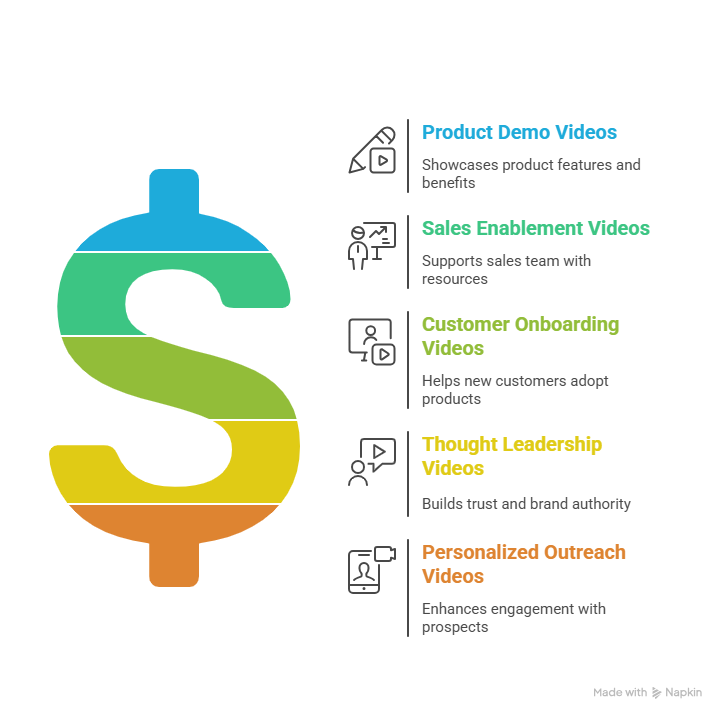
1. Product Demo Videos
If there's one video format that directly influences purchase decisions, it's the product demo video. These sit firmly in the middle of the funnel, where buyers are actively evaluating solutions and comparing alternatives. A well-executed demo doesn't just show features, it answers the unspoken question every buyer has: "Will this actually work for my situation?"
The numbers back this up. Product demo videos account for 47% of all business videos produced, and deals where buyers consumed three or more vendor videos closed 28% more often than deals where they didn't. That's not a marginal lift, that's a fundamental shift in close rates.
The key is specificity. Generic "here's everything our platform does" walkthroughs are losing ground to role-based and industry-specific demos that speak directly to a CFO's cost concerns or a CTO's integration worries. PuppyDog's AI-powered demo video maker makes it possible to create these tailored demos at scale, without a full production team behind every asset.
2. Sales Enablement Videos
Sales enablement videos are the unsung heroes of the revenue funnel. These aren't glamorous brand films, they're the practical, bottom-of-funnel assets that help your sales team close. Think ROI walkthroughs, competitive comparison breakdowns, objection-handling clips, and post-meeting follow-up videos that keep momentum alive between calls.
What makes them powerful is timing. A well-placed sales enablement video sent 24 hours after a discovery call can do more than a 10-page proposal. It keeps your brand visible, reinforces key messages, and gives the internal champion something tangible to share with the rest of the buying committee.
3. Customer Onboarding Videos
Here's a video type that often gets overlooked in the acquisition-obsessed world of B2B marketing: onboarding content. Once a deal is closed, the real work begins, and video is one of the most effective tools for reducing time-to-value, cutting support ticket volume, and improving product adoption.
Companies that invest in structured video onboarding report significantly lower churn and higher net revenue retention. If your customer success team is still relying on lengthy PDF guides or one-size-fits-all webinars, it might be time to rethink that approach. PuppyDog's customer success solution is built specifically for this, turning product walkthroughs into personalized onboarding experiences that actually stick.
4. Thought Leadership & Brand Videos
At the top of the funnel, the goal isn't to sell, it's to be remembered. Thought leadership videos, expert interviews, founder-led content, and brand narrative films build the kind of slow-burn trust that eventually converts.
Here's a stat worth saving: founder-led video content generates 3.2x more inbound demo requests than standard company page posts. Buyers want to hear from real people with real opinions, not polished corporate messaging. Short-form content under 60 seconds on LinkedIn is currently growing twice as fast as any other format on the platform, which makes this a high-ROI investment even for lean teams.
5. Personalized Outreach Videos
Cold outreach is broken. Open rates are down, reply rates are painful, and most prospects can smell a templated email from a mile away. Personalized video messages, even short, 60-second clips that reference a prospect's company, role, or a specific pain point, cut through that noise in a way text simply can't.
Sales teams using personalized video in their prospecting sequences report 2–3x higher response rates compared to traditional email alone. And with AI-powered tools making personalization scalable, there's really no excuse for still sending the same message to 500 different prospects.
Building Your B2B Video Marketing Strategy: A 6-Step Framework
Having great video ideas is one thing. Having a system that consistently turns those ideas into pipeline is another. Most B2B teams struggle not because they lack creativity, they struggle because they lack structure. This six-step framework is designed to fix that, giving you a repeatable, scalable approach to enterprise video strategy that connects content to revenue.
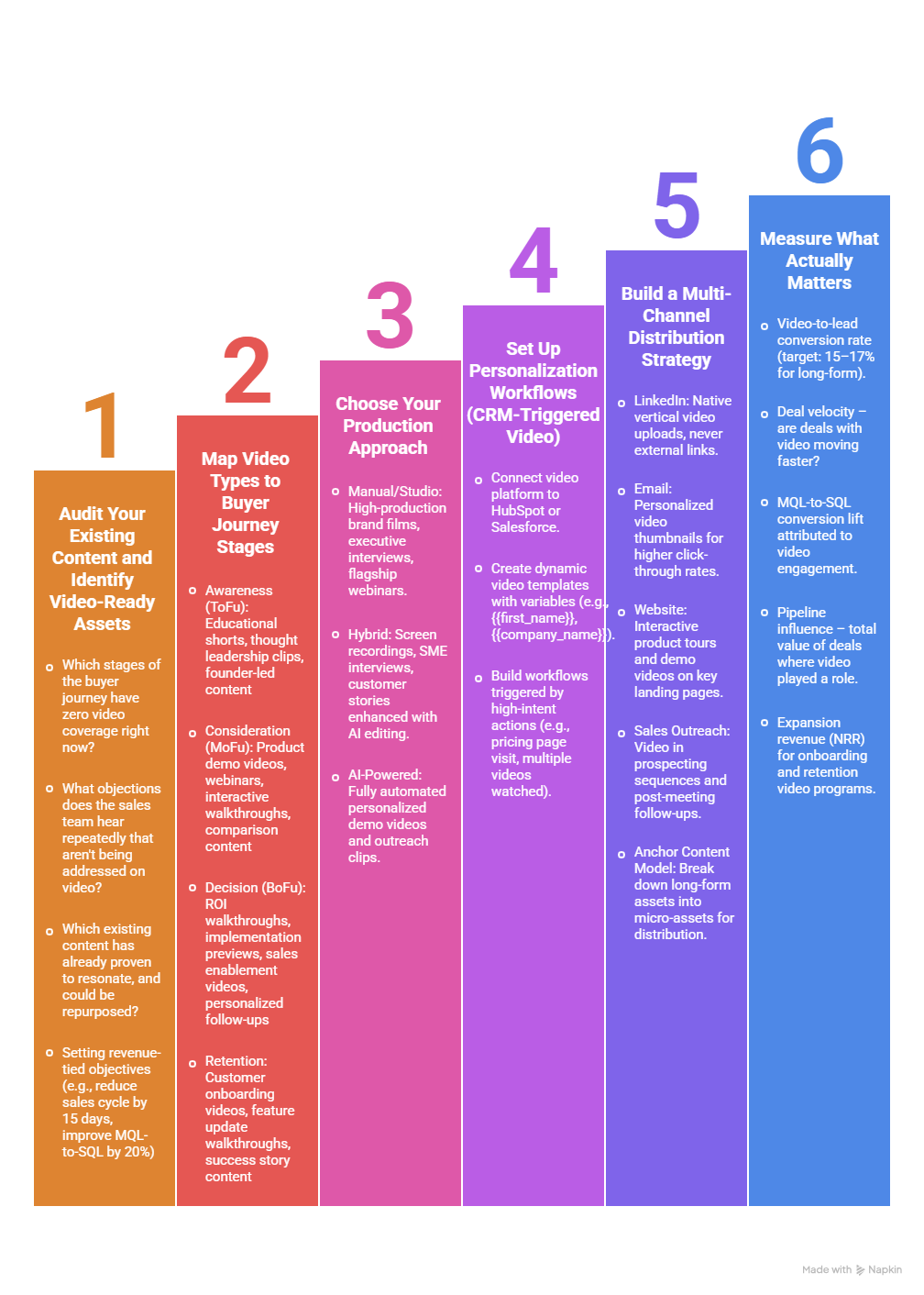
Step 1: Audit Your Existing Content and Identify Video-Ready Assets
Before you produce a single new asset, look at what you already have. Sales decks, webinar recordings, onboarding guides, blog posts, customer case studies, most of these contain the raw material for compelling video content. The goal here isn't to start from scratch; it's to identify gaps and opportunities.
Ask yourself three questions during this audit:
- Which stages of the buyer journey have zero video coverage right now?
- What objections does the sales team hear repeatedly that aren't being addressed on video?
- Which existing content has already proven to resonate, and could be repurposed?
This stage also involves setting goals that actually mean something. Not "increase video views", but "reduce average sales cycle by 15 days" or "improve MQL-to-SQL conversion by 20%." Revenue-tied objectives keep the entire strategy grounded in commercial reality.
Step 2: Map Video Types to Buyer Journey Stages
Once you know what you have (and what's missing), the next step is intentional mapping. Every video you produce should serve a specific stage of the journey and address a specific buyer need, not just fill a content calendar.
A simple but effective mapping looks like this:
- Awareness (ToFu): Educational shorts, thought leadership clips, founder-led content
- Consideration (MoFu): Product demo videos, webinars, interactive walkthroughs, comparison content
- Decision (BoFu): ROI walkthroughs, implementation previews, sales enablement videos, personalized follow-ups
- Retention: Customer onboarding videos, feature update walkthroughs, success story content
One thing enterprise teams often miss is the retention layer. Acquiring a customer and then going dark on video is a missed opportunity, especially when expansion revenue is increasingly where growth happens for SaaS businesses.
Step 3: Choose Your Production Approach
Let's be honest, not every team has the budget or bandwidth for high-production video shoots. And in 2026, they don't need to. AI has fundamentally changed the production economics of video, cutting average costs by 41% while boosting output volume by 68%.
Your production approach will likely fall into one of three models:
- Manual/Studio: High-production brand films, executive interviews, flagship webinars. Reserved for top-of-funnel brand building where quality signals credibility.
- Hybrid: Screen recordings, SME interviews, and customer stories enhanced with AI editing and captions. The sweet spot for most mid-market and enterprise teams.
- AI-Powered: Fully automated personalized demo videos and outreach clips generated at scale. Ideal for sales prospecting, onboarding, and feature announcements.
The smartest teams aren't choosing one approach, they're using all three, depending on the purpose and funnel stage. Creating product demos with AI has become particularly accessible, making it possible for product marketers to ship polished demo content without waiting weeks for a production cycle.
Step 4: Set Up Personalization Workflows (CRM-Triggered Video)
This is where strategy starts to separate good teams from great ones. CRM-triggered video workflows allow you to deliver the right video to the right person at exactly the right moment automatically.
The setup involves connecting your video platform to HubSpot or Salesforce, creating dynamic video templates with variables like {{first_name}}, {{company_name}}, and {{industry}}, and then building workflows triggered by high-intent actions, a form submission, a pricing page visit, or a third demo video watched in a single session.
When a high-value account hits that third video threshold? Your sales rep gets an alert. That's not just automation, that's intent-based precision that transforms how teams prioritize outreach.
Step 5: Build a Multi-Channel Distribution Strategy
A great video with poor distribution is just an expensive file sitting on a server. Distribution needs to be as deliberate as production. Here's how high-performing enterprise teams are thinking about it in 2026:
- LinkedIn: Native vertical video uploads only, never external links. The algorithm rewards content that keeps users on the platform, and vertical format drives 1,450% more engagement than text or image posts.
- Email: Personalized video thumbnails in outreach sequences consistently deliver 8x better click-through rates than text-only emails.
- Website: Interactive product tours and demo videos on key landing pages drive 2x higher conversion rates versus static pages.
- Sales Outreach: Video in prospecting sequences and post-meeting follow-ups keeps deals warm between touchpoints.
One underrated move: the Anchor Content Model. Record one long-form asset, a webinar, expert interview, or detailed product walkthrough, and systematically break it into 8 to 15 micro-assets for multi-platform distribution. It sounds like extra work upfront, but it's actually the most efficient way to maintain consistent visibility throughout a 60-to-180-day enterprise sales cycle without burning out your team.
Step 6: Measure What Actually Matters
Views are vanity. Pipeline is reality. If your video reporting stops at play counts and watch time, you're measuring the wrong things.
The metrics that matter in 2026 are:
- Video-to-lead conversion rate (target: 15–17% for long-form content)
- Deal velocity is deals where video was consumed, moving faster through the pipeline?
- MQL-to-SQL conversion lift attributed to video engagement
- Pipeline influence total value of deals where video played a role
- Expansion revenue (NRR) for onboarding and retention video programs
The shift from vanity metrics to management KPIs isn't just a reporting preference. It's what gets video programs protected when budget conversations happen. When you can show that video-engaged accounts close 28% more often and 18 days faster, the ROI case makes itself.
Video Prospecting & Personalization at Scale
Here's the personalization paradox that every B2B marketing and sales team eventually runs into: the more personalized your outreach, the better it performs, but the more time it takes to produce. And time, as any sales rep managing a 200-account territory will tell you, is the one thing they never have enough of.
For years, the choice was binary. Either you sent generic mass messaging and accepted mediocre reply rates, or you hand-crafted individual video messages and exhausted your team doing it. In 2026, AI has quietly dismantled that trade-off entirely.
The Rise of AI-Powered Video Prospecting
Video prospecting, sending short, personalized video messages as part of a sales outreach sequence, has moved from a scrappy sales hack to a mainstream growth strategy. And the results are hard to argue with. Sales teams using personalized video in their prospecting workflows report 2–3x higher response rates compared to text-only email sequences. When you add a personalized video thumbnail to a cold email, click-through rates improve by 8x.
What's changed in 2026 is the ability to deliver that level of personalization without the manual overhead. AI-powered platforms can now generate customized video messages at scale, dynamically inserting a prospect's name, company, industry pain point, or even a reference to their recent LinkedIn activity, all triggered automatically by CRM signals.
Think about what that means practically. A single sales rep can maintain genuinely personal video touchpoints across hundreds of active accounts, spending less than an hour a day on actual production. That's not just efficiency, it's a fundamental shift in how enterprise sales teams operate.
Personalized Video Marketing Beyond Prospecting
The personalization opportunity doesn't stop at cold outreach. Personalized video marketing is equally powerful further down the funnel, in post-demo follow-ups, proposal walkthroughs, renewal conversations, and even customer onboarding sequences.
AI-personalized landing pages that serve video content based on a visitor's industry or referral source have shown conversion lifts of 112% in enterprise software verticals. That kind of result doesn't come from better copywriting alone, it comes from making every buyer feel like the content was built specifically for them.
The companies winning in 2026 aren't just producing more video. They're producing smarter video, content that adapts to the audience rather than forcing the audience to adapt to the content.
Ready to see what personalized demo videos can do for your pipeline? PuppyDog uses AI to turn your screen recordings and screenshots into fully personalized product demo videos, automatically. No production team required. Start your free trial.
Enterprise Case Study Spotlight: What Real Results Look Like
Strategy frameworks are useful. Actual results are more convincing. Here's what happens when the principles outlined above get put into practice, both at the enterprise level and with PuppyDog's own customers.
SarcMedIQ: Personalized Demos That Open Doors
SarcMedIQ, a leading Cloud PACS provider operating in one of the most competitive and compliance-heavy verticals in healthcare technology, faced a challenge that many B2B SaaS teams know well: how do you break through to busy hospital administrators and physician offices who are already flooded with vendor outreach?
Generic demos weren't cutting it. The buying committee in healthcare is notoriously complex multiple stakeholders, long procurement cycles, and a very low tolerance for content that doesn't speak directly to their operational reality.
By partnering with PuppyDog to deploy AI-powered personalized demo videos, SarcMedIQ fundamentally changed how they approached outbound. Instead of sending a one-size-fits-all product walkthrough, they delivered tailored demos that reflected the specific workflows, pain points, and priorities of each target account.
The results spoke for themselves. Asaad Hakeem, CEO of SarcMedIQ, put it plainly: PuppyDog's platform had "significantly boosted our outreach efforts," enabling the team to successfully engage multiple hospitals and physician offices and generate genuine interest in their product at a scale they hadn't achieved before. He described it as "an indispensable tool" for their marketing strategy, not a nice-to-have, but a core part of how they go to market.
Re-Engagement Campaign: Turning Cold Leads Warm Again
One of the most underutilized opportunities in B2B pipeline management is the dormant lead list, prospects who showed interest at some point, then went quiet. Most teams either send a generic "just checking in" email or write those contacts off entirely.
PuppyDog's platform was used to run a targeted re-engagement campaign for a customer who took a different approach. Using personalized demo videos triggered by CRM data, they reached back out to cold contacts with content that felt relevant and timely rather than intrusive.
The outcome? The campaign "far exceeded expectations in terms of reply rates, meetings booked, and reactivated leads", a result that's difficult to achieve with standard email sequences alone. The combination of personalization and video format gave the outreach a human quality that cut through the noise.
The Bigger Picture: $3.6M in Qualified Pipeline
These aren't isolated wins. Since launching in April 2024, PuppyDog's customers have collectively generated over $3.6 million in qualified leads through AI-powered personalized demo videos. That figure reflects something important: personalized video at scale isn't just a productivity play, it's a revenue play.
The platform also carries the backing of Andrew Ng's AI Fund, whose endorsement reflects a broader conviction that hyper-personalized demo automation is one of the most commercially significant applications of generative AI in the B2B space right now.
Tools & Technology Stack for B2B Video Marketing in 2026
The right strategy only gets you so far. At some point, execution comes down to the tools you're using, and in 2026, the B2B video tech stack has matured significantly. Most high-performing teams now run a combination of specialized platforms rather than relying on a single all-in-one solution. Here's how the landscape breaks down.
AI Video Generation & Personalization
Synthesia and HeyGen dominate the avatar-led video space. Synthesia is the go-to for enterprise teams that need multilingual content at scale, supporting 140+ languages with strong security compliance. HeyGen tends to appeal more to marketers who want creative flexibility and polished avatar styles for outbound campaigns.
But both platforms share a common limitation: they're built for content creation, not for demo-specific personalization tied to your product and CRM data.
That's precisely the gap PuppyDog was built to fill. Unlike general-purpose AI video tools, PuppyDog is purpose-built for B2B sales and marketing teams that need to turn screen recordings or screenshots into fully personalized product demo videos automatically, and at scale. It's the only platform that combines AI-powered demo creation, prospect-level personalization, and CRM integration in a single workflow. You can check out how it compares to other tools in this roundup of the best product demo tools for campaigns.
Interactive Demo Platforms
For teams building self-serve product experiences, platforms like Navattic and Supademo are strong options. Navattic is well-suited for enterprise HTML cloning with deep fidelity, while Supademo is a faster, more budget-friendly option for screenshot-based guided tours. These tools excel at letting buyers explore a product on their own terms, but they still require manual build time and ongoing maintenance.
Video Hosting & Analytics
Vidyard and Wistia remain the gold standard for video hosting with CRM-connected analytics. Vidyard is the preferred choice for sales teams who need real-time alerts when a prospect watches a video, while Wistia shines for marketing teams that want clean, ad-free on-site video experiences with detailed engagement data.
The key difference between a functional video stack and a revenue-generating one? Integration. Tools that talk to each other, passing engagement signals back into your CRM and triggering the right follow-up at the right time, are what separate teams that produce video from teams that profit from it.
The Bottom Line: Video Is Now a Revenue Function, Not a Marketing Tactic
If there's one thing this playbook should make clear, it's that B2B video marketing in 2026 is no longer about producing polished content and hoping it lands. It's about building a system — one that maps the right video to the right buyer at the right moment, measures what actually moves pipeline, and improves with every cycle.
The six-step framework outlined here gives you exactly that structure:
- Audit what you have and set revenue-tied goals
- Map video types to specific buyer journey stages
- Choose a production approach that matches your resources
- Automate personalization through CRM-triggered video workflows
- Distribute natively across the channels your buyers actually use
- Measure pipeline influence, deal velocity, and conversion lift, not just views
The teams winning in 2026 aren't necessarily the ones with the biggest budgets or the slickest production values. They're the ones who've made video a consistent, measurable, and deeply personalized part of how they sell.
That's not as complicated as it sounds, especially when the right tools do the heavy lifting for you.
PuppyDog turns your screen recordings and screenshots into AI-powered, personalized product demo videos in minutes. No production team. No editing bottlenecks. Just demos that speak directly to each prospect's needs, automatically.

Sarah Thompson is a storyteller at heart and Business Developer at PuppyDog.io. She’s passionate about creating meaningful content that connects people with ideas, especially where technology and creativity meet.