AI-Generated How-To Videos for SaaS Customer Success Teams


Here's a number worth pausing on: 96% of consumers have watched a how-to video to understand a product or service. Not a brochure. Not a PDF. A video.
So if your users are already showing up expecting to watch how your software works, the real question isn't whether your Customer Success team should be creating how-to videos. It's whether the way you're creating them right now is actually sustainable.
Let's be honest, for most CS teams, it isn't.
A single three-minute tutorial can take anywhere from 12 to 15 hours to produce when you factor in scripting, screen recording, voiceover, editing, and branding. That's two full workdays. For one video. Meanwhile, your product UI is getting updated every few weeks, your account list is growing, and your inbox is full of the same five support questions it was full of last month.
This is exactly the gap that AI how-to video tools are designed to close, turning what used to be a production bottleneck into something a CSM can handle in under an hour, without a film degree or a video editing suite.
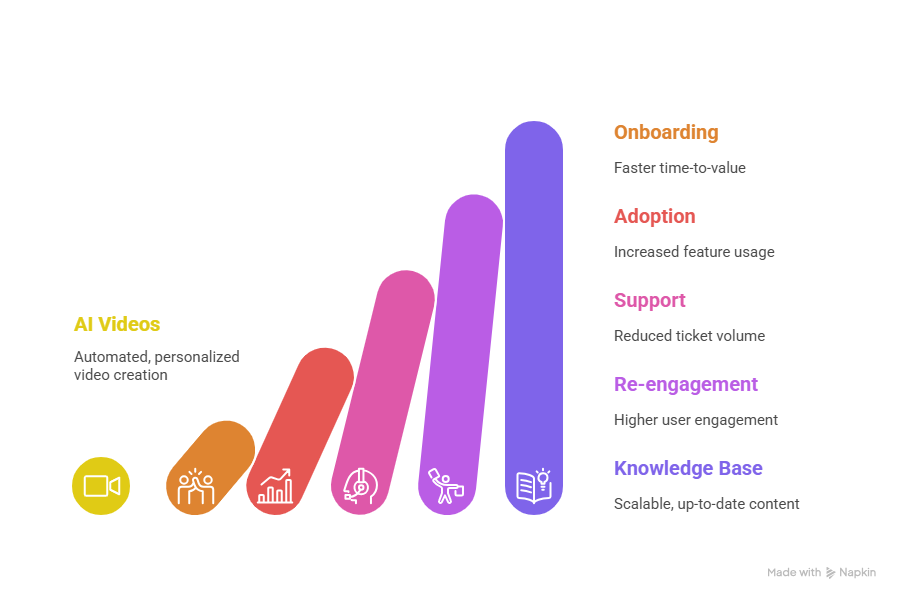
Below are five real scenarios where AI-generated how-to videos don't just save time, they genuinely move the needle on onboarding, retention, and support efficiency.
1. Onboarding a New Customer Cohort, Without Scheduling 40 Calls
The Situation: It's the first week of the month. You've just onboarded 80 new accounts, spread across three different industries. Each one has slightly different workflows, slightly different terminology, and very different expectations of what "getting started" looks like.
The Pain: You can't book 80 onboarding calls. Even if you could, a generic walkthrough that works for a legal firm is going to leave a creative agency completely cold. Completion rates for one-size-fits-all onboarding videos hover below 30% for exactly this reason. People tune out when the content doesn't speak to their world.
How AI Video Solves It: With a platform like PuppyDog, your CS team can generate vertical-specific onboarding walkthroughs from a single screen recording. A legal user sees a walkthrough built around case files and billing workflows. A creative user sees asset management and client approvals. Same product, totally different experience, produced in a fraction of the time it would take to manually recreate each one.
The impact here is real. Personalized onboarding has been shown to cut Time-to-Value (TTV) by up to 50%, which directly lowers early-stage churn. When users reach their first "Aha!" moment faster, they stick around longer. It's that straightforward.
2. Announcing a New Feature, Without Writing a Wall of Text
The Situation: Your product team just shipped a significant update. It's genuinely useful. It'll save your power users hours every week. You need customers to actually use it.
The Pain: You send an email with a link to the release notes. A month later, product analytics show that 5% of your user base has touched the new feature. The other 95%? They either didn't open the email, skimmed past the PDF, or clicked away when they saw how long it was.
How AI Video Solves It: Instead of a long-form announcement, your team uses customer success video automation to turn the product spec into a 60-second micro-demo, one that shows the feature in action, not just describes it. Better yet, with AI personalization, you can generate variations for your top enterprise accounts that include their company name, their specific use case, and a voiceover that speaks directly to their workflow.
The numbers on this are hard to ignore. AI-generated feature clips have been documented to increase feature adoption rates by 300% compared to static content. A video that shows someone exactly how a feature works inside their actual context is simply more persuasive than a PDF ever will be.
3. Deflecting Repetitive Support Tickets: With a Self-Serve Video Library
The Situation: Your support queue is backed up. Response times are slipping past 24 hours. Your agents are sharp, capable people, and they're spending 60% of their time answering the same five questions.
The Pain: "How do I export my report?" "How do I add a new user?" "Where do I find the billing settings?" These are Level 1 questions. They don't require an expert. But without a reliable self-serve resource, they keep landing in the queue anyway.
How AI Video Solves It: Identify your top 10 most common support queries and turn each one into a short, searchable how-to video. Embed them in your chatbot auto-replies, your help center articles, and your onboarding email sequences. When a user types "how do I export," they get a video answer instantly, no ticket, no wait, no agent required.
Organizations that implement this approach consistently report a 60% reduction in support tickets. That's not a rounding error. That's your team getting half their day back to focus on the complex, high-value issues that actually require human judgment. This is what reducing support tickets with video looks like in practice — not just a cost-saving tactic, but a quality-of-service upgrade for everyone.
4. Re-Engaging Inactive Users, Before They Quietly Churn
The Situation: Your CS platform flags a segment of 300 users who haven't logged in for two weeks. Renewal is three months away, but the clock is already ticking.
The Pain: You send a "we miss you" email. Open rate: 8%. Click-through: negligible. The users who were already disengaged have zero reason to respond to a generic nudge that could have been sent by anyone, to anyone.
How AI Video Solves It: This is where personalized customer education video really earns its keep. Instead of a bland re-engagement email, your AI tool pulls data from the user's last session — say, they were halfway through setting up a payroll template — and generates a message that references exactly where they left off. "Hi Marcus, we noticed you were in the middle of your payroll setup. We've since updated the tax tables for your region — here's a quick 45-second walkthrough of what changed and how to finish in three clicks."
That level of specificity changes the dynamic entirely. It doesn't feel like a mass email. It feels like someone on your team actually noticed. Personalized video re-engagement campaigns have shown engagement rates up to 65% higher than generic outreach, and more importantly, they surface at-risk users early enough to actually do something about it.
5. Scaling Your Knowledge Base, Without a Video Production Team
The Situation: Your product has grown. What started as a scrappy 10-feature tool is now a comprehensive platform with integrations, admin controls, and a genuinely deep feature set. Your knowledge base hasn't kept up.
The Pain: You have maybe 20 tutorial videos, most of them made 18 months ago, several of them pointing to UI screens that no longer exist. Users follow along faithfully until the screen they're looking at doesn't match what's in the video, and then they abandon the task and open a ticket.
This is what researchers call the "UI Fragility Problem," and it's one of the most quietly damaging issues in SaaS support. In many manual video libraries, only about 10% of the content is genuinely current and accurate.
How AI Video Solves It: PuppyDog's AI video approach dramatically compresses the time it takes to build and maintain a comprehensive tutorial library. When your UI gets updated, you don't re-record everything from scratch. You upload one new screenshot, and the AI re-renders the affected videos with updated visuals and voiceover. What used to take days of editing takes minutes.
This shifts your knowledge base from a static document graveyard into a living, evolving resource that actually stays in sync with your product. For a global SaaS team, this also opens the door to instant localization. The same workflow that produces an English tutorial can generate a German or Japanese version without hiring a single voice actor.
The Bigger Picture: Educational Velocity Is a Retention Strategy
Here's the through line connecting all five of these scenarios: customers who understand your product stay. Customers who are confused leave.
It sounds almost too obvious to say out loud. But the reality is that most CS teams are still treating video production as a nice-to-have, something to get to when there's bandwidth, something that requires a production budget and a creative team and a careful review cycle. The result is a knowledge base full of gaps, an onboarding experience that relies heavily on live calls, and a support queue full of questions that a 60-second video could have answered at midnight on a Sunday.
AI how-to videos for customer success aren't about replacing the human side of CS. They're about making sure the human moments, the QBRs, the strategic check-ins, the complex troubleshooting sessions, are spent on things that actually require a human. The repetitive stuff? Let automation handle it.
Start Small. Start This Week.
You don't need to rebuild your entire video library on day one. Pull up your support ticket data and find your top five most frequently asked questions. Those five questions are your starting point.
Turn each one into a 60-second AI-generated how-to video. Drop them into your help center and your chatbot. See what happens to your ticket volume over the next 30 days.
That's not a big project. That's an afternoon, if you have the right tool.
Start your free trial with PuppyDog and see how fast your CS team can go from "we should really make more videos" to actually having them.

Sarah Thompson is a storyteller at heart and Business Developer at PuppyDog.io. She’s passionate about creating meaningful content that connects people with ideas, especially where technology and creativity meet.