Puppydog vs. Gemini: Multimodal AI vs. a Purpose-Built Product Video Engine

The Multimodal Moment: Why Everyone Is Talking About Gemini
We’re living in the era of multimodal AI. Tools like Gemini and Google’s Veo 3.1 have changed what “content creation” even means.
You can now:
- Generate cinematic video from text prompts
- Turn images into moving scenes
- Add voice, music, and narration in a single pass
- Build creative campaigns without a production team
Honestly, it feels a bit like magic.
So it’s no surprise that PMMs and demand gen leaders are asking:
“Do we still need a dedicated product demo platform… or can we just use Gemini?”
That question is everywhere right now.
And it’s a good question. But it’s also slightly the wrong framing.
Because product demos aren’t just content.
They’re operational systems.
What Gemini Does Really Well (And This Matters)
Before we compare, let’s be fair. Google Gemini and Veo are genuinely powerful.
Here’s where they shine:
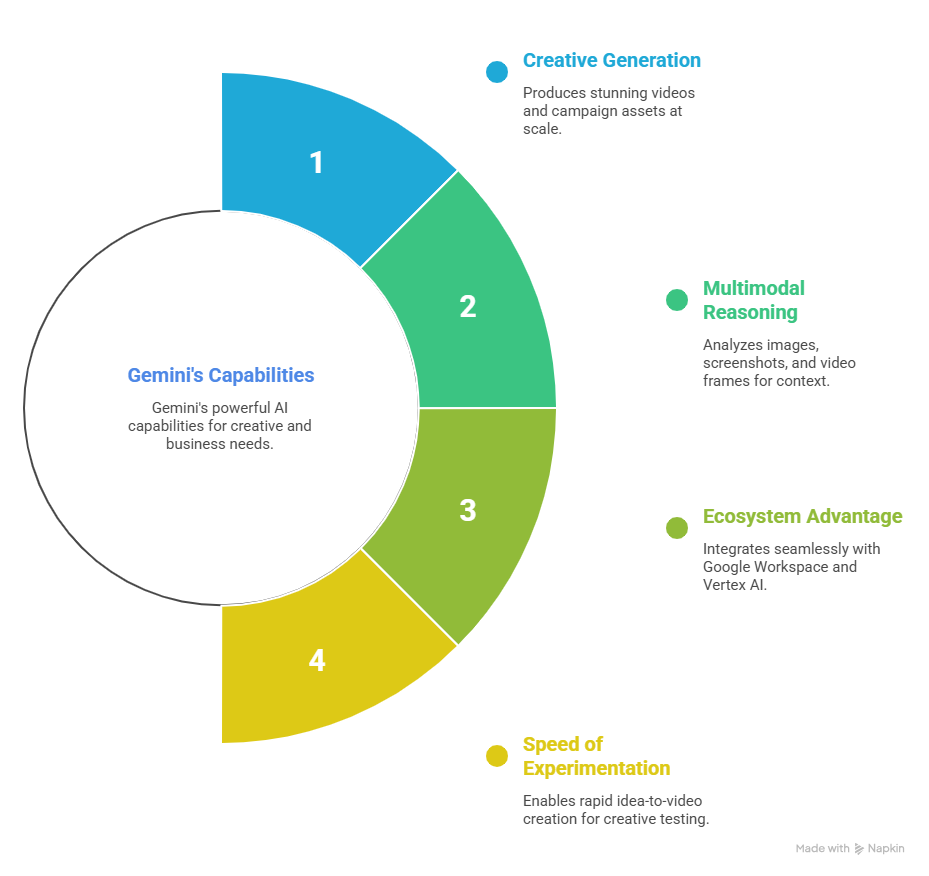
1. Creative generation at scale
Gemini can produce visually stunning “hero” videos, campaign assets, and storytelling content that would normally require agencies.
2. Multimodal reasoning
It can analyze images, screenshots, and even video frames, then generate context-aware outputs.
3. Ecosystem advantage
Deep integration with Google Workspace, Vertex AI, and advertising tools makes it extremely attractive for enterprise teams already inside that ecosystem.
4. Speed of experimentation
You can go from idea → video in minutes, which is perfect for top-of-funnel creative testing.
So yes, Gemini is not “just another AI tool.” It’s a platform shift.
But here’s the catch…
None of this guarantees accurate product demos.
The Problem Nobody Talks About: A Product Demo Is Not a Video
This is where most teams start going wrong.
A product demo is not a creative video.
It is:
- A guided walkthrough of your real UI
- A representation of your actual product behavior
- A trust-building asset used in sales conversations
- A measurable step in the revenue journey
Now compare that with generative video tools.
Even with Veo, Gemini is still fundamentally:
- Predicting what a UI might look like
- Generating visuals from patterns in training data
- Optimizing for realism, not factual accuracy
And that creates a real business risk.
Because in B2B SaaS, if a button is in the wrong place or a workflow looks slightly “off”… buyers notice immediately.
And once trust breaks, conversion drops.
What a Real Product Demo Actually Requires
Let’s break this down properly. A serious B2B demo system needs more than video generation.
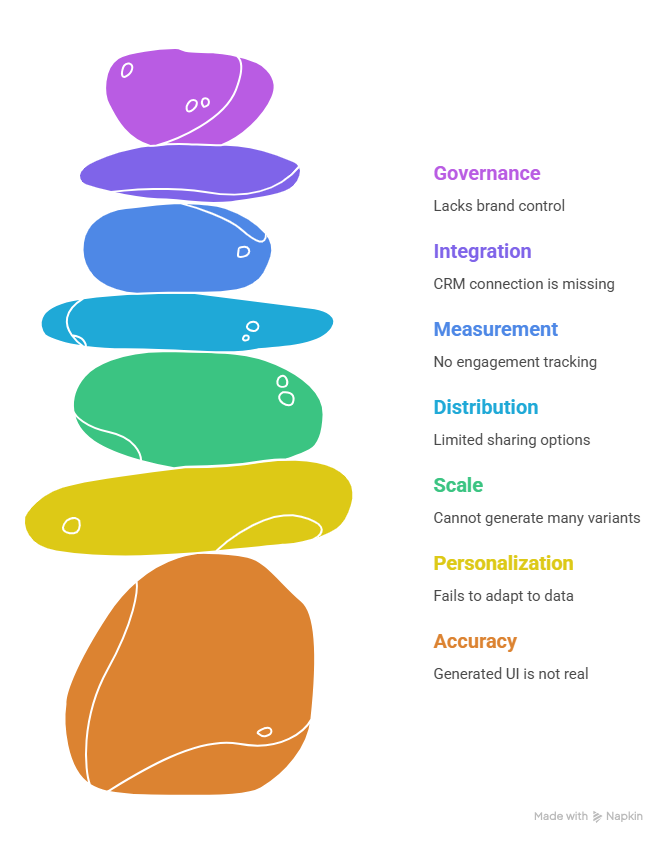
The 7 Non-Negotiables
- Accuracy
It must show your real product UI, not a generated interpretation. - Personalization
It should adapt per account, persona, and CRM data. - Scale
You should be able to generate hundreds or thousands of variants without redoing work. - Distribution
Hosting, embeds, landing pages, email sharing, not just exporting a video file. - Measurement
Who watched, where they dropped off, and what they engaged with. - Integration
CRM systems like Salesforce or HubSpot must connect directly. - Governance
Brand control, approvals, compliance, and consistency.
Now ask yourself honestly:
Does a general-purpose AI video model handle all seven?
Not really.
And this is where the category split becomes obvious.
Puppydog: Built for Revenue Teams, Not Creators
This is where Puppydog.io takes a completely different approach.
Instead of starting with a prompt, it starts with reality.
Capture-to-narrative workflow
You record your real product once.
Then Puppydog builds everything around that.
It:
- Turns screen recordings into structured demos
- Auto-writes scripts based on real UI flow
- Generates voiceovers and narration
- Injects CRM-based personalization
- Produces multiple versions for different audiences
This is not “video creation.”
It’s a demo automation infrastructure.
Side-by-Side Comparison (Simple View)
Here’s the clearest breakdown:
Where the Gap Shows Up Between Gemini and Puppydog
This is where the real decision becomes obvious.
On paper, both Google Gemini and Puppydog.io can “generate videos.” But in real B2B SaaS workflows, that’s not the problem teams are trying to solve.
The real question is:
Can this tool reliably turn my product into a revenue-driving, scalable demo system?
And that’s where the gap shows up across six critical areas.
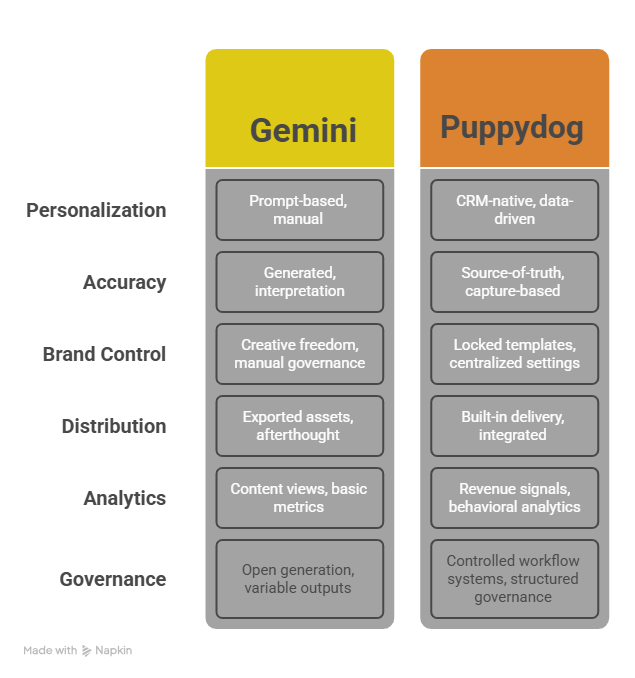
1. Personalization: Prompt-Based vs CRM-Native
Gemini can personalize content through prompts, but it doesn’t naturally sit inside your GTM data.
So personalization becomes manual:
- You describe the persona
- You simulate the context
- You rewrite prompts for each segment
It works, but it doesn’t scale cleanly with real sales workflows.
Puppydog takes a different approach.
It connects directly with CRM systems like HubSpot and Salesforce, which means personalization is not “creative writing”—it’s data-driven automation:
- Account-specific demos
- Role-based messaging
- Industry-aware walkthroughs
- Trigger-based video generation from real pipeline data
So instead of asking “how do I personalize this?” the system already knows who it’s for.
2. Accuracy of Your Real UI: Generated vs Source-of-Truth
This is one of the most important distinctions.
With Gemini and Veo-style tools, the video is generated. Even when it looks realistic, it is still an interpretation of what the model thinks your product should look like.
That introduces risk:
- UI elements may be misplaced
- Features may be misrepresented
- Navigation flows may be slightly “off.”
- Buyers may notice inconsistencies
In B2B SaaS, that’s not a small issue—it’s a trust problem.
Puppydog avoids this entirely by using a capture-based system:
- Real screen recordings
- Real product flows
- Real UI behavior
So what the buyer sees is not AI-imagined—it’s your actual product.
That difference is subtle visually, but massive commercially.
3. Brand Control: Creative Freedom vs Governance
Gemini gives you creative flexibility, but brand governance is largely manual.
That means:
- Different prompts = different outputs
- Inconsistent tone or visuals
- Harder enforcement of brand standards across teams
For marketing teams at scale, that becomes messy fast.
Puppydog is built with brand control in mind:
- Locked templates and approved scripts
- Centralized voice and avatar settings
- Controlled messaging across teams
- Consistent output across hundreds of demos
So instead of policing outputs, teams standardize inputs.
4. Distribution: Exported Assets vs Built-In Delivery
With general AI video tools, distribution is usually an afterthought.
You generate a video… then figure out:
- Where to host it
- How to embed it
- How SDRs will share it
- How campaigns will distribute it
That fragmentation slows everything down.
Puppydog treats distribution as part of the product:
- Embedded demo players for landing pages
- Shareable personalized links for outbound
- Email-ready demo formats for SDR sequences
- Campaign-ready demo hubs for PMM teams
So the video doesn’t sit in a folder. It actively moves through your GTM engine.
5. Analytics: Content Views vs Revenue Signals
Most AI video tools stop at “views.”
Maybe you get:
- Play count
- Basic engagement metrics
But that’s not enough for revenue teams.
Puppydog goes deeper into behavioral analytics:
- Watch time per account
- Drop-off points in the demo
- Feature-level engagement signals
- Rewatch behavior from high-intent leads
- CRM-linked intent tracking
This turns video from a marketing asset into a pipeline intelligence layer.
You’re no longer guessing if it worked. You can see how it influenced buying behavior.
6. Governance: Open Generation vs Controlled Workflow Systems
This is the enterprise layer that most teams only realize later.
With Gemini-style tools, governance depends heavily on how you use the model:
- Outputs vary by prompt
- Hard to enforce compliance rules globally
- Risk of inconsistent messaging across teams
That’s manageable for creators—but risky for revenue organizations.
Puppydog introduces structured governance:
- Controlled approval workflows
- Standardized messaging layers
- Role-based access for teams
- Compliance-friendly content generation
- Consistent brand-safe outputs at scale
So teams don’t just “create faster,” they create safely and consistently.
The Real Takeaway
Once you break it down, the difference is no longer about AI capability.
It’s about system design.
- Gemini is built for the generation
- Puppydog is built for revenue execution
And that’s why the gap shows up not in “what the video looks like,” but in everything around it:
personalization, accuracy, brand control, distribution, analytics, and governance.
That’s where SaaS teams either stay stuck in content creation…
or move into actual demo-driven revenue systems.
Buyer Decision Tree: When to Use What
Let’s make this practical.
Use Gemini / Veo when:
- You need campaign visuals or hero videos
- You’re testing creative concepts
- You want cinematic storytelling
- Accuracy of UI is not critical
- You are building top-of-funnel brand assets
Use Puppydog when:
- You need accurate product walkthroughs
- You’re doing ABM or outbound campaigns
- You want CRM-personalized demos
- You need engagement tracking tied to revenue
- You are scaling sales or onboarding workflows
Use both when:
- You want creative campaign videos + actual product demos
- You’re running full-funnel marketing campaigns
- You need storytelling + operational conversion assets
Real-World Scenario: Same Campaign, Two Different Outputs
Imagine launching a SaaS product update.
With Gemini
You generate a cinematic video:
- Stylish narration
- Abstract visuals
- Emotional storytelling
Great for awareness.
But it doesn’t show your real product flow.
With Puppydog
You take one screen recording:
- It becomes 50+ personalized demos
- Each mentions the prospect’s company
- Each is embedded in outbound emails
- Each tracks engagement in CRM
That’s not awareness.
That’s pipeline generation.
Why This Shift Matters in 2026
Here’s the uncomfortable truth:
B2B SaaS is drowning in content.
Everyone has AI tools now.
The difference is no longer:
“Who can create content?”
It is:
“Who can operationalize content into revenue?”
That’s why the market is splitting:
- Horizontal AI → creativity and media generation
- Vertical AI → revenue systems and workflows
Gemini belongs to the first category.
Puppydog belongs to the second.
FAQ
Can Gemini make product demo videos?
Yes, but they are generative. They may not accurately represent your real product UI or workflows. They are better suited for creative storytelling than technical demos.
Is Puppydog replacing AI video tools like Gemini?
No. They solve different problems. Gemini is a general AI model. Puppydog is a workflow system for personalized product demos tied to CRM and revenue operations.
Won’t AI video models eventually replace demo platforms?
Better models will improve video generation, but the real moat is operational:
CRM integration, hosting, analytics, governance, and scaling workflows.
Final Thoughts: The Real Decision
This isn’t really a “tools comparison.”
It’s a philosophy split.
Do you want:
- A tool that generates impressive videos?
Or:
- A system that turns your product into a scalable revenue engine?
Because in 2026, the winning teams are not the ones making the best videos.
They are the ones turning every video into a measurable sales asset.
And that’s the real gap between Gemini and Puppydog.
See what “personalized at CRM scale” actually looks like.
Start free, no credit card required, and ship your first personalized product demo in under 10 minutes.
Because at the end of the day:
Gemini can imagine a product video.
Puppydog delivers one for every account in your CRM by Friday.

Sarah Thompson is a storyteller at heart and Business Developer at PuppyDog.io. She’s passionate about creating meaningful content that connects people with ideas, especially where technology and creativity meet.